

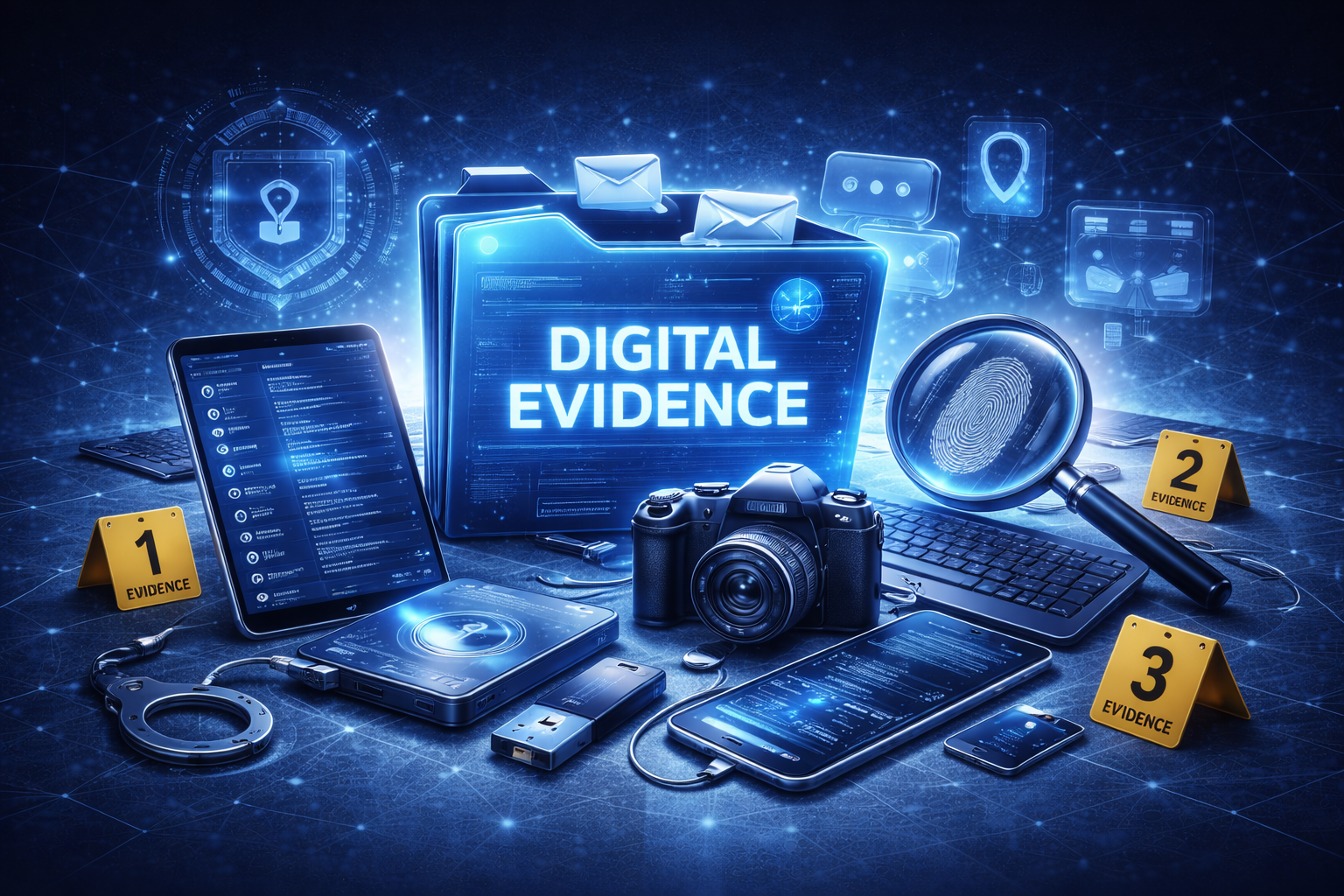
Digital evidence is any information stored or transmitted in electronic format that can be legally presented in court proceedings as proof of facts. This includes communications data, financial transactions, cloud storage files, social media content, blockchain records, and metadata that maintains legal admissibility through proper collection and authentication protocols. For financial crime investigations and crypto asset recovery cases, digital evidence has become the foundation of successful outcomes.
Unlike traditional physical evidence, digital evidence requires specialized forensic techniques to preserve integrity and establish authenticity. At Crypto Trace Labs, our team—featuring VP and Director-level executives from Blockchain.com, Kraken, and Coinbase—has handled digital evidence in hundreds of crypto asset recovery cases and provided expert witness testimony in court proceedings. This guide draws on that decade of experience to explain what legal professionals, compliance teams, and investigation specialists need to know.
What are the key characteristics of digital evidence?
Digital evidence possesses three fundamental characteristics that distinguish it from physical evidence. First, it is latent, meaning the information requires specialized software and forensic tools to interpret raw data stored on electronic devices. Unlike physical objects that provide immediate visual evidence, digital files exist as binary code that needs technical analysis to reveal meaningful content.
The second characteristic is volatility, where digital information can be easily altered, deleted, or corrupted without proper handling. This fragility demands immediate preservation using write-blocking tools and forensic imaging techniques. The third characteristic is the requirement for authenticity verification through cryptographic hash values and digital signatures to prove the evidence has not been tampered with since collection.
Core Evidence Verification Methods:
- Hash Value Verification — Cryptographic fingerprints using MD5 or SHA-256 algorithms that detect any alterations to the original data
- Chain of Custody Documentation — Complete audit trail tracking every person who handled the evidence from collection to court presentation
- Forensic Imaging — Bit-for-bit copies of storage devices that preserve all data including deleted files and slack space
- Metadata Preservation — Timestamp information, sender details, and file properties that provide context and authenticity
- Write-Blocking Protocols — Hardware or software tools that prevent any modifications to original evidence during examination
- Digital Signatures — Cryptographic certificates that verify the identity of the evidence collector and preservation methods used
These characteristics require specialized training and certification from organizations like ACAMS for professionals handling digital evidence in financial crime investigations. The complexity of maintaining evidence integrity while extracting meaningful information has created a specialized field requiring both technical expertise and legal knowledge.
How do legal standards govern digital evidence?
Legal admissibility of digital evidence depends on meeting specific standards established by courts and regulatory bodies worldwide. The Daubert Standard in United States courts requires that forensic methods be scientifically reliable, peer-reviewed, and generally accepted within the professional community. This standard applies directly to blockchain analytics tools from providers like Chainalysis and Elliptic, as well as cryptocurrency tracing techniques used in crypto asset recovery investigations.
ISO/IEC 27037:2012 provides international guidelines for the identification, collection, acquisition, and preservation of digital evidence. These standards ensure that evidence maintains its integrity throughout the entire lifecycle from initial discovery to final court presentation. The National Institute of Standards and Technology (NIST) reinforces these requirements by mandating that digital forensic processes be repeatable and reproducible by independent analysts.
Federal Rules of Civil Procedure Rule 26 specifically addresses electronically stored information, requiring disclosure with proof of relevance, authenticity through hash values, and integrity via documented chain of custody. Professional organizations like ACAMS have developed specialized training programs for AML compliance specialists who handle digital evidence in cryptocurrency investigations. The UK AML regulations and EU AML directives provide additional frameworks for cross-border investigations involving blockchain transactions.
Court-recognized expertise becomes essential when presenting complex blockchain analytics or cryptocurrency tracing evidence. Analysts must demonstrate competency with forensic tools and understanding of the technical processes used to collect and interpret digital evidence. This requirement has led to increased demand for MLRO qualified professionals with specialized blockchain analytics training—credentials that Crypto Trace Labs team members hold across UK, US, and European jurisdictions.
What types of digital evidence exist in investigations?
Digital evidence categories span multiple data sources, each requiring specific collection and preservation techniques. Communications evidence includes emails, text messages, chat logs, and voice recordings that document conversations between parties. Financial transaction records cover bank statements, cryptocurrency blockchain transactions, payment processor logs, and digital wallet records that trace monetary flows.
Cloud storage data represents a growing category as organizations migrate to remote servers. This evidence type includes documents, images, videos, and databases stored on platforms like AWS, Google Cloud, or Microsoft Azure. Social media content provides another rich source through posts, messages, photos, and metadata that reveals user behavior and connections.
Web browsing evidence captures internet activity through browser history, cookies, cached files, and download records. Mobile device evidence covers call logs, GPS location data, application usage, and synchronized cloud information. In cryptocurrency investigations, blockchain evidence includes transaction histories, wallet addresses, smart contract interactions, and exchange records that enable crypto asset recovery.
In 2026, metadata preservation in cloud-based evidence collection has become increasingly critical as more organizations operate in distributed environments. Specialized blockchain analytics tools can trace cryptocurrency transactions across multiple exchanges and non-custodial wallets. Crypto Trace Labs uses platforms from Chainalysis and Elliptic alongside proprietary techniques developed through executive-level experience at major crypto platforms—enabling direct access to transaction records that might otherwise require lengthy legal processes.
How should organizations collect digital evidence?
Proper digital evidence collection requires following established forensic protocols to maintain legal admissibility. The process begins with immediate preservation using write-blocking tools that prevent any modifications to original data sources. Forensic investigators must document the entire collection process, including photographs of device states, serial numbers, and environmental conditions.
Forensic imaging creates bit-for-bit copies of storage devices while preserving deleted files, slack space, and system metadata. Hash value generation using algorithms like SHA-256 provides cryptographic proof that copied data matches the original source exactly. Chain of custody documentation tracks every person who handles the evidence, creating an unbroken audit trail from collection to court presentation.
Evidence Collection Protocol:
- Incident Response Planning — Establish immediate containment procedures to prevent evidence destruction or contamination
- Tool Validation — Use only forensically sound tools that have been tested and accepted by courts
- Documentation Standards — Record all collection activities with photographs, timestamps, and detailed process notes
- Hash Generation — Create cryptographic fingerprints before and after each evidence handling step
- Secure Storage — Maintain evidence in tamper-evident containers with restricted access controls
- Expert Witness Preparation — Ensure collectors can testify about their methods and tool competency
The 10+ years of crypto and financial crime experience that professionals at Crypto Trace Labs possess enables navigation of complex multi-jurisdictional investigations. Our ACAMS certifications, MLRO qualifications, and Chartered status at Fellow Grade ensure AML compliance with varying regulatory requirements across UK, US, and European markets. This expertise proves particularly valuable when dealing with cryptocurrency evidence that spans multiple exchanges and jurisdictions.
What challenges affect digital evidence integrity?
Digital evidence faces unique integrity challenges that do not affect physical evidence. Data volatility means that electronic information can be accidentally or intentionally altered, deleted, or corrupted during handling. This risk requires immediate preservation using forensic imaging techniques and write-blocking tools that prevent any modifications to original sources.
Authenticity verification presents another significant challenge, as digital files can be easily manipulated without leaving obvious traces. Cryptographic hash values and digital signatures provide solutions by creating mathematical proofs of data integrity. However, these protections only work when properly implemented using validated forensic tools and documented procedures.
Cloud storage introduces additional complexity as evidence may be distributed across multiple servers and jurisdictions. Data retention policies can result in automatic deletion, while shared access controls may compromise chain of custody requirements. Organizations must work quickly to preserve cloud-based evidence before it becomes inaccessible or altered by normal business operations.
Cryptocurrency investigations present unique challenges due to the pseudonymous nature of blockchain transactions and the technical complexity of tracing assets across multiple exchanges. Successful crypto asset recovery requires specialized expertise and direct relationships with major crypto exchanges. Through partnerships with large crypto providers, Crypto Trace Labs recovered 101 Bitcoin in the past year alone—demonstrating how executive-level industry connections accelerate recovery outcomes that traditional legal channels struggle to achieve.
Emerging threats in 2026 include increasingly sophisticated AI-generated content and deepfake technology that challenge the verifiability of digital evidence. New authentication methods and expert analysis have become essential to distinguish genuine evidence from manufactured alternatives. Courts now routinely require AI provenance verification for video, audio, and image evidence in high-stakes proceedings.
How do courts evaluate digital evidence admissibility?
Courts apply specific criteria when determining whether digital evidence meets admissibility standards. Relevance requires that the evidence directly relates to facts in dispute and provides probative value to the case. Authentication demands proof that the evidence is what it purports to be, typically established through cryptographic hash values and testimony from qualified forensic analysts.
The best evidence rule requires presentation of original digital files rather than copies, unless proper chain of custody can establish that copies are identical to originals. Courts also consider whether collection methods followed accepted forensic standards and whether the analyzing party possesses appropriate qualifications and certifications.
Hearsay exceptions often apply to digital evidence, particularly business records maintained in the ordinary course of operations. However, these exceptions require proof of reliability and authenticity through witness testimony or documentation. The Federal Rules of Evidence provide specific guidelines for electronic evidence, while international courts may apply different but related standards.
Expert witness testimony becomes crucial when presenting complex digital evidence requiring technical interpretation. Forensic analysts must demonstrate competency with the tools and methods used, often requiring specialized certifications from ACAMS or professional experience in blockchain analytics. Court-recognized expertise stems from demonstrated experience—such as director-level roles at top global crypto platforms and decade-long track records in AML fraud investigations.
Judges increasingly require proof that forensic tools meet scientific reliability standards, particularly for emerging technologies like blockchain analytics from Chainalysis, Elliptic, and similar platforms. This requirement has led to increased scrutiny of proprietary tools versus open-source alternatives that allow independent verification of methodologies.
Frequently Asked Questions
What are the three main branches of digital forensics?
The three main branches of digital forensics are computer forensics, network forensics, and mobile device forensics. Computer forensics focuses on analyzing data from desktop computers, laptops, and servers to recover files, examine system logs, and trace user activities. Network forensics involves capturing and analyzing network traffic to investigate cyber attacks, unauthorized access, and data breaches. Mobile device forensics specializes in extracting data from smartphones and tablets including call logs, messages, and application data.
What are the four steps of digital forensics?
The four fundamental steps of digital forensics are identification, collection, analysis, and presentation. Identification involves recognizing potential sources of digital evidence and documenting their location and condition. Collection requires preservation using forensically sound methods including hash value generation and chain of custody documentation. Analysis covers examination of collected data using specialized tools to extract relevant information. Presentation involves preparing findings for legal proceedings with expert witness testimony.
Is digital forensics a high paying job?
Digital forensics offers competitive compensation with significant growth potential, particularly in cryptocurrency investigations and financial crime analysis. Entry-level positions typically start above average technology salaries, while experienced professionals with ACAMS credentials command premium rates. The increasing complexity of cyber crimes and regulatory requirements has created strong demand for qualified experts. Organizations handling crypto asset recovery and AML compliance often offer the highest compensation due to specialized expertise requirements.
What do digital forensic investigators do?
Digital forensic investigators collect, analyze, and interpret electronic evidence for legal proceedings and internal investigations. They use specialized tools to create forensic images of storage devices, recover deleted files, and trace digital activities across networks. Their work includes documenting chain of custody, generating hash values for authentication, and preparing detailed reports for court presentation. In cryptocurrency cases, investigators trace blockchain transactions and coordinate with exchanges to freeze or recover stolen assets.
How long does digital evidence last?
Digital evidence can last indefinitely when properly preserved using appropriate storage methods and formats. However, longevity depends on the storage medium, environmental conditions, and preservation techniques. Magnetic storage devices may degrade over decades, while solid-state drives can maintain data integrity for extended periods. Cloud storage and WORM systems provide enhanced preservation. The key is implementing proper preservation protocols immediately, including creating multiple copies with verified hash values.
What makes digital evidence different from physical evidence?
Digital evidence differs from physical evidence in three fundamental ways: it is latent, volatile, and requires authentication. Latent means the evidence needs specialized software to interpret binary data, unlike physical objects providing immediate visual evidence. Volatile refers to the ease with which digital data can be altered, requiring immediate preservation using write-blocking tools. Authentication demands cryptographic verification through hash values, whereas physical evidence relies on visual inspection and traditional chain of custody.
Can digital evidence be altered without detection?
Digital evidence can be altered, but proper forensic techniques detect most modifications when correct preservation methods are followed. Cryptographic hash values create mathematical fingerprints revealing any changes to original data. Metadata analysis exposes alterations through timestamp inconsistencies. However, sophisticated attackers may attempt modifications while maintaining hash values, making expert analysis crucial. Courts require testimony from qualified forensic analysts who can demonstrate the reliability of their findings.
What happens if chain of custody is broken?
Broken chain of custody can result in digital evidence being ruled inadmissible in court. Courts require complete documentation of everyone who handled evidence from collection to presentation. Any gaps raise questions about potential tampering. However, courts may still admit evidence with custody issues if other factors demonstrate reliability. The strength of cryptographic hash values, witness testimony, and circumstances determine admissibility—emphasizing the importance of working with experienced forensic professionals from the start.
How do investigators trace cryptocurrency transactions?
Cryptocurrency transaction tracing involves analyzing blockchain records to follow digital asset movements between wallet addresses. Investigators use blockchain analytics tools from Chainalysis and Elliptic to identify patterns, cluster related addresses, and connect pseudonymous wallets to real-world identities through exchange records. Success depends on cooperation from cryptocurrency exchanges and access to advanced analytics platforms. Firms with direct executive relationships at major exchanges achieve higher crypto asset recovery rates than those relying solely on standard legal channels.
What training is required for digital forensics?
Digital forensics training typically includes formal education in computer science or cybersecurity, specialized certification programs, and hands-on experience with forensic tools. ACAMS certification for anti-money laundering specialists provides industry recognition, as do MLRO qualifications for compliance roles. Many positions require familiarity with specific forensic software, legal procedures, and court testimony. Continuing education remains essential due to rapidly evolving technology, particularly for cryptocurrency investigations and blockchain analytics.
What Should You Do Next?
Understanding the definition of digital evidence and its legal requirements is essential for anyone involved in investigations, compliance, or legal proceedings. The complexity of maintaining evidence integrity while meeting court admissibility standards requires specialized expertise and proven methodologies that withstand legal scrutiny.
This guide was prepared by the team at Crypto Trace Labs, drawing on 10+ years of crypto and financial crime experience. Our founders held VP and Director positions at Blockchain.com, Kraken, and Coinbase, and hold ACAMS certifications, MLRO qualifications across UK, US, and Europe, and Chartered status at Fellow Grade. We’ve provided expert witness testimony in court proceedings and recovered hundreds of Bitcoin for clients through our crypto asset recovery services.
If your organization faces cryptocurrency theft, needs assistance with digital evidence collection, or requires expert support for financial crime investigations, we can help. For non-custodial wallet recoveries, we offer no upfront charge—you only pay after successful fund recovery.
Contact Crypto Trace Labs for a confidential assessment.
This content is for informational purposes only and does not constitute legal, financial, or compliance advice. Crypto asset recovery outcomes depend on specific circumstances, regulatory cooperation, and technical factors. Consult qualified professionals regarding your situation.