


Last updated: March 2026
Presenting on-chain evidence in court requires expert witnesses to translate technically complex blockchain data into clear, defensible findings that can be understood and relied upon by judges and juries without specialist technical knowledge. The role of the blockchain forensic expert witness in 2026 has become significantly more defined by case law, regulatory guidance, and established professional standards than it was even three years ago. According to the CPS (2024), blockchain-related prosecutions in England and Wales have increased by over 300% since 2021, making court-ready on-chain evidence presentation a core competency requirement for any forensic expert working in this field.
Crypto Trace Labs provides expert witness testimony in UK civil and criminal proceedings, combining ACAMS-accredited blockchain forensic analysis with CPR Part 35 and CrimPR Part 19 compliant reporting. This guide is for forensic analysts preparing to give expert evidence and solicitors briefing experts for court appearances.
Key Takeaways
- The expert witness’s overriding duty is to the court, not the instructing party – this principle governs every aspect of how on-chain evidence should be presented
- Lay explanation is essential: transaction graphs, hash values, and wallet clustering must be explained in plain language accessible to non-technical judges and jurors
- Confidence levels must match evidence quality – deterministic findings from immutable blockchain data are stated as facts; probabilistic findings from heuristics are stated as probable conclusions with stated confidence
- Cross-examination preparation requires the expert to be able to defend every attribution, explain every methodology step, and acknowledge limitations without appearing to concede the case
- The 2024 Tulip Trading litigation established important UK precedents for what courts expect from blockchain expert witnesses, including the requirement to address technical counterfactuals raised by defence experts
Why This Matters
The volume of blockchain-related court proceedings in the UK has grown rapidly and courts are developing clearer expectations for expert witness standards in this area. Expert witnesses who cannot present on-chain evidence clearly, acknowledge uncertainty appropriately, and withstand technical cross-examination are a liability to the parties who instruct them. The FCA (2024) has issued guidance noting that the quality of blockchain expert witness testimony is a limiting factor in enforcement actions where technical evidence is contested. The ACAMS (2025) expert witness certification framework now includes specific requirements for blockchain forensic testimony methodology, reflecting the maturation of this area as a specialist discipline.

The Expert Witness Role and Court Duties
The expert witness role in UK proceedings is governed by CPR Part 35 for civil cases and CrimPR Part 19 for criminal proceedings. Both frameworks impose the same overriding duty: the expert’s obligation is to assist the court, not to advance the instructing party’s case. This means the expert must present findings honestly, acknowledge limitations and uncertainty, address points unfavourable to the client if they are relevant, and not tailor evidence to achieve a particular outcome. Blockchain forensic experts who are seen to be advocates rather than independent advisers will have their credibility reduced by the court and may face adverse comment in judgments.
In practice, this duty shapes how on-chain evidence is presented in specific ways. When presenting transaction flows, the expert must acknowledge any gaps in the trace – addresses where attribution is uncertain, transactions that cannot be followed, or chains that were not available for analysis. Acknowledging these gaps proactively is more credible than having them exposed on cross-examination.
Presenting Transaction Graphs Effectively
Transaction graphs are the primary visual aid in on-chain evidence presentation and are the element most likely to require explanation for non-technical audiences. Effective presentation of transaction graphs requires: a plain-language legend explaining the symbols and notation used; a narrative walkthrough of the relevant transaction paths in chronological order; clear distinction between confirmed entity attributions (exchange deposits, known service addresses) and probabilistic cluster attributions; and explicit annotation of the time-to-exchange gap for any funds reaching a known exchange.
For contested hearings, the expert should prepare a simplified version of the transaction graph that omits irrelevant transaction paths and focuses the court’s attention on the specific flows in dispute. Comprehensive graphs showing hundreds of transactions may be technically complete but are unhelpful for court presentation. The test is whether a non-technical judge or juror can follow the narrative using the graph as a guide. For more on how investigators build these graphs using commercial tools, see our guide on Chainalysis Reactor workflows.
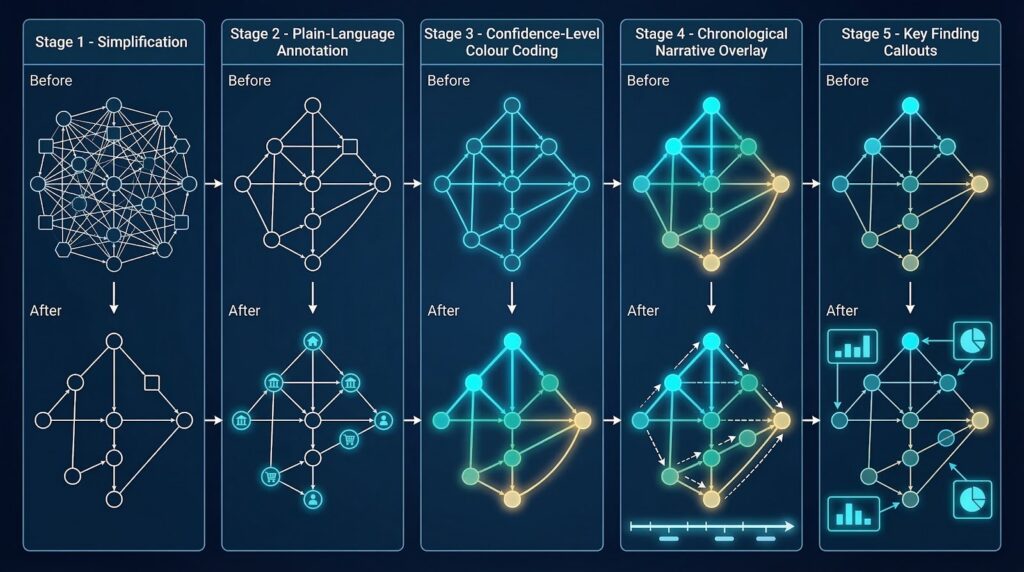
Explaining Technical Concepts to Non-Technical Courts
Non-technical explanation of blockchain concepts is a core expert witness competency that is difficult to develop without court experience. The most commonly misunderstood concepts requiring plain-language explanation in court are: the difference between a wallet address and an identity (many people assume blockchain addresses are equivalent to named accounts), how transaction clustering works (co-spend analysis must be explained without jargon), the significance of exchange deposit addresses (why reaching an exchange deposit address matters for identity attribution), and the meaning of risk scores (whether a red score means criminal activity is proven or merely indicated). Experts should prepare concise plain-language explanations for each of these concepts before any court appearance and practise delivering them without technical jargon.
Cross-Examination Preparation for Blockchain Experts
Cross-examination of blockchain forensic experts typically focuses on four areas: the reliability of the specific platform or tool used, the confidence level of entity attributions, the completeness of the transaction trace, and the expert’s qualifications and independence. Effective cross-examination preparation involves reviewing each attribution in the report and preparing a clear explanation of the basis for it, identifying the weakest attributions in the report and preparing to acknowledge their limitations proactively, briefing with counsel on likely defence expert counter-points, and maintaining familiarity with the underlying data so that counsel’s questions about specific transactions can be answered precisely without reference to the report alone. For an understanding of how methodologies are documented to withstand cross-examination, see our guide on UK court evidence requirements.
The 2024 Tulip Trading Precedent and Expert Standards
The Tulip Trading litigation in the UK Court of Appeal addressed several questions relevant to blockchain expert witness standards, including the admissibility of probabilistic attribution evidence and the treatment of contested identity claims based on on-chain analysis. The proceedings established that probabilistic blockchain evidence is admissible in UK courts when the methodology is documented and the confidence levels are appropriately stated, but that expert witnesses who present probabilistic findings as definitive will have their credibility reduced. The case also underscored that defence experts with access to the same underlying blockchain data can independently verify or challenge the prosecution expert’s analysis, making methodology documentation and data source transparency essential rather than optional.
Jurisdiction-Specific Presentation Standards
On-chain evidence presentation standards differ between UK civil, UK criminal, US federal, and EU proceedings. UK civil proceedings follow CPR Part 35, with single joint experts common in lower-value cases and competing experts in high-value contested matters. UK criminal proceedings follow CrimPR Part 19, with prosecution and defence instructing separate experts who may produce a joint statement of agreed and disputed issues before trial. US federal proceedings use Daubert standards for expert evidence admissibility, requiring that the methodology is generally accepted in the relevant scientific community and has been peer-reviewed. EU proceedings vary by member state but generally require similar methodology documentation standards.
| Jurisdiction | Governing Rules | Expert Type | Key Requirement |
|---|---|---|---|
| UK civil | CPR Part 35 | Single joint or competing | Court duty, Part 35 format |
| UK criminal | CrimPR Part 19 | Prosecution / defence | Joint statement of issues |
| US federal | Federal Rules / Daubert | Competing | Peer-reviewed methodology |
| EU civil | Member state rules | Varies | Methodology documentation |
Frequently Asked Questions
What is the expert witness’s duty in UK blockchain proceedings?
The expert witness’s overriding duty in UK proceedings – under CPR Part 35 for civil cases and CrimPR Part 19 for criminal matters – is to assist the court in understanding technical evidence, not to advance the instructing party’s case. This means presenting findings honestly, acknowledging limitations and uncertainty, addressing points unfavourable to the client if relevant, and not tailoring evidence to achieve a particular outcome. Expert witnesses who are perceived as advocates rather than independent advisers will have their credibility reduced and may face adverse judicial comment.
How should transaction graphs be presented to non-technical courts?
Transaction graphs should be presented with a plain-language legend, a chronological narrative walkthrough of the relevant paths, clear distinction between confirmed and probabilistic attributions using visual coding, and a simplified version that removes irrelevant transactions. The test is whether a non-technical judge can follow the key narrative using the graph as a guide. Complex graphs showing hundreds of wallet hops may be technically complete but are counterproductive in court. Experts should prepare court-specific simplified versions of investigation graphs rather than presenting raw platform outputs.
What are the Daubert standards for blockchain evidence in US courts?
Daubert standards in US federal courts require that expert testimony be based on sufficient facts or data, use reliable methods, and apply those methods reliably to the facts of the case. For blockchain forensic evidence, this means the tracing methodology must be generally accepted in the blockchain forensics community, ideally peer-reviewed or documented in published guidance. Chainalysis Reactor and Elliptic Forensics outputs have been accepted under Daubert in multiple US federal proceedings. The expert must be able to explain why their methodology is reliable and how it compares to alternative approaches.
How should probabilistic blockchain findings be stated in court?
Probabilistic blockchain findings should be stated using explicit confidence terminology that the court can understand. A useful framework for court presentation distinguishes between: confirmed attribution (stated as a fact with the evidentiary basis), highly probable attribution (stated as highly probable with the heuristic basis explained), probable attribution (stated as probable with stated confidence), and possible attribution (stated as a possibility requiring further corroboration). The expert should never use the word ‘certain’ for a probabilistic finding and should proactively acknowledge the probabilistic nature of heuristic-based attributions rather than waiting to be challenged on it.
What is a joint expert statement in UK criminal proceedings?
In UK criminal proceedings under CrimPR Part 19, the court may direct prosecution and defence experts to produce a joint statement identifying the areas of agreement and disagreement between their reports. The joint statement narrows the issues for trial to those where the experts genuinely disagree on technical points, rather than allowing duplication of agreed evidence. Blockchain forensic experts instructed in criminal proceedings should be prepared to engage in the joint statement process and should not attempt to manufacture disagreement on points that are actually agreed in order to preserve disputed issues for court.
How does cross-examination of blockchain experts typically proceed?
Cross-examination of blockchain forensic experts typically focuses on four areas: the reliability and limitations of the specific platform or tool used, the confidence level and basis for entity attributions, the completeness of the transaction trace including any gaps or unresolved paths, and the expert’s qualifications and independence from the instructing party. Effective cross-examination preparation involves reviewing each attribution in the report, identifying the weakest points, and preparing clear explanations of their basis. Acknowledging limitations proactively in chief examination is more credible than having them exposed under cross-examination.
Can a blockchain forensic expert refuse to give a definitive opinion?
Yes. An expert who is not able to form a definitive opinion should say so, stating the limitations of the available evidence and what additional information would be required to reach a more confident conclusion. Courts respect expert witnesses who acknowledge the limits of their analysis. Refusing to overstate confidence is consistent with the CPR Part 35 duty to the court and is more credible than providing a definitive opinion that the evidence does not support. Expert witnesses who stretch their conclusions beyond what the evidence justifies risk having their entire report reduced in weight or excluded.
What visual aids are most effective for blockchain evidence presentation?
The most effective visual aids for blockchain evidence presentation in court are: simplified transaction graphs showing only the key wallet hops and named entity attributions relevant to the dispute, timeline charts correlating on-chain events with off-chain evidence such as exchange records and IP addresses, summary comparison tables comparing the findings against alternative hypotheses, and plain-language glossaries of technical terms used in the report. Exhibits should be numbered consistently with the forensic report and prepared at a resolution suitable for display on court presentation screens. Pre-prepared enlarged copies for the judge’s bundle are standard practice in high-value cases.
What happens when defence and prosecution blockchain experts disagree?
When defence and prosecution blockchain forensic experts disagree on technical findings, the court must determine which expert’s methodology and analysis is more reliable. Factors the court will consider include the qualifications and experience of each expert, the documentation quality of each methodology, the internal consistency of each report, whether the expert acknowledged limitations appropriately, and the plausibility of each expert’s interpretation of the data. Courts are increasingly willing to prefer one expert’s analysis over another based on methodology quality alone, making documentation standards as important as technical accuracy.
How should an expert handle new evidence disclosed shortly before trial?
When new evidence is disclosed shortly before trial – such as additional wallet addresses, exchange data, or a defence expert’s report – the expert should notify the instructing solicitor immediately, review the new material to determine whether it affects any conclusions in their existing report, and prepare a supplementary report if required. Under CPR Part 35 and CrimPR Part 19, experts have a duty to update their reports if new information materially changes their conclusions. Attempting to defend conclusions that are no longer supportable in light of new evidence is a serious breach of the expert’s court duty and will damage credibility significantly.
Executive Summary
Presenting on-chain evidence in court requires expert witnesses to combine technical accuracy with court-accessible explanation, consistent confidence-level labelling, and rigorous cross-examination preparation. The overriding duty under CPR Part 35 and CrimPR Part 19 is to the court, not the instructing party. Transaction graphs must be simplified for non-technical courts without losing evidential accuracy. Probabilistic attributions must be explicitly labelled as such. Methodology must be documented to a standard capable of independent verification. The 2024 Tulip Trading proceedings reinforced UK court expectations for blockchain expert standards and the consequences of overstating attribution confidence.
What Should You Do Next?
Effective expert witness testimony on blockchain evidence requires technical depth, court procedural knowledge, and communication skills that take years to develop through actual court experience. The difference between a technically accurate report and court-effective testimony is significant and consequential.
Crypto Trace Labs provides expert witness testimony in UK civil and criminal proceedings, combining ACAMS-accredited forensic analysis with CPR Part 35 and CrimPR Part 19 compliance. Our team has appeared in Crown Court and civil proceedings across fraud, ransomware, asset recovery, and financial regulation matters. Contact Crypto Trace Labs to discuss your expert witness requirements.
People Also Read
- What UK Courts Require from Cryptocurrency Tracing Reports
- How Solicitors Should Work with Blockchain Forensic Experts
- How to Evaluate Blockchain Forensic Firms: 12 Questions Law Enforcement Should Ask
- Crypto Freezing Injunctions: How Courts Protect Victims of Cryptocurrency Theft
About the Author
Crypto Trace Labs is a specialist crypto asset recovery and blockchain forensics firm founded by VP and Director-level executives formerly of Blockchain.com, Kraken, and Coinbase. Our team holds ACAMS accreditations, MLRO qualifications across the UK, US, and EU, and Chartered Fellow Grade status at the CMI. With over 10 years of experience in financial crime investigation and court-recognized blockchain forensics expertise, we have recovered 101 Bitcoin for clients in the last 12 months and delivered record fraud reduction for a $14bn crypto exchange. We work with law enforcement agencies, regulated financial institutions, and private clients on crypto asset recovery, blockchain forensics, AML compliance, and expert witness testimony – globally. We offer no upfront charge for non-custodial wallet recoveries. Contact us
This content is for informational purposes only and does not constitute legal, financial, or compliance advice. Crypto asset recovery outcomes depend on specific circumstances, regulatory cooperation, and technical factors. Consult qualified professionals regarding your specific situation.