


Last Updated: March 2026
Verifying on-chain analysis means independently reproducing and testing the conclusions of a blockchain forensic investigation to confirm that the findings are accurate, the methodology is sound, and the evidence will withstand scrutiny in court or regulatory proceedings. In practice, verification involves querying the same raw blockchain data from independent sources, applying alternative analytical methods to test the same conclusions, and identifying any assumptions or probabilistic attributions that have been stated as certainties. According to Elliptic‘s 2024 forensic methodology documentation, the most common errors in blockchain forensic analyses – overclaimed attribution, unvalidated clustering heuristics, and undisclosed tool limitations – are precisely the errors that independent verification catches before they reach a judge or regulator.
Crypto Trace Labs provides independent verification of blockchain forensic findings for legal teams, compliance officers, and institutional clients who need to test the reliability of analysis produced by other parties. Our team – ACAMS (Association of Certified Anti-Money Laundering Specialists) accredited, MLRO (Money Laundering Reporting Officer) qualified across UK, US, and EU, and Chartered Fellow Grade at the CMI, with founding members from Blockchain.com, Kraken, and Coinbase – has reviewed and counter-reviewed expert blockchain analyses in High Court proceedings.
Key Takeaways
- Every finding must trace to raw data: A finding that cannot be traced back to a specific transaction hash, block height, or on-chain event is an assertion, not a verified fact – and opposing experts will say so.
- Attribution claims are the highest-risk element: According to Chainalysis’s 2024 investigator training materials, attribution errors are present in approximately 15% of blockchain analyses submitted without independent verification.
- Independent source cross-checking is the gold standard: Querying the same address or transaction from Chainalysis, Etherscan, and a direct node query and confirming consistent results is the minimum standard for critical findings.
- Probabilistic and confirmed findings must be clearly separated: A single instance of probabilistic attribution presented as confirmed fact in a report can render the entire analysis suspect under cross-examination.
- Tool version and configuration must be recorded: The same commercial tool can produce different results across versions – analysis conducted on Chainalysis Reactor 3.x may produce different clustering outputs than the same analysis run on Reactor 4.x.
Why This Matters
Blockchain forensic analysis is increasingly contested in UK courts and regulatory proceedings. Defendants with resources instruct specialist opposing experts specifically to verify – and challenge – the analytical findings of claimants’ forensic teams. Courts have moved from accepting blockchain evidence largely on trust to requiring methodological transparency and the ability to reproduce results independently. An analysis that has not been independently verified before it enters proceedings is significantly more vulnerable to a well-resourced challenge, and the cost of an analysis being discredited mid-proceedings – in adverse costs, wasted hearing time, and damaged credibility – is far higher than the cost of independent verification at the outset.
Raw Data Verification Standards
Raw data verification is the process of confirming that the transaction data underlying a forensic analysis is accurate and matches primary blockchain records.
The first step is to independently query every transaction hash cited in the analysis from at least two independent sources – a direct blockchain node query and a reputable third-party API or explorer – and confirm that the transaction details (block height, timestamp, input/output addresses, values) match exactly. Discrepancies between sources must be investigated: they may indicate data processing differences in a third-party API, or they may indicate an error in the original analysis.
The second step is to verify that no transactions in the relevant trace have been omitted. This requires querying the complete transaction history of each wallet address in the trace and confirming that the analysis has not selectively included only those transactions that support a particular narrative while omitting transactions that complicate it. Selective omission is rare in good-faith professional analysis, but it is one of the first things an opposing expert will check.
| Verification Step | Method | Acceptable Outcome | Failure Indicator |
|---|---|---|---|
| Transaction data accuracy | Cross-query 2+ independent sources | Matching txid, values, addresses | Any field discrepancy |
| Completeness check | Full address history query | All transactions accounted for | Unexplained gaps in trace |
| Attribution verification | Source documentation review | KYC or authoritative basis | Heuristic-only with no disclosure |
| Tool output consistency | Re-run analysis on same version | Identical clustering output | Differing cluster assignments |
| Timestamp accuracy | UTC cross-reference | Consistent block timestamps | Local time offsets unexplained |
Attribution Verification Methodology
Attribution verification is the process of testing whether wallet addresses have been correctly linked to the entities claimed in the analysis, and it is the most consequential component of any verification exercise.
Confirmed attributions – where an address has been linked to a named entity through KYC data, court-disclosed records, or the entity’s own published address – should be verified by requesting the underlying attribution evidence from the original analyst. If the source of confirmed attribution is KYC data held by an exchange, the verification examiner must be provided with either the KYC record itself or a certification from the relevant exchange. Attributions cited as confirmed but backed only by industry databases without primary source documentation are a common finding in verification exercises.
Probabilistic attributions – derived from clustering heuristics such as common input ownership or change address identification – must be tested by independently applying the same heuristic to the relevant transactions and confirming the analysis reaches the same cluster assignments. Differences in cluster assignments between the original analysis and independent verification indicate either a tool version difference or a methodology error, both of which require disclosure.

Tool Consistency and Version Validation
Tool consistency validation confirms that the commercial or open-source tools used in the original analysis are documented, that the correct version was used, and that the analysis would produce the same results if reproduced.
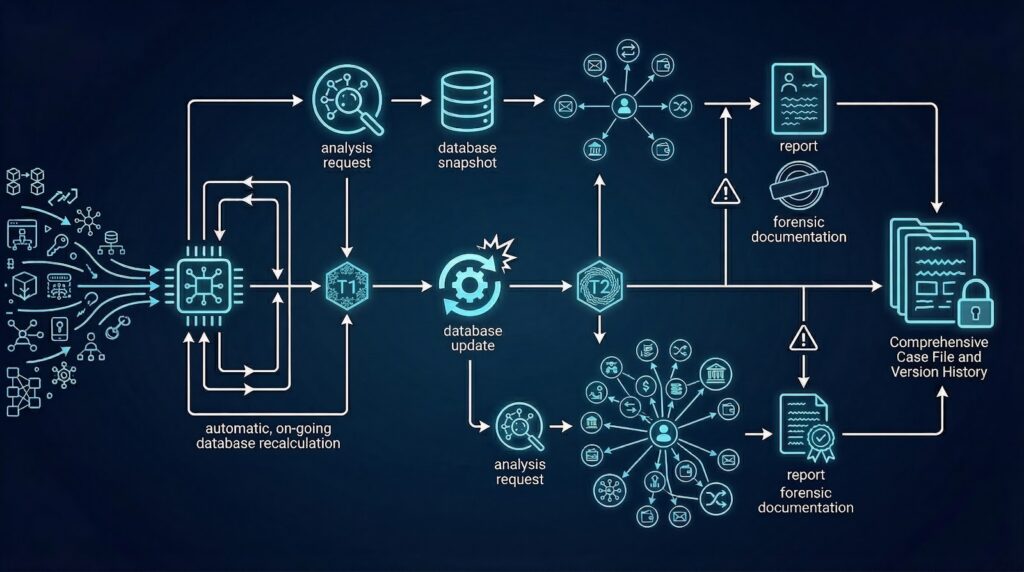
Commercial blockchain analytics platforms update their underlying attribution databases and clustering algorithms continuously. Chainalysis, Elliptic, and TRM Labs all update their address attribution data on a daily basis and release algorithm updates on their own schedules. An analysis conducted in November 2025 may produce different cluster assignments than the same analysis run in March 2026 because new attribution data has been added or clustering logic has changed.
For forensic purposes, the original analysis must document the date the analysis was run, the tool version used, and where possible a static snapshot of the attribution database state at that date. Verification exercises should replicate the analysis on the same tool version and date, not the current version. Where the original analyst cannot confirm the tool version and date, this is itself a methodology weakness that must be disclosed.
Statistical Validity of Clustering Conclusions
Statistical validity testing assesses whether the clustering heuristics used in an analysis are appropriate for the specific transaction types and blockchain being analysed.
The common input ownership heuristic – which attributes all co-signing addresses in a Bitcoin transaction to the same wallet entity – has a known false positive rate that varies with transaction type. For standard P2PKH transactions, the heuristic is reliable. For CoinJoin transactions, it is not applicable. For PayJoin transactions, it produces systematic errors. An analysis that applies the common input ownership heuristic to a blockchain that has significant CoinJoin activity without acknowledging this limitation is statistically unsound.
According to TRM Labs’s 2024 blockchain analytics methodology report, verification exercises should test cluster size distributions against expected distributions for the specific blockchain and time period – unusually large or fragmented clusters relative to the expected distribution are indicators of heuristic misapplication. For Ethereum analyses, verification should test whether DeFi protocol interactions have been correctly excluded from personal wallet clustering, as many DeFi protocol addresses are incorrectly assigned to user entities by default in some commercial tools.
Frequently Asked Questions
How do I verify that a blockchain forensic finding is accurate?
Verify by independently querying the transaction hashes cited in the finding from at least two independent sources such as a blockchain node and a reputable explorer, confirming the data matches; testing the attribution claims against their cited sources; and where possible re-running the same clustering analysis on the same tool version to confirm identical results. Discrepancies in any of these checks indicate errors or weaknesses that must be investigated before the finding is relied upon in proceedings.
What does it mean if two blockchain analytics tools produce different results for the same transaction?
Different results from two blockchain analytics tools typically indicate differences in attribution databases, clustering algorithm versions, or heuristic configurations. Chainalysis, Elliptic, and TRM Labs all maintain proprietary attribution databases and update them independently, so differences in entity attribution are expected and common. The appropriate response is to investigate the basis for each tool’s attribution, identify which is better supported by primary evidence, and disclose the discrepancy in the forensic report.
Can I verify blockchain analysis results myself without specialist tools?
Yes, for basic transaction data verification. Any transaction hash can be verified against multiple public blockchain explorers such as Blockchair, Blockchain.com, and Etherscan to confirm that the transaction details are accurate. Attribution claims require access to the source data supporting the attribution, which is typically held by the original analyst or the exchange that provided KYC data. Clustering verification requires the same tools and versions used in the original analysis.
How long does independent verification of a blockchain forensic analysis take?
For a straightforward analysis covering 20-50 transactions and 10-20 attributed addresses, independent verification typically takes 2-5 business days. For complex analyses covering multi-hop traces across several blockchains, DeFi protocol interactions, or large numbers of attributed addresses, verification can take 2-4 weeks. Emergency verification for injunction applications can be completed within 24-48 hours for the critical elements, with full verification completed for the return date.
What should I do if independent verification finds errors in an analysis?
If verification finds errors, the nature of the error determines the response. Minor data discrepancies that do not affect the overall conclusion should be corrected and disclosed in a supplemental report. Errors in attribution that change the identity of a wallet owner require immediate disclosure to the instructing solicitor and potentially a material amendment to any proceedings based on the original finding. Systematic methodology errors that undermine the entire analysis require a full re-analysis.
Is it possible for blockchain analysis to be deliberately manipulated?
Deliberate manipulation of blockchain forensic analysis is theoretically possible but is rare in professional practice due to the self-evidently verifiable nature of blockchain data. Any manipulation in reported transaction data would be detectable by any party who queries the blockchain directly. The more realistic risk is unconscious bias – analysts who are instructed by a claimant may inadvertently favour interpretations that support the claimant’s case when making probabilistic attribution decisions.
What qualifications should a blockchain forensic verification expert have?
A verification expert should hold at minimum ACAMS certification or equivalent AML credentials, have direct experience with the commercial tools used in the original analysis, and be capable of running independent blockchain node queries. For court proceedings, the verification expert must be able to comply with CPR Part 35 and provide an independent expert declaration. The expert should have no prior relationship with the original analyst or the instructing party.
How much does independent verification of blockchain forensic analysis cost?
For a straightforward civil fraud analysis covering a single blockchain and 50 or fewer transactions, independent verification typically costs £5,000-£15,000. For complex multi-chain analyses or those involving DeFi protocol interactions, costs range from £15,000-£50,000. Emergency verification services are available at premium rates. Cost is typically a fraction of the legal fees at risk if an unverified analysis is successfully challenged in proceedings.
Executive Summary
Verifying on-chain analysis findings before they enter court proceedings or regulatory submissions is the single most effective risk reduction measure available to legal teams handling crypto fraud cases. Independent verification catches attribution errors, tool version inconsistencies, and probabilistic-to-confirmed attribution misrepresentations that are present in a significant minority of blockchain analyses. The verification process requires independent data queries from primary sources, attribution source documentation review, tool version consistency testing, and statistical validity assessment of clustering conclusions. The cost of pre-proceedings verification is consistently lower than the cost of dealing with a successful admissibility challenge mid-proceedings.
What Should You Do Next?
If you need independent verification of blockchain forensic findings before litigation, a regulatory submission, or a law enforcement referral, Crypto Trace Labs provides independent expert verification services that meet CPR Part 35 standards.
The team at Crypto Trace Labs – ACAMS-accredited, MLRO-qualified across UK, US, and EU, Chartered Fellow Grade at the CMI, with founding members from Blockchain.com, Kraken, and Coinbase who have reviewed expert blockchain analyses in High Court proceedings – provides verification reports that are defensible under cross-examination. We offer no upfront charge for non-custodial wallet recoveries. Contact us to discuss your verification requirements.
People Also Read
- How Does Blockchain Forensics Work? Expert Methods Explained
- Comparing On-Chain Analysis Platforms: Technical Feature Analysis
- On-Chain Heuristics: How Pattern Recognition Identifies Wallet Owners
- On-Chain Risk Scoring: How Investigators Rate Transaction Suspiciousness
About the Author
Crypto Trace Labs is a specialist crypto asset recovery and blockchain forensics firm founded by VP and Director-level executives formerly of Blockchain.com, Kraken, and Coinbase. Our team holds ACAMS accreditations, MLRO qualifications across the UK, US, and EU, and Chartered Fellow Grade status at the CMI. With over 10 years of experience in financial crime investigation and court-recognized blockchain forensics expertise, we have recovered 101 Bitcoin for clients in the last 12 months and delivered record fraud reduction for a $14bn crypto exchange. We work with law enforcement agencies, regulated financial institutions, and private clients on crypto asset recovery, blockchain forensics, AML compliance, and expert witness testimony – globally. We offer no upfront charge for non-custodial wallet recoveries. Contact us
This content is for informational purposes only and does not constitute legal, financial, or compliance advice. Crypto asset recovery outcomes depend on specific circumstances, regulatory cooperation, and technical factors. Consult qualified professionals regarding your specific situation.