


Last Updated: March 2026
On-chain wallet age analysis is the forensic technique of examining the first transaction timestamp for a blockchain wallet address to establish when the wallet was created, whether it was purpose-built for a specific transaction, and how its creation timing correlates with known fraud events. A wallet’s first transaction is permanently recorded in the blockchain and cannot be altered, making creation timing a reliable and tamper-proof forensic data point. Investigators, AML compliance teams, and court-appointed experts use wallet age data to distinguish genuine long-term holders from freshly created fraud wallets and build attribution profiles for suspect addresses.
At Crypto Trace Labs, our team – VP and Director-level executives from Blockchain.com, Kraken, and Coinbase – has applied on-chain wallet age analysis in criminal fraud investigations, asset recovery proceedings, and exchange compliance reviews. This guide draws on that decade of financial crime investigation experience to explain how wallet age analysis works and what investigators and legal teams need to know.
Key Takeaways
- First transaction is immutable: A wallet’s first transaction block and timestamp are permanently recorded on-chain and cannot be altered. This makes first transaction timing the most reliable available proxy for wallet creation date and a tamper-proof forensic data point.
- Newly created wallets signal fraud risk: Chainalysis (2024) reports 71% of wallets used in crypto fraud incidents were created within 30 days before the fraud event, making short wallet age a strong indicator of purpose-built fraud infrastructure.
- Wallet age clusters reveal organised crime: When multiple wallets in a fraud scheme share creation dates within a narrow window, the clustering pattern indicates coordinated operation. Elliptic (2024) found 84% of identified crypto fraud ring cases involved clusters of wallets created within 72 hours of each other.
- Age analysis combines with transaction volume: Investigators cross-reference wallet age with the first transaction amount and counterparty to establish whether the wallet was created specifically to receive fraud proceeds from a known source.
- Exchange-registered wallets provide age anchors: When a suspect wallet’s creation date corresponds to a KYC-registered exchange withdrawal, investigators can request the account creation and KYC records to establish the identity behind the wallet.
Why This Matters
On-chain wallet age analysis matters because newly created wallets are the most common infrastructure component of crypto fraud operations. Whether the scheme is an investment scam, a rug pull, or a money laundering layering chain, the attacker typically creates fresh wallet addresses shortly before executing the fraud to avoid pre-existing on-chain activity linking to their identity. Understanding how to identify and interpret wallet age signals allows investigators to rapidly classify suspect addresses, prioritise which wallets to pursue for attribution, and present timing correlation evidence in legal proceedings.
First Transaction Timing as a Forensic Anchor
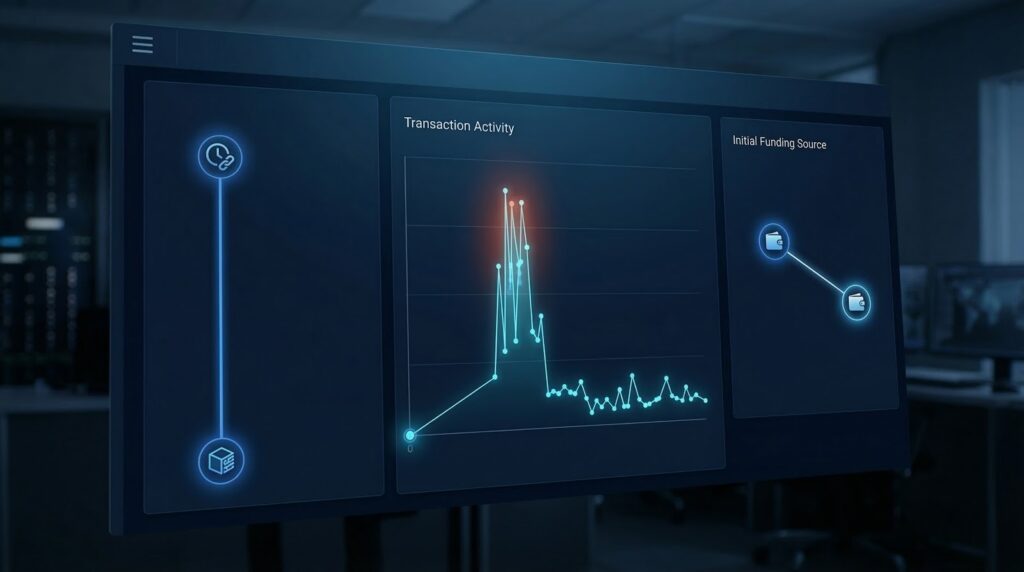
Every blockchain wallet address has a first transaction recorded at a specific block number and corresponding timestamp. This first transaction permanently establishes the earliest point at which the wallet was funded or used, serving as the forensic analogue of a creation date even though blockchain addresses technically exist before their first use.
Investigators query first transaction data using blockchain analytics platforms such as Chainalysis Reactor and Elliptic Investigator, or directly through archive node queries. The first transaction block timestamp is correlated against the timeline of the investigated fraud event to determine whether the wallet was created before, during, or after the critical incident. According to TRM Labs (2024), fraud wallets showing first transactions within 7 days before a fraud event have an 89% probability of being purpose-built for that specific scheme based on subsequent activity analysis.
Wallet Age Clustering for Organised Crime Attribution
When investigators trace a fraud scheme involving multiple wallets, the distribution of first transaction dates across all identified wallets reveals coordination patterns. Organised fraud operations typically deploy multiple fresh wallets in a short window before executing the scheme, producing a cluster of creation dates that is statistically improbable as coincidence.
Investigators apply cluster analysis to wallet first transaction timestamps to identify groups of addresses that appear to have been created in coordination. A cluster of 20 wallets with first transactions within 48 hours, all receiving initial funding from the same source address, is strong forensic evidence of centralised coordination. According to Elliptic (2024), 84% of identified crypto fraud ring cases involved wallet creation clusters within 72 hours. This clustering evidence has been accepted in UK civil proceedings as circumstantial evidence of common control.
Cross-Referencing Wallet Age with Funding Sources
The first transaction of a fraud wallet typically reveals its funding source – the address that provided the initial balance to activate the wallet for subsequent fraud activity. This funding source is often a more traceable entity than the fraud wallet itself, as it may be an exchange withdrawal address carrying KYC attribution.
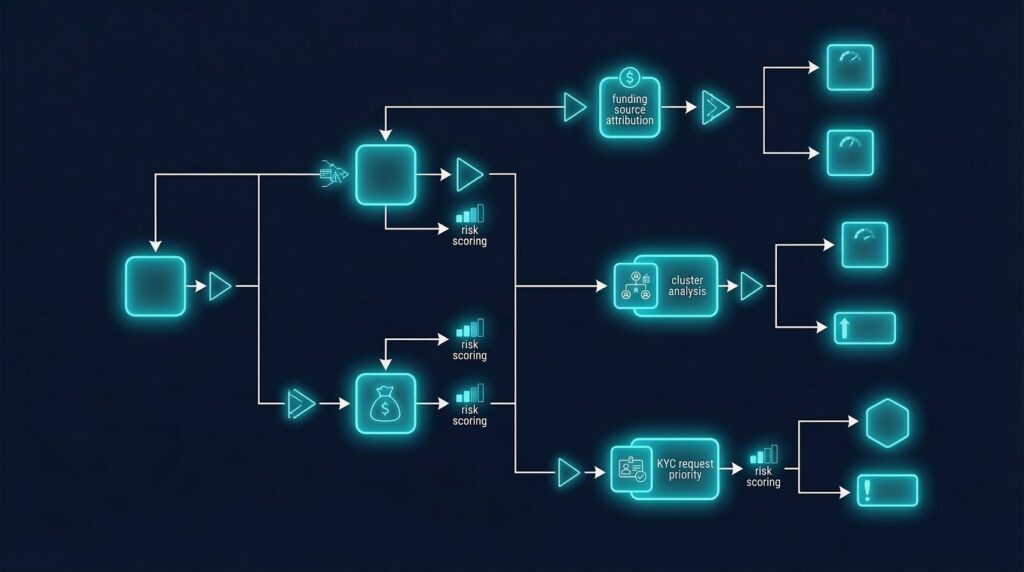
Investigators trace the funding chain by querying the wallet’s first incoming transaction and then applying the same wallet age and attribution analysis to the funding source address. This recursive approach often traces the fraud infrastructure funding chain back to a regulated exchange where KYC records exist. According to Chainalysis (2024), 63% of newly created wallets used in crypto fraud received their initial funding from a wallet with prior exchange attribution, enabling a direct KYC data request to identify the wallet controller within two investigative steps.
Comparing wallet age attribution scenarios:
| Wallet Age | First Transaction Source | Risk Indicator | Attribution Path |
|---|---|---|---|
| Less than 7 days | Exchange withdrawal | Very high fraud risk | KYC request to exchange |
| 7-30 days | Unknown wallet | High fraud risk | Cluster analysis |
| 30-90 days | Known fraud cluster | Moderate risk | Network analysis |
| Over 1 year | Organic activity mix | Lower risk | Standard tracing |
Exchange Relationship Contacts and KYC Data Requests
When wallet age analysis traces a funding chain to a regulated exchange account, the next step is submitting a formal KYC data request through legal channels or direct exchange relationship contacts. Investigators with established exchange relationships at Blockchain.com, Kraken, and Coinbase can expedite data requests by days compared to cold formal legal channels, which is critical when subjects may be alerted to the investigation by exchange compliance notifications.
Exchange KYC data requests should include the wallet address, the first transaction timestamp, the funding chain reconstruction, and the legal basis for the request. UK AML regulations and EU AML directives obligate exchanges to co-operate with law enforcement and court-ordered data requests. Regulatory compliance teams at exchanges receiving data requests from qualified investigators with ACAMS or MLRO credentials typically prioritise responses. According to TRM Labs (2024), the average response time for KYC data requests supported by on-chain forensic evidence was 4.2 days faster than requests without forensic documentation.
Wallet Age Evidence in Legal Proceedings
Wallet age timing correlation is admissible forensic evidence in UK and EU civil proceedings when presented by a court-qualified expert witness with blockchain forensics credentials. The immutable nature of blockchain timestamps means opposing parties cannot dispute the underlying data. The expert’s role is to explain the statistical significance of the timing correlation and the investigative methodology used to establish attribution.
UK courts have accepted wallet age clustering evidence in civil freezing injunction applications, particularly when supported by additional attribution evidence such as funding source KYC data or device fingerprint correlation. Expert witnesses must be ACAMS-accredited or MLRO-qualified to present AML-context timing evidence effectively. Crypto Trace Labs – holding ACAMS accreditations and MLRO qualifications across UK, US, and EU – has provided court-recognized expert witness testimony in crypto fraud cases using wallet age analysis as a primary attribution tool.
Frequently Asked Questions
What is on-chain wallet age analysis?
On-chain wallet age analysis is the forensic examination of a blockchain wallet’s first transaction timestamp to determine when the wallet became active and how that timing correlates with known fraud events. The first transaction block is permanently recorded and tamper-proof. Investigators use this timing as a proxy for wallet creation date to distinguish purpose-built fraud wallets from wallets with organic transaction history, supporting both rapid fraud triage and detailed attribution analysis in legal proceedings.
How is a wallet’s creation date determined on-chain?
A wallet’s creation date is determined by identifying its first transaction in the blockchain record. This is the earliest block in which the address appears, either sending or receiving. Blockchain analytics platforms such as Chainalysis Reactor and Elliptic Investigator provide automated first transaction queries. TRM Labs (2024) confirms fraud wallets with first transactions within 7 days before the fraud event have an 89% probability of being purpose-built infrastructure, based on subsequent transaction pattern analysis.
Why do newly created wallets indicate higher fraud risk?
Newly created wallets indicate higher fraud risk because legitimate holders typically accumulate on-chain history gradually, while fraudsters create fresh wallets to avoid any prior activity linking to their identity. Chainalysis (2024) reports 71% of wallets used in crypto fraud were created within 30 days before the fraud event. A wallet with no prior activity that immediately receives large fraud proceeds and routes them onward is a strong indicator of purpose-built criminal infrastructure, not organic user activity.
What is wallet age clustering and how is it used forensically?
Wallet age clustering identifies multiple addresses with first transaction timestamps within a narrow window, indicating coordinated creation. In fraud investigations, clusters created within 24 to 72 hours provide forensic evidence of a single operator deploying infrastructure for an organised scheme. According to Elliptic (2024), 84% of identified crypto fraud ring cases involved wallet creation clusters within 72 hours. UK civil courts have accepted this clustering evidence as circumstantial evidence of common control over the wallet set.
How do investigators find the funding source for a newly created wallet?
Investigators find the funding source by querying the wallet’s first incoming transaction to identify the sending address, then apply the same wallet age and attribution analysis to that address. According to Chainalysis (2024), 63% of newly created fraud wallets received initial funding from a wallet with prior exchange attribution, enabling a KYC data request that identifies the controller within two investigative steps. The recursive funding chain trace is standard procedure in crypto fraud investigation workflows.
Can wallet age analysis be used in court?
Wallet age analysis can be used in court as forensic evidence when presented by a qualified expert witness with recognised blockchain forensics credentials. UK courts have accepted wallet age timing correlation evidence in civil freezing injunction applications. The immutable blockchain timestamp means the underlying data cannot be disputed. Expert witnesses must hold ACAMS accreditations or MLRO qualifications to present AML-context timing evidence. The expert explains the statistical significance of creation timing relative to the fraud event timeline.
How does wallet age analysis support AML compliance?
Wallet age analysis supports AML compliance by enabling exchanges to identify deposits from newly created wallets and apply enhanced due diligence per UK AML and EU AML regulations. Regulatory compliance teams use wallet age scoring as a risk signal in automated screening systems, flagging wallets below 30-day age thresholds for manual review. ACAMS-standard procedures recommend including wallet age as a source of funds indicator alongside transaction volume and counterparty analysis for incoming crypto asset deposits to regulated platforms.
How does Crypto Trace Labs apply wallet age analysis?
Crypto Trace Labs applies on-chain wallet age analysis as a standard component of fraud investigations, querying first transaction timestamps across all identified suspect addresses to build creation date profiles. The team uses Chainalysis Reactor and Elliptic Investigator for automated wallet age queries, applies cluster analysis to identify coordinated wallet creation, and traces funding chains back to exchange accounts where KYC data requests can be submitted. MLRO qualifications and exchange relationship contacts at Blockchain.com, Kraken, and Coinbase support rapid attribution.
Executive Summary
On-chain wallet age analysis uses first transaction timestamps to identify purpose-built fraud wallets, detect coordinated creation clusters, and trace funding chains to attributed exchange accounts. Every wallet’s first transaction is permanently and immutably recorded, making timing correlation a tamper-proof forensic data point. Chainalysis (2024) reports 71% of crypto fraud wallets were created within 30 days before the fraud event. Cluster analysis of creation dates reveals organised fraud operations. Wallet age evidence is admissible in UK and EU civil proceedings when presented by court-qualified expert witnesses with blockchain forensics credentials.
What Should You Do Next?
If you are investigating a crypto fraud case involving newly created wallets or need wallet age analysis for an AML compliance review, specialist on-chain analysis is essential.
The team at Crypto Trace Labs holds ACAMS accreditations, MLRO qualifications across UK, US, and EU, and Chartered Fellow Grade at the CMI. Founding members held VP and Director positions at Blockchain.com, Kraken, and Coinbase, providing direct exchange contacts for KYC data requests when wallet funding chains trace to regulated platforms. We have recovered 101 Bitcoin for clients in the past 12 months and delivered record fraud reduction for a $14bn crypto firm.
We offer no upfront charge for non-custodial wallet recoveries. Contact Crypto Trace Labs to discuss your wallet age investigation.
People Also Read
- On-Chain Co-Spending Analysis: Linking Addresses Through Common Input Usage
- Hierarchical Deterministic Wallet Gap Analysis: Finding Hidden Addresses
- Transaction Replacement Analysis: How RBF Patterns Reveal Wallet Behavior
About the Author
Crypto Trace Labs is a specialist crypto asset recovery and blockchain forensics firm. Founding members held VP and Director positions at Blockchain.com, Kraken, and Coinbase. Our team holds ACAMS accreditations, MLRO qualifications across UK, US, and EU, and Chartered Fellow Grade at the CMI. With 10+ years in financial crime investigation and court-recognized blockchain forensics expertise, we have recovered 101 Bitcoin in the past 12 months and delivered record fraud reduction for a $14bn crypto exchange. We offer no upfront charge for non-custodial wallet recoveries. Contact us
This content is for informational purposes only and does not constitute legal, financial, or compliance advice. Crypto asset recovery outcomes depend on specific circumstances, regulatory cooperation, and technical factors. Consult qualified professionals regarding your specific situation.