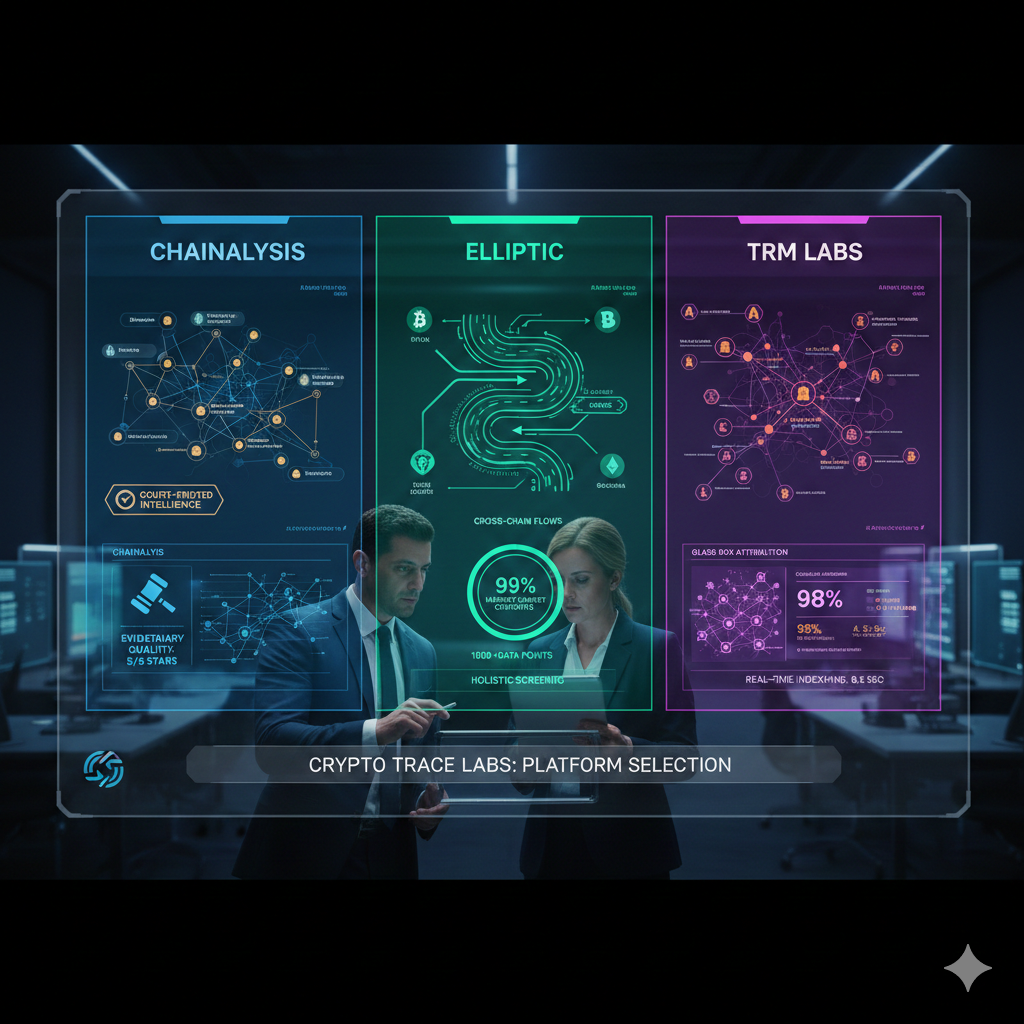
Chainalysis, Elliptic, and TRM Labs represent the three leading blockchain analytics platforms used by law enforcement agencies, financial institutions, and compliance teams worldwide. Chainalysis holds the largest market share with over 1,500 organizational clients and is widely considered the gold standard for investigations, particularly for cross-chain tracing and court testimony. Elliptic pioneered blockchain analytics in 2013 and offers the most extensive blockchain coverage at 99% of the market with over 100 billion data points, making it strong for compliance operations requiring broad asset coverage. TRM Labs, founded in 2018, recently achieved unicorn status with a $1 billion valuation and focuses on AI-driven threat intelligence and real-time cross-chain screening, appealing to institutions prioritizing automation and national security applications.
At Crypto Trace Labs, our team has used all three platforms extensively during our years at Blockchain.com, Kraken, and Coinbase. We’ve conducted hundreds of cryptocurrency investigations using these tools and understand their strengths, limitations, and practical applications in real-world crypto asset recovery cases. This comparison draws on that operational experience to help investigators, compliance teams, and institutions make informed platform decisions.
What Are the Core Differences Between These Platforms?
The three platforms serve overlapping but distinct use cases within blockchain analytics and compliance operations. While all three offer transaction tracing, risk scoring, and entity identification capabilities, their architectural approaches and target markets create meaningful differences for practitioners.
Chainalysis positions itself as the comprehensive enterprise solution with the deepest integrations into law enforcement workflows. According to AWS Marketplace documentation, Chainalysis Reactor is recognized as “the gold standard for investigations across public and private sectors” with court-trusted intelligence powered by on-chain and off-chain data combined with AI heuristics. The platform’s Investigations suite combines Reactor for tracing, Rapid for address triage, and Wallet Scan for seed phrase analysis into a unified workflow that accelerates casework from initial lead to asset seizure.
Elliptic differentiates through superior blockchain coverage and cross-chain capabilities. Their Holistic Screening technology traces funds across and between all blockchains simultaneously, addressing the $21 billion in illicit cross-chain flows that sophisticated threat actors now routinely employ. Founded in 2013, Elliptic became the first blockchain analytics company to achieve ISO 27001 certification and maintains what they describe as the industry’s largest labeled dataset with over 100 billion data points linking crypto addresses to verified entities.
TRM Labs brings a national security focus with deep ties to government agencies. The company’s recent $70 million Series C funding round led by Blockchain Capital valued TRM at $1 billion, reflecting strong demand for their AI-enabled compliance and investigation solutions. TRM supports over 200 million assets across 100 blockchains and emphasizes “glass box attribution” that shows users not just what an address represents, but why – with confidence scores and transparent methodologies that contrast with competitors’ “black box” approaches.
For professional cryptocurrency fraud investigation work, the choice depends on your primary use case, technical requirements, and existing workflows.
How Do Their Investigation Capabilities Compare?
Investigation tools represent the core value proposition for all three platforms. Professional investigators conducting blockchain forensics need platforms that balance depth, speed, and evidentiary quality.
Chainalysis Reactor provides the most mature investigation workflow with automated demixing for mixer analysis, seed phrase recovery tools, and extensive cross-chain tracing. The platform’s comprehensive attribution database built through law enforcement collaboration delivers reliable entity labeling based on verified ground truth data. This focus on court admissibility matters critically for cases facing legal scrutiny.
Elliptic Navigator excels at complex cross-chain investigations where funds move through bridges and DEXs. According to Elliptic’s 2026 regulatory outlook, money laundering now routinely involves multiple blockchains, with sophisticated threat actors moving funds across chains seamlessly. Elliptic’s architecture enables investigators to trace value across dozens of blockchains concurrently.
TRM Labs differentiates through speed and AI-assisted triage. TRM’s platform provides real-time indexing on 45+ chains with 200 million assets. Their Transfer Labels detect specific laundering typologies and scam tactics on-chain, enabling faster pattern recognition than manual analysis.
Key Investigation Features by Platform:
- Chainalysis – Gold standard attribution database with verified entity labels for major exchanges and services, automated demixing for funds passing through Tornado Cash and similar mixers, integrated seed phrase analysis via Wallet Scan, extensive visualization capabilities for building case narratives, strongest reputation for court testimony and expert witness support
- Elliptic – Superior cross-chain tracing across 99% of market with simultaneous multi-chain analysis, extensive DeFi protocol coverage including lending platforms and DEXs, advanced privacy coin analysis techniques, visual analytics for transaction network mapping, detailed VASP profiles via Discovery product
- TRM Labs – Fastest real-time risk triage with AI-powered threat detection, glass box attribution showing confidence levels and source methodology, Transfer Labels detecting specific fraud patterns and laundering techniques, 160+ new services added to attribution database weekly, strong integration with government agency workflows
These investigation capabilities serve different operational priorities. Chainalysis optimizes for evidentiary quality and court defensibility. Elliptic prioritizes comprehensive cross-chain visibility for complex modern fraud schemes. TRM Labs emphasizes speed and automation for high-volume operations.
What Compliance and AML Features Do They Offer?
AML compliance drives much of the blockchain analytics market. Financial institutions and crypto exchanges require automated transaction monitoring and wallet screening to meet regulatory obligations.
Chainalysis KYT provides real-time monitoring with customizable risk thresholds and automated alerting. According to Capterra reviews, the platform is “easily customizable” with multi-user access under single licenses. However, pricing sits mid-to-high range, and some teams report complexity for basic screening needs.
Elliptic Lens delivers fully automated cross-chain screening with their Holistic Screening approach. For institutions handling multi-chain operations or DeFi exposure, this provides risk visibility that single-chain tools miss. Elliptic’s 100 billion data points reduce false positives through high-fidelity attribution.
TRM Labs offers Wallet Screening with configurable risk rules covering FATF money laundering predicate offenses. The platform emphasizes real-time processing with sub-second API response times. TRM’s approach provides contextual intelligence explaining why addresses are risky – whether sanctions exposure, ransomware connections, or exchange hack involvement.
Crypto Trace Labs assists institutions with compliance strategy development and platform selection aligned with operational needs.
Which Platform Offers Better Blockchain Coverage?
Blockchain coverage impacts investigative effectiveness as criminals increasingly move funds across multiple networks. The proliferation of Layer 1 chains, Layer 2 solutions, and cross-chain bridges has expanded the surface area investigators must monitor.
Chainalysis supports major blockchains including Bitcoin, Ethereum, and leading altcoins. The platform excels at Bitcoin tracing given the chain’s continued dominance in ransomware payments and darknet markets. Chainalysis recently introduced “Workflows” for no-code automation of blockchain insights.
Elliptic claims 99% market coverage across 100+ blockchains including extensive ERC-20 tokens, stablecoins, DeFi protocols, NFT marketplaces, and emerging networks. Elliptic’s cross-chain architecture treats multi-chain investigations as first-class use cases. For tracking complex transaction paths, this comprehensive coverage proves essential.
TRM Labs supports risk screening for 100+ blockchains with real-time indexing on 45+ chains covering 200 million assets. TRM adds 160+ new services weekly, reflecting rapid expansion as new protocols launch.
How Do Pricing Models Differ?
Pricing remains opaque across all platforms, with custom quotes based on organizational size and requirements. This enterprise model frustrates smaller teams but reflects institutional focus.
Chainalysis uses tiered subscription pricing based on usage, features, and customer type. Gartner reviews indicate pricing varies by investigation volume and modules selected, with annual or multi-year options. Chainalysis typically represents the premium option.
Elliptic pricing falls mid-to-high range per competitor analysis. Some organizations report paying for unused features, as Elliptic’s comprehensive suite can exceed basic compliance needs.
TRM Labs provides custom enterprise pricing. The company’s $1 billion valuation and 150% annual revenue growth indicate strong adoption, but pricing remains confidential.
Organizations should request quotes from all providers for direct comparison. Crypto Trace Labs provides platform guidance and cost analysis.
What Are Their Strengths and Weaknesses?
Chainalysis dominates through extensive entity databases and court-proven credibility. The platform’s law enforcement collaboration provides reliable attribution for major exchanges. Premium pricing and limited DeFi/NFT capabilities represent trade-offs. Gartner reviews note “when dealing with smart contracts and NFTs, Chainalysis is difficult to understand.”
Elliptic excels at cross-chain investigations with 100 billion data points and 99% market coverage. Early ISO 27001 certification demonstrates mature security. The comprehensive suite creates workflow complexity for teams requiring only basic screening.
TRM Labs brings speed, transparency, and AI-driven intelligence. “Glass box attribution” provides investigative transparency competitors lack. Deep government integration offers unique threat intelligence access. As the newest platform, TRM has less extensive court testimony precedent than Chainalysis’ decade-plus track record.
Hiring experienced investigators helps navigate these trade-offs.
Frequently Asked Questions
Which platform do law enforcement agencies prefer?
Law enforcement worldwide uses all three platforms depending on jurisdiction and case type. Chainalysis holds the largest global law enforcement market share with extensive training programs. TRM Labs has strong U.S. federal agency adoption including FBI and IRS, serving over 50 countries. Elliptic maintains significant European and UK presence where the company is headquartered. Platform choice depends on investigative needs, budget, and blockchain coverage requirements rather than universal preference.
Can these platforms trace privacy coins like Monero?
Tracing through mixers and privacy blockchains presents technical challenges but is increasingly possible. Chainalysis and Elliptic employ proprietary privacy coin analysis methods, though effectiveness varies. TRM Labs supports privacy coin investigations through behavioral analysis and clustering. However, privacy coins remain more difficult to trace than transparent blockchains. Investigators typically focus on on-ramps and off-ramps where privacy coins convert to traceable assets.
How accurate is the entity attribution across these platforms?
Attribution accuracy varies by blockchain, entity type, and available ground truth data. All three platforms employ clustering algorithms and verified entity databases, but confidence levels differ. Chainalysis emphasizes court-trusted intelligence proven in numerous legal cases. Elliptic claims over 100 billion data points with reduced false positives. TRM Labs provides transparency through confidence scores. Professional investigators should verify critical attributions through multiple sources rather than relying solely on automated labeling.
Do I need multiple platforms or is one sufficient?
Most organizations operate effectively with one platform selected for their primary use case. Large institutions and government agencies sometimes maintain multiple subscriptions for cross-reference validation. Compliance teams typically standardize on one platform for workflow consistency and staff training. At Crypto Trace Labs, we maintain access to multiple platforms for diverse client needs, but individual organizations rarely require this approach. Evaluate core requirements and select the platform addressing your top priorities.
Which platform is best for cryptocurrency exchanges?
Exchanges require high-volume real-time monitoring with low latency and minimal false positives. Chainalysis KYT powers AML for numerous major exchanges with proven high-volume scalability. Elliptic Lens provides strong multi-chain screening for exchanges supporting diverse assets and DeFi. TRM Labs offers sub-second API response times with configurable risk rules. Exchange operators should evaluate based on transaction volumes, blockchain coverage needs, and existing compliance system integration requirements.
How do these platforms handle DeFi protocol analysis?
DeFi protocols present unique challenges due to smart contract complexity and cross-protocol composability. Elliptic leads in DeFi coverage with extensive protocol support across lending platforms, DEXs, and yield farming. TRM Labs focuses heavily on DeFi with specialized transfer labels detecting protocol-specific fraud patterns. Chainalysis continues expanding DeFi capabilities but historically focused on traditional exchanges. Organizations with significant DeFi exposure should prioritize platforms with proven protocol coverage in their specific ecosystems.
Can smaller organizations afford these platforms?
Enterprise pricing for these platforms typically exceeds budget constraints for small organizations and individual investigators. These tools target institutional clients including government agencies, large financial institutions, and established crypto businesses. Smaller organizations may consider alternative providers with lower pricing tiers or consumption-based models. Investigation firms like Crypto Trace Labs provide access to institutional-grade tools without direct platform subscriptions, offering cost-effective alternatives for periodic analytics needs.
What training and certification do these platforms offer?
All three provide training programs with varying depth. Chainalysis offers the most extensive training through Chainalysis Reactor Certification, widely recognized across law enforcement and compliance communities. The certification includes hands-on investigation training often required by government agencies. Elliptic Learn provides tailored training in blockchain forensics and workflow optimization. TRM Labs offers customer training but lacks a formal third-party certification program comparable to Chainalysis. Organizations should factor training availability into platform selection.
How do these platforms address cross-chain bridge tracking?
Cross-chain bridges enable value transfer between blockchains and represent critical money laundering infrastructure. Elliptic built Holistic Screening specifically to address cross-chain flows, tracking $21 billion in illicit funds moving across bridges. TRM Labs emphasizes cross-chain tracking with real-time indexing across 45+ chains and specialized bridge protocol coverage. Chainalysis supports cross-chain investigations through Reactor but requires more manual coordination across blockchain views. As bridge usage grows, cross-chain capabilities increasingly differentiate platform effectiveness.
Which platform integrates best with existing security infrastructure?
Integration depends on your specific infrastructure and workflow requirements. All three provide REST APIs enabling automated screening within existing workflows. Chainalysis integrates with compliance platforms including Unit21 through documented APIs. Elliptic offers 24/7 technical support for enterprise deployments. TRM Labs emphasizes API performance with sub-second response times and dedicated customer success. Organizations should request technical specifications and proof-of-concept testing to validate integration compatibility before commitment.
How quickly can these platforms deploy for a new organization?
Deployment timelines vary by organizational size and technical requirements. Basic platform access typically provisions within days after contract execution, but full operational deployment including staff training and workflow integration takes weeks to months. Chainalysis implementation for large institutions can extend several months given comprehensive features and integration requirements. Elliptic and TRM deployment may proceed faster for simpler requirements. All platforms provide dedicated customer success teams. Organizations should plan 90-day minimum timelines for full operational readiness including staff proficiency.
Are there emerging alternatives to these three platforms?
The blockchain analytics market includes newer entrants like Scorechain, CipherTrace (acquired by Mastercard), and regional providers. However, Chainalysis, Elliptic, and TRM Labs maintain dominant positions through network effects, extensive data advantages, and established regulatory relationships. Smaller alternatives may offer competitive pricing or specialized features but typically lack comprehensive blockchain coverage and attribution databases institutional clients require. Organizations should evaluate emerging platforms carefully regarding data quality, regulatory acceptance, and long-term viability before standardizing on newer entrants.
What Should You Do Next?
This comparison was prepared by the team at Crypto Trace Labs, drawing on extensive operational experience with all three platforms during our years at Blockchain.com, Kraken, and Coinbase. Our founders held VP and Director positions at these leading exchanges and bring decade-plus expertise in blockchain analytics, crypto asset recovery, and financial crime investigation. We hold ACAMS certifications, MLRO qualifications across UK, US, and Europe, and Chartered status at Fellow Grade. Our team has provided expert witness testimony in court proceedings using blockchain evidence from these platforms.
Professional blockchain analytics platforms require significant investment in licensing, training, and operational integration. Organizations uncertain about platform selection benefit from working with experienced investigation firms that maintain access to multiple tools. Crypto Trace Labs provides crypto asset recovery, blockchain analytics, and AML compliance consulting services using institutional-grade platforms without requiring clients to make direct platform commitments.
If your organization needs cryptocurrency fraud investigation support, blockchain analytics capabilities, or guidance on platform selection for your compliance operations, our team can help. We offer no upfront charge for non-custodial wallet recoveries – you only pay after successful fund recovery.
Contact Crypto Trace Labs for professional blockchain analytics and crypto asset recovery services.
This content is for informational purposes only and does not constitute legal, financial, or compliance advice. Crypto asset recovery outcomes depend on specific circumstances, regulatory cooperation, and technical factors. Consult qualified professionals regarding your situation.