

Last updated: March 2026
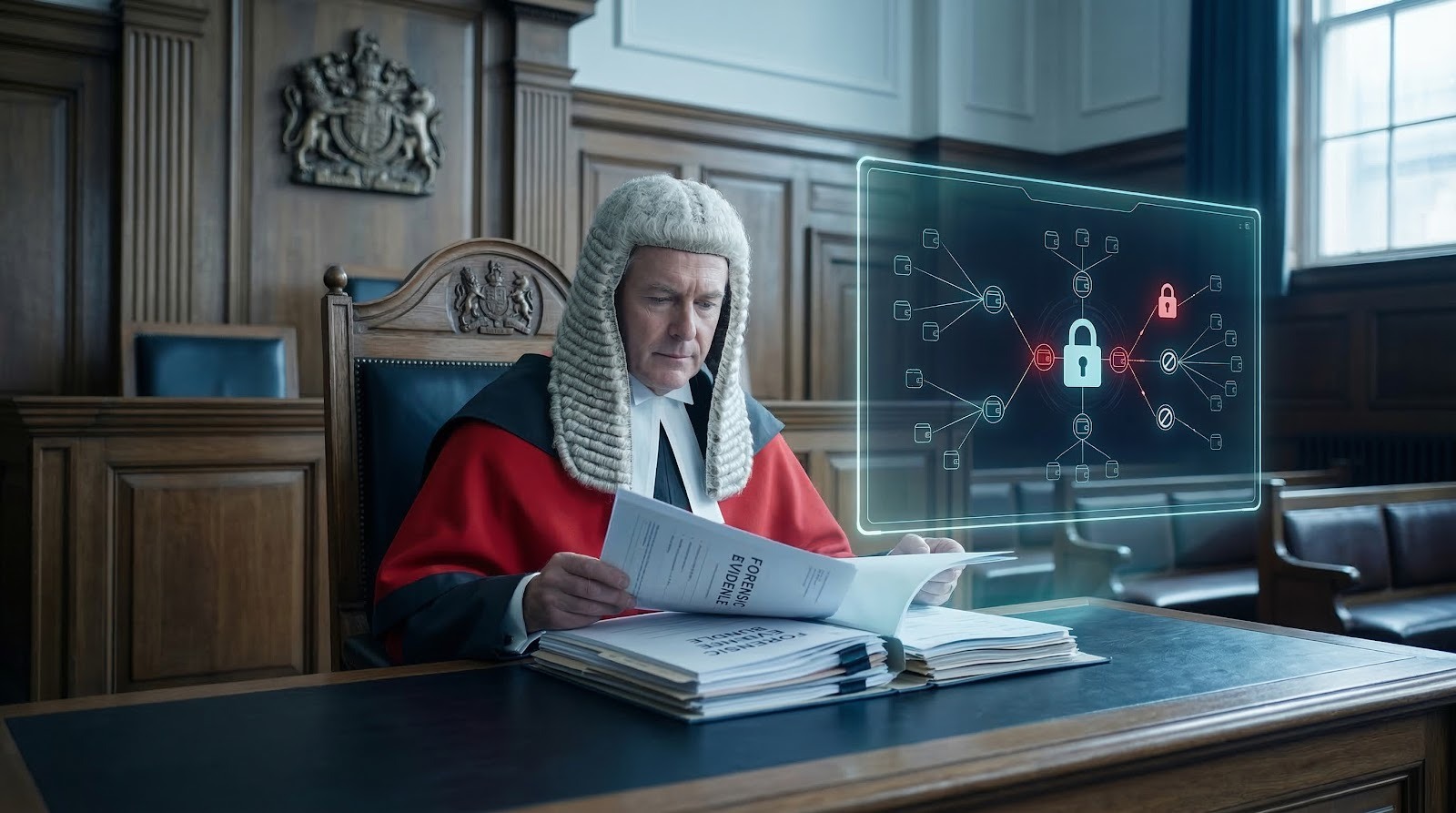
Crypto asset freezing injunctions are court orders that prevent a defendant from dissipating, transferring, or hiding digital assets pending litigation or enforcement. In UK proceedings, obtaining and maintaining such an injunction depends on the quality of the forensic report submitted in support.
Crypto Trace Labs prepares court-ready forensic reports that satisfy the procedural and evidentiary requirements of the UK High Court, Court of Appeal, and specialist commercial courts. Our team holds ACAMS accreditations, MLRO qualifications, and CMI Chartered Fellow Grade status, with over 10 years of experience in crypto-related litigation support.
Key Takeaways
- A freezing injunction forensic report must trace assets from theft or fraud to their current location with a documented chain of custody.
- Courts require a clear methodology section explaining how blockchain analysis was conducted and which tools were used.
- Attribution evidence (connecting wallet addresses to identifiable entities) must be clearly distinguished from inference and probability.
- Expert witnesses must comply with CPR Part 35 and confirm their overriding duty is to the court, not the instructing party.
- The report must be updated if asset movements occur between preparation and the hearing date.
Why This Matters
Crypto asset freezing injunctions are time-sensitive. Courts grant them on the basis of evidence presented at short notice, often without the defendant present. A forensic report that lacks methodological transparency, fails to distinguish confirmed attribution from probabilistic inference, or omits chain of custody documentation will be challenged at the return date hearing. If the report does not withstand scrutiny, the injunction can be set aside, and the claimant may face adverse costs. Getting the forensic report right at the outset protects the client’s legal position and ensures assets remain frozen while proceedings continue.
What a Freezing Injunction Forensic Report Must Cover
A forensic report supporting a crypto asset freezing injunction must address eight core areas without exception.
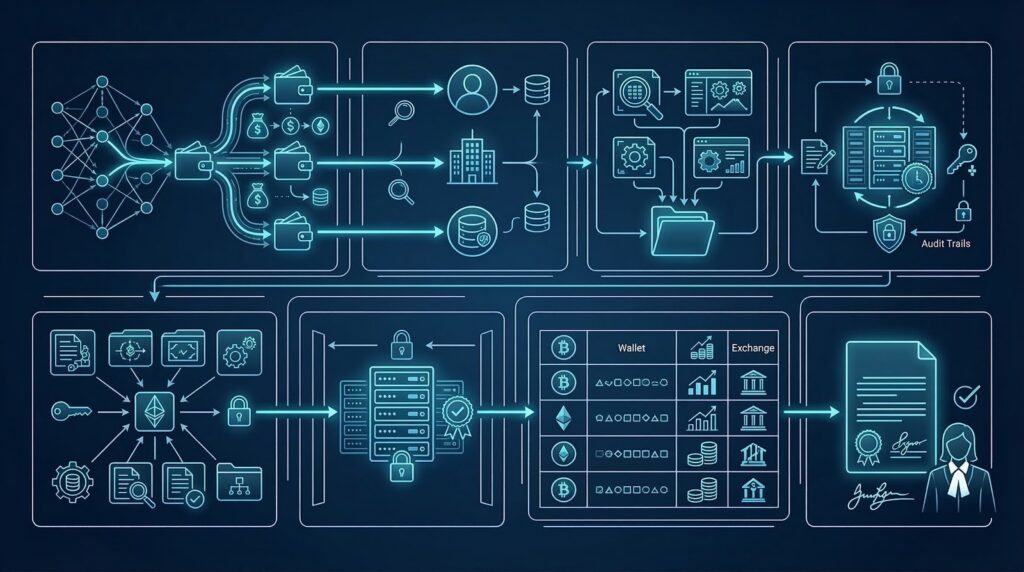
1. Transaction tracing from origin to current location. The report traces the flow of cryptocurrency from the confirmed point of theft, fraud, or breach to the wallets currently holding the assets. Each transaction hop must be documented with transaction hash, block height, timestamp, sending address, receiving address, and value transferred.
2. Attribution methodology. The report must state how wallet addresses were attributed to entities (defendant, exchange, mixer) and distinguish between confirmed attribution (KYC data, exchange records) and probabilistic attribution (clustering heuristics, co-spend analysis). Courts are increasingly alert to overclaiming.
3. Tool disclosure. The report must identify all blockchain analysis tools used (Chainalysis Reactor, Elliptic Lens, TRM Labs, Crystal Intelligence, or open-source tools) and acknowledge their limitations. Courts will ask whether the tool’s methodology has been independently validated.
4. Chain of custody documentation. All data sources must be documented: which blockchain nodes were queried, which APIs were used, what data was downloaded and when. Hash values for downloaded datasets should be recorded to establish integrity.
5. Current asset location and estimated value. The report must identify the current holding wallets, whether assets remain on-chain or have been converted to fiat, and the estimated GBP value at the date of the report. If assets are held at an identified exchange, that exchange’s jurisdiction must be noted.
6. Risk of dissipation evidence. The report must demonstrate that assets are at risk of being moved or dissipated. Evidence of prior movements, mixer usage, privacy coin conversion, or cross-border transfers strengthens this element.
7. Wallet address schedule. A complete schedule of all wallet addresses identified in the tracing exercise, with their associated entities and balances, must be appended for inclusion in the draft freezing order.
8. Expert declaration. The expert must confirm compliance with CPR Part 35, state their qualifications, confirm their overriding duty to the court, and sign the report.

How UK Courts Evaluate Forensic Reports in Freezing Applications
Courts assess forensic reports on three primary dimensions when deciding whether to grant or maintain a freezing injunction.
Traceability. Can the court follow the asset from point of loss to current location? The chain must be unbroken and each link documented. Courts have rejected reports that relied on assumptions to bridge gaps in the transaction trail.
Proportionality of the freeze. The injunction should freeze only the assets that can be traced to the defendant. Freezing unrelated assets is challengeable. The forensic report must provide a precise quantification of traceable assets to anchor the freezing order.
Credibility of the expert. Judges evaluate the expert’s qualifications, the tools used, and whether the methodology is reproducible. Reports from firms with recognised ACAMS or equivalent credentials are given greater weight.
| Evaluation Criterion | What Courts Look For | Common Weakness |
|---|---|---|
| Traceability | Documented hop-by-hop path | Inference-based gaps |
| Attribution | KYC-confirmed or probability-stated | Overclaiming identity |
| Methodology | Named tools, version, validation | Vague “proprietary analysis” |
| Chain of custody | Hash-verified data, timestamped | No data integrity record |
| Expert credentials | ACAMS, MLRO, court experience | Generic IT background |
| Current valuation | GBP value at report date | No exchange rate reference |
Worldwide Freezing Orders and Cross-Border Tracing
Where crypto assets have moved to foreign wallets or exchanges, a worldwide freezing order (WFO) may be sought. The forensic report for a WFO must additionally:
- Identify the jurisdiction of each exchange or custodian holding frozen assets.
- Confirm whether those exchanges have cooperated with preservation requests or are subject to mutual legal assistance treaties.
- Document any assets held at Binance, Coinbase, Kraken, or other major exchanges that can be subject to direct disclosure applications.
Cross-border tracing reports must clearly separate assets subject to UK jurisdiction from those requiring foreign court orders. The forensic expert may need to provide jurisdiction-specific supplemental reports for each country where enforcement is sought.
Updating Forensic Reports Between Application and Return Date
Crypto assets can move within hours. Between the without-notice application and the return date (typically 7-14 days later), the defendant may attempt to move assets. The forensic expert must:
- Monitor all identified wallet addresses for new transactions.
- Update the asset schedule with any movements.
- Prepare a supplemental report if material asset movements have occurred.
- Advise the instructing solicitor immediately if assets are leaving identified wallets so an urgent application can be made.
Courts expect the claimant’s evidence to be current. A forensic report that is already out of date at the return date hearing undermines the strength of the injunction application.
The Difference Between Civil and Criminal Freezing Orders
Forensic reports prepared for civil freezing injunctions differ from those prepared for criminal restraint orders under the Proceeds of Crime Act 2002.
In civil proceedings, the standard of proof is the balance of probabilities and the focus is on tracing assets to the defendant. In criminal proceedings, the prosecution must demonstrate that assets are the proceeds of specific criminal conduct. The forensic report structure, terminology, and attribution standards differ accordingly.
Firms with experience only in criminal proceedings may not appreciate the different disclosure obligations and CPR Part 35 duties that apply in civil litigation.
People Also Read
- What UK Courts Require from Cryptocurrency Tracing Reports
- Presenting On-Chain Evidence in Court: Expert Witness Guide for 2026
- How Solicitors Should Work with Blockchain Forensic Experts
- Blockchain Forensics: The Complete Guide for 2026
Frequently Asked Questions
What must a forensic report include to support a freezing injunction?
The report must include a documented transaction trace from origin to current wallet, attribution methodology distinguishing confirmed from probabilistic attribution, tool disclosure, chain of custody records, a current asset valuation in GBP, a wallet address schedule, evidence of risk of dissipation, and a CPR Part 35 expert declaration. Missing any of these elements creates grounds for challenge at the return date hearing.
How quickly can a forensic report be prepared for an emergency application?
For genuine emergency applications, a preliminary forensic report can often be prepared within 24-48 hours covering the core transaction trace and risk of dissipation evidence. A full report meeting all CPR Part 35 requirements is then prepared for the return date. Early instruction is critical, as blockchain data and exchange records are more accessible when tracing begins promptly.
What is the standard of proof for a crypto freezing injunction?
The claimant must demonstrate a good arguable case on the merits, show that the defendant has assets within jurisdiction or subject to a worldwide freezing order, and establish a real risk of dissipation. The forensic report supports the third limb by documenting asset movements consistent with dissipation intent, such as mixer usage, rapid cross-exchange transfers, or conversion to privacy coins.
Can forensic reports based on open-source tools satisfy court requirements?
Yes, but only if the methodology is fully documented, the tools are named and their limitations acknowledged, and the expert can defend the analysis under cross-examination. Courts are not concerned with whether commercial or open-source tools were used, but with whether the methodology is transparent, reproducible, and defensible. Undisclosed proprietary tools or vague methodology create more risk than well-documented open-source approaches.
What happens if assets move after the freezing order is granted?
The forensic expert must monitor identified wallets and notify the instructing solicitor immediately if movements occur. A supplemental report should be filed, and an urgent variation application may be needed if assets are leaving identified addresses. Failure to monitor and update can leave the claimant with an injunction that no longer attaches to the actual asset location.
Does the forensic report need to identify the defendant by name?
The report must attribute wallet addresses to entities to the extent the evidence allows. Where KYC data from exchanges or law enforcement intelligence confirms identity, that attribution should be stated with its source. Where attribution is probabilistic (based on clustering heuristics), the report should state the confidence level and methodology. Courts do not require certainty of identity at the freezing stage, but the attribution must be defensible.
What is a wallet address schedule and why is it needed?
A wallet address schedule is a complete list of all wallet addresses identified in the tracing exercise, with their associated entities, current balances, and jurisdictions. It is appended to the forensic report and forms the basis of the injunction order itself, specifying exactly which addresses are frozen. Without a precise schedule, the injunction may be unenforceable or overbroad.
How does a worldwide freezing order differ from a domestic one?
A worldwide freezing order (WFO) extends the asset freeze to all jurisdictions and requires the defendant to disclose all assets globally. The forensic report for a WFO must identify the jurisdiction of each custodian or exchange holding frozen assets, note whether those entities are subject to mutual legal assistance treaties, and distinguish assets under UK jurisdiction from those requiring foreign enforcement. Supplemental jurisdiction-specific reports may be needed for enforcement abroad.
What qualifications should a crypto forensic expert have for court proceedings?
Courts look for ACAMS certification or equivalent AML credentials, experience with court-recognised blockchain analysis tools, prior expert witness experience in civil or commercial litigation, and compliance with CPR Part 35. MLRO qualifications, CMI Chartered Fellow Grade status, and a background in regulated financial services strengthen credibility. The expert must be able to demonstrate independence from the instructing party.
How long does a freezing injunction last?
A without-notice freezing injunction is typically granted for 7-14 days pending a return date hearing, at which point both parties can make submissions. If the injunction is maintained at the return date, it continues until trial or further order. The forensic report must remain current throughout, with updated asset schedules provided as the case progresses.
Executive Summary
Crypto asset freezing injunctions are powerful tools for preserving digital assets pending litigation, but their success depends entirely on the quality of the forensic report filed in support. Courts evaluate reports on traceability, attribution credibility, and methodological transparency. A report that fails to document chain of custody, distinguish confirmed from probabilistic attribution, or include a precise wallet address schedule gives the defendant grounds to have the injunction set aside. Firms seeking to freeze crypto assets should instruct forensic experts at the earliest possible stage, monitor asset movements continuously between application and return date, and ensure the expert is fully qualified to comply with CPR Part 35 duties.
What Should You Do Next?
If you are involved in proceedings that require a crypto asset freezing injunction, instruct Crypto Trace Labs to prepare a court-ready forensic report. Our team has experience preparing blockchain tracing evidence for UK High Court applications, worldwide freezing orders, and cross-border enforcement actions. We can provide preliminary reports for emergency applications within 24-48 hours and full CPR Part 35 compliant reports for return date hearings. Contact us now to discuss your case.
People Also Read
- What UK Courts Require from Cryptocurrency Tracing Reports
- Presenting On-Chain Evidence in Court: Expert Witness Guide for 2026
- How Solicitors Should Work with Blockchain Forensic Experts
- Blockchain Forensics: The Complete Guide for 2026
About the Author
Crypto Trace Labs is a specialist crypto asset recovery and blockchain forensics firm founded by VP and Director-level executives formerly of Blockchain.com, Kraken, and Coinbase. Our team holds ACAMS accreditations, MLRO qualifications across the UK, US, and EU, and Chartered Fellow Grade status at the CMI. With over 10 years of experience in financial crime investigation and court-recognized blockchain forensics expertise, we have recovered 101 Bitcoin for clients in the last 12 months and delivered record fraud reduction for a $14bn crypto exchange. We work with law enforcement agencies, regulated financial institutions, and private clients on crypto asset recovery, blockchain forensics, AML compliance, and expert witness testimony – globally. We offer no upfront charge for non-custodial wallet recoveries. Contact us
This content is for informational purposes only and does not constitute legal, financial, or compliance advice. Crypto asset recovery outcomes depend on specific circumstances, regulatory cooperation, and technical factors. Consult qualified professionals regarding your specific situation.