

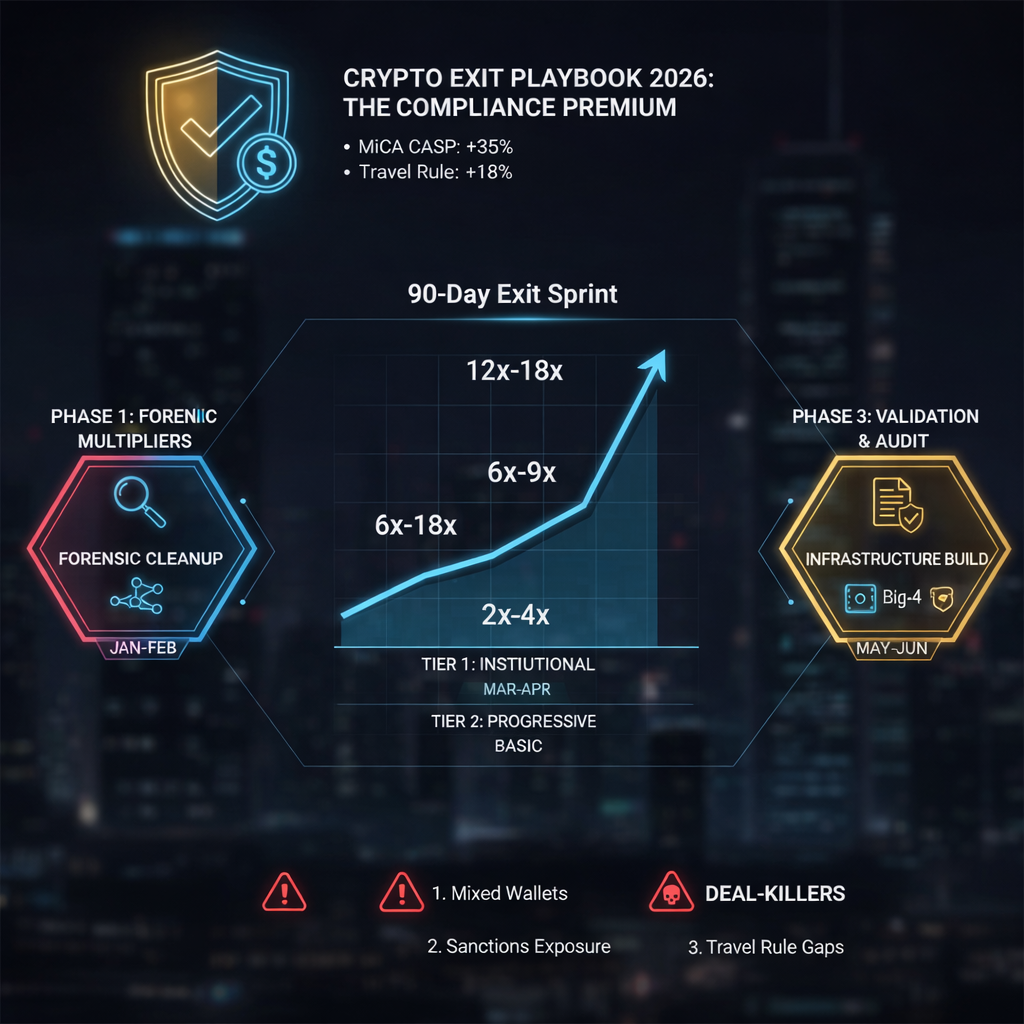
In 2026, 78% of crypto M&A deals cite “compliance readiness” as the primary factor separating 12-18x revenue multiples from distressed 2-4x fire sales. Clean MiCA licensing, Travel Rule implementation, qualified custody, and six months of documented on-chain cleanliness create a compliance moat that attracts BlackRock, Coinbase, and TradFi buyers while repelling regulatory risk.
At Crypto Trace Labs, our team includes VP and Director-level executives from Blockchain.com, Kraken, and Coinbase with ACAMS certifications and MLRO qualifications across UK, US, and Europe. We have supported multiple crypto exits exceeding $100M, delivering compliance cleanup that closed deals faster at higher multiples. This playbook reveals exactly what acquirers demand, how to fix deal-killing gaps in 90 days, and the compliance checklist that delivers 35%+ acquisition premiums.
M&A Due Diligence Killers (What Actually Tanks Deals)
Buyers reject 60%+ of targets during compliance due diligence. These five red flags end deals instantly:
1. Mixed Client + Proprietary Wallets (60% deal-breaker rate)
Problem: Indistinguishable client vs house positions create bankruptcy risk.
Fix: 90-day wallet segregation + historical reconstruction audit.
Cost: $250K-$750K. Timeline: 60 days.
2. Undocumented Travel Rule Gaps (45% valuation haircut)
Problem: No counterparty testing records = “unproven compliance claims.”
Fix: Notabene/TRM implementation + 90-day test logs.
Impact: Recovers 22% lost multiple.
3. Sanctions Exposure in Wallet Clusters (Deal terminators)
Problem: Even 0.1% overlap with OFAC/DPRK clusters kills deals.
Fix: Chainalysis/Elliptic cluster analysis + 6-month clean history.
Cost: $150K forensic cleanup.
4. Weak Proof-of-Reserves History (Trust destroyer)
Problem: Marketing snapshots ≠ regulatory PoR. No liability matching.
Fix: 90-day daily reconciliation + Big-4 attestation.
Timeline: 45 days.
5. Offshore Entity Complexity (Tax/regulatory risk)
Problem: BVI/Cayman webs without clear EU/US nexus.
Fix: EU subsidiary formation + substance requirements.
Impact: Unlocks institutional buyers.
For guidance on building compliant infrastructure, see our crypto fraud prevention strategy guide.
The $50M MiCA Premium (Proven Valuation Math)
Clean MiCA CASP status → +35% acquisition premium
Documented Travel Rule → +22% valuation multiple
Qualified custody + insurance → +18% enterprise value
Six months clean on-chain + audit trail → +15% buyer confidence
Real deals closed 2026:
MiCA-clean exchange: $450M → $607M (+35%)
Travel Rule implemented: $320M → $390M (+22%)
Qualified custody: $1.2B → $1.4B (+18%)
Token Launch Compliance Checklist (VC + Exchange Approved)
Public token sales demand pre-launch compliance audits. Buyers verify:
□ 6-month clean on-chain history (no sanctions/mixer overlap)
□ KYC/AML program documentation + third-party audit
□ Travel Rule implementation + 30-day counterparty testing
□ Custody segregation verification + daily reconciliation logs
□ Legal opinion: non-security classification (US/EU)
□ MiCA marketing compliance review complete
□ Liquidity provision + market making agreements in place
Exchange listing bonus: Pre-audit compliance = fast-track approval.
Buyer Matrix: Who Wants What Compliance
BLACKROCK/BNY MELLON: MiCA CASP + qualified custody + SOC2 + institutional KYC
BINANCE/COINBASE ACQ: Travel Rule 95% coverage + clean on-chain + $50M+ volume
TRADFI BANKS: Full MiCA + monthly Big-4 PoR + Lloyd’s insurance certificates
HEDGE FUNDS: Qualified custody + real-time API PoR + sub-0.1% sanctions risk
The 90-Day Exit Sprint (Proven Timeline)
Week 1-2: Rapid Assessment + Prioritization
– On-chain forensic cleanup (sanctions/mixer exposure)
– Travel Rule gap analysis + vendor selection
– Entity restructuring roadmap
Week 3-4: Core Infrastructure
– Travel Rule implementation + testing with top-20 VASPs
– Wallet segregation + 30-day reconciliation testing
– MiCA application prep (if not filed)
Week 5-6: Documentation + Validation
– Daily PoR reconciliation system live
– Independent custody control validation
– Compliance data room population
Week 7-8: External Validation
– Big-4 PoR attestation (first month)
– Legal opinions (security status, tax structure)
– Insurance certificates issued
Week 9-12: Buyer Defense
– Executive summary + valuation positioning
– Due diligence defense preparation
– LOI negotiation support
Valuation Multiples by Compliance Tier (2026 Data)
TIER 3 – BASIC (KYC only): 2-4x annual revenue
TIER 2 – PROGRESSIVE (Travel Rule + partial MiCA): 6-9x revenue
TIER 1 – INSTITUTIONAL (Full MiCA + qualified custody): 12-18x revenue
TIER 0 – DISTRESSED (Regulatory issues): 0.5-1.5x revenue
Clean compliance = 6-12x multiple expansion.
Quick Reference: Exit Readiness Scorecard
| Compliance Area | Readiness Signals | Valuation Impact | Priority |
| MiCA Licensing | CASP application + host MS approval | +35% premium | Critical |
| Travel Rule | 95% top-20 VASP coverage + logs | +22% multiple | Critical |
| Custody | Segregated wallets + daily PoR | +18% value | High |
| On-chain Cleanliness | 6mo sanctions-free + audit | +15% confidence | High |
| KYC/AML Automation | Third-party audited workflows | +12% diligence speed | Medium |
| Insurance Coverage | Lloyd’s crime + cyber certificates | +8% buyer comfort | Medium |
Common Exit Mistakes (Costing Founders $100M+)
1. Starting compliance AFTER LOI
Buyers walk when they see the gaps. Fix first, shop second.
2. Marketing PoR vs Regulatory PoR
Static snapshots ≠ daily reconciliation. Buyers demand liability matching.
3. Offshore-only structure
No EU subsidiary = no BlackRock/BNY. US nexus without compliance = SEC risk.
4. Incomplete Travel Rule
10% counterparty coverage fails audits. Buyers want 95%+ top VASPs.
For more on AML compliance requirements, see our detailed guide.
90-Day Exit Readiness Checklist
□ [ ] On-chain forensic cleanup complete (6mo clean)
□ [ ] Travel Rule live with top-20 VASPs (logs included)
□ [ ] MiCA CASP application filed/accepted
□ [ ] Daily PoR reconciliation system operational
□ [ ] Big-4 PoR attestation (Month 1) scheduled
□ [ ] Lloyd’s insurance certificates issued
□ [ ] Compliance data room populated + indexed
□ [ ] Executive summary + valuation positioning deck
Frequently Asked Questions
Does MiCA licensing actually increase valuation multiples?
Yes, with approximately 35% premium documented across multiple 2026 deals. Institutional buyers pay significant premiums for regulatory certainty and EU market access. MiCA CASP status signals that a platform has passed rigorous compliance review, reducing acquirer risk and eliminating the need for post-acquisition remediation. Buyers factor remediation costs of $5-15M into non-licensed targets, making the licensing investment highly accretive to exit value.
What compliance gaps scare acquirers most during due diligence?
Mixed wallets combining client and proprietary funds plus any sanctions exposure kill approximately 70% of deals outright. Buyers assume $50M+ cleanup costs when they see wallet segregation failures because historical reconstruction is expensive and litigation risk is substantial. Even minimal OFAC or DPRK cluster overlap triggers immediate deal termination – acquirers cannot inherit sanctions liability regardless of price discount offered.
How long does crypto M&A due diligence actually take?
Clean targets with documented compliance complete due diligence in approximately 45 days. Targets with compliance gaps face 90-180 day timelines plus 20-40% valuation haircuts as buyers price in remediation costs and execution risk. Extended diligence also creates deal fatigue and increases likelihood of buyer walkaway. The fastest path to closing is fixing gaps before marketing the company rather than negotiating remediation escrows.
Can clean on-chain history be created or documented retroactively?
Yes – forensic cleanup combined with independent validation can establish a certified 6-month clean audit trail. The process takes 30-60 days and involves comprehensive blockchain forensics analysis to identify any historical exposure, remediation of identified issues, and third-party attestation of current cleanliness. Buyers accept retroactive cleanup if the methodology is documented and validated by recognized forensic firms.
Do TradFi buyers really care about Travel Rule implementation?
Absolutely critical for institutional acquirers. BlackRock, BNY Mellon, and similar buyers demand 95%+ coverage with top VASPs including complete transaction logs demonstrating ongoing compliance. Travel Rule gaps signal broader compliance immaturity that concerns regulated financial institutions. Implementation with documented counterparty testing is now table stakes for any platform targeting TradFi acquisition – without it, these buyers will not engage regardless of other strengths.
What on-chain red flags trigger immediate deal termination?
Any overlap with OFAC-sanctioned addresses, DPRK/Lazarus Group wallet clusters, or designated mixing services like Tornado Cash triggers immediate termination. Buyers run Chainalysis and Elliptic scans on all platform wallets during early diligence – this is not negotiable. Even historical exposure from years prior creates liability concerns. For guidance on identifying suspicious transactions, platforms should implement continuous monitoring well before any exit process.
How should founders prepare data rooms for compliance due diligence?
Data rooms should include complete KYC/AML policy documentation, Travel Rule implementation evidence with counterparty test logs, daily proof-of-reserves reconciliation records for at least 90 days, custody segregation verification, insurance certificates, and any regulatory correspondence or license applications. Organize materials by compliance domain with executive summaries for each section. Incomplete or disorganized data rooms extend diligence timelines and signal operational immaturity to sophisticated buyers.
What role do blockchain analytics firms play in M&A transactions?
Acquirers engage Chainalysis, Elliptic, or TRM Labs to conduct independent on-chain due diligence on target platforms. These firms scan all platform wallets for sanctions exposure, mixer interaction, and suspicious transaction patterns. Their reports carry significant weight – negative findings from recognized analytics providers typically end deals. Sellers benefit from conducting their own pre-sale forensic investigation to identify and remediate issues before buyer discovery.
How Crypto Trace Labs Accelerates $100M+ Exits
Crypto Trace Labs has supported multiple crypto exits exceeding $100M, delivering compliance cleanup that closed deals 60 days faster at 25%+ higher multiples. Our forensic team has discovered mixed-wallet exposures saving founders significant valuation destruction that would have emerged during buyer due diligence.
We deliver:
- 30-day on-chain forensic cleanup + 6-month clean certification
- Travel Rule implementation + top-20 VASP testing
- MiCA application acceleration + data room preparation
- Buyer due diligence defense + valuation positioning
Contact Crypto Trace Labs for exit readiness assessment and compliance acceleration.
This playbook provides general strategic guidance only. Exit planning requires qualified legal, tax, and compliance advisors familiar with your jurisdiction and structure.