


Last Updated: March 2026
Law enforcement data requests to crypto exchanges are formal demands for KYC (Know Your Customer) records, transaction histories, wallet addresses, and user account data, issued by police, financial intelligence units, or judicial authorities in the course of criminal investigations. Exchanges operating under UK FCA registration, EU MiCA compliance, or US FinCEN registration face mandatory obligations to respond to these requests within defined timeframes, subject to tipping-off prohibitions and legal professional privilege considerations. According to ACAMS (Association of Certified Anti-Money Laundering Specialists) 2024 guidance, the most common compliance failure among crypto exchanges facing law enforcement requests is inadequate documentation of the response process – creating regulatory exposure regardless of whether the underlying data was correctly produced.
Crypto Trace Labs advises crypto exchanges and institutional digital asset firms on law enforcement response procedures, AML (Anti-Money Laundering) compliance frameworks, and suspicious activity reporting obligations. Our team holds MLRO (Money Laundering Reporting Officer) qualifications across the UK, US, and EU, ACAMS accreditations, and Chartered Fellow Grade at the CMI, with founding members from Blockchain.com, Kraken, and Coinbase who have personally managed law enforcement interactions at scale.
Key Takeaways
- UK exchanges must respond within defined production periods: Under the Proceeds of Crime Act 2002 (POCA), production orders for financial records typically specify a return date within 7 days, and voluntary requests from the National Crime Agency should be treated with similar urgency.
- Tipping-off is a criminal offence: Informing a customer that their account is subject to a law enforcement request is an offence under Section 333A of POCA – internal access to the request must be strictly controlled.
- Data must be produced in a forensically sound format: Producing data in a format that courts cannot validate – such as informal CSV exports without hash verification – can cause evidential problems in subsequent proceedings.
- MLROs must be notified immediately: According to the FCA’s 2024 Financial Crime Guide, any law enforcement contact relating to AML matters must be escalated to the MLRO within the same business day.
- Voluntary cooperation can expedite recovery for victims: According to Chainalysis‘s 2024 crypto crime report, exchanges that have pre-established law enforcement cooperation protocols recover assets for victims in an average of 6 fewer weeks than exchanges without such protocols.
Why This Matters
Crypto exchanges that mishandle law enforcement data requests face consequences that extend well beyond regulatory fines. Exchanges that produce data in incorrect formats, fail to meet production timelines, or inadvertently tip off customers face criminal liability for MLRO-level officers, FCA enforcement action, and reputational damage with banking partners whose fiat rails are essential to exchange operations. Equally, exchanges that over-respond – producing data beyond the scope of the request or without adequate legal review – face data protection liability under UK GDPR. The correct response process requires a documented workflow that balances compliance obligations with data subject rights, and it must be rehearsed before the first request arrives, not improvised when law enforcement is waiting.
Understanding Different Request Types
Law enforcement data requests to crypto exchanges take several distinct legal forms, each with different obligations, timelines, and response protocols.
A voluntary information request (also called a Section 7 request under POCA) is an informal request from a law enforcement agency asking for information about a specific wallet address, transaction, or user account. There is no legal compulsion to comply, but cooperation is strongly encouraged and refusal may be noted in future regulatory interactions. A production order under Section 345 of POCA is a court-issued order requiring the exchange to produce specified financial records. The exchange must comply by the return date specified in the order and cannot refuse on the grounds of inconvenience or commercial sensitivity. A disclosure order under Section 357 of POCA is issued in the context of confiscation proceedings and requires disclosure of information relating to a defendant’s assets. A restraint order under Section 41 of POCA freezes assets and may require the exchange to prevent a user from transacting.
| Request Type | Legal Basis | Response Timeline | Tipping-Off Prohibition |
|---|---|---|---|
| Voluntary information request | POCA S.7 | Best efforts, typically 5-10 days | Not statutory but best practice |
| Production order | POCA S.345 | As specified in order (typically 7 days) | Yes – S.333A applies |
| Disclosure order | POCA S.357 | As specified in order | Yes – S.333A applies |
| Restraint order | POCA S.41 | Immediate compliance | Yes – S.333A applies |
| FinCEN request (US) | BSA/AML | Typically 30 days | Yes – statutory prohibition |
Internal Escalation and MLRO Notification
The internal escalation process for law enforcement requests must be triggered immediately upon receipt, with the MLRO as the mandatory notification point for all requests relating to AML matters.
The exchange’s compliance operations team must log the request upon receipt – noting the requesting agency, the officer’s name and badge number or official reference, the specific data requested, the legal basis cited, and the return date or deadline. The log must be created contemporaneously in the compliance management system. The MLRO must be notified within the same business day in all cases where the request relates to suspicious activity, money laundering, or terrorist financing. Legal counsel should be notified in parallel if the request is a formal production or disclosure order.
Access to the request documentation within the exchange must be limited on a strict need-to-know basis. The FCA’s 2024 Financial Crime Guide emphasises that tipping-off risk is highest in the first hours after a request is received, when staff who are unaware of the prohibition may inadvertently mention the request to colleagues who have contact with the affected customer.

Data Production Standards
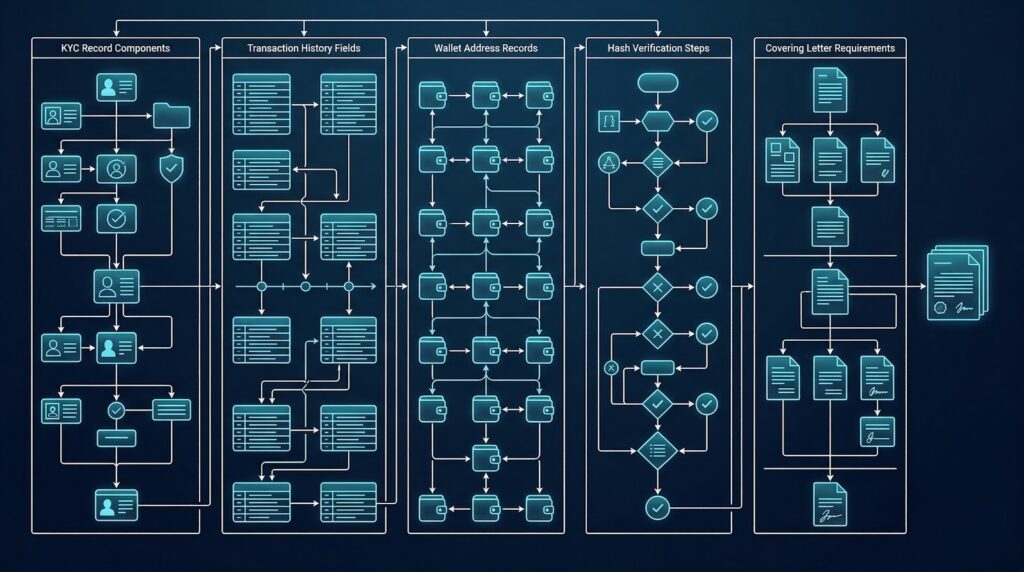
Data produced in response to law enforcement requests must be accurate, complete within the scope of the request, and formatted in a way that the receiving agency can use and that courts can rely on if the data is later exhibited as evidence.
For KYC records, the production should include: the full legal name, date of birth, and address as verified at onboarding; the verification documents provided and the date of verification; the current verification status and any subsequent re-verification events; and any enhanced due diligence records if the customer was subject to higher-risk procedures. For transaction records, the production should include: a complete transaction history in chronological order; wallet addresses associated with the account; deposit and withdrawal records including counterparty exchange and transaction hashes where available; and any internal notes, flags, or SAR references associated with the account.
Data must be produced in a format that preserves integrity. Hash-verified exports – where the exchange computes an SHA-256 hash of each produced file and certifies it in the covering letter – are increasingly standard and expected by sophisticated law enforcement agencies.
Managing Tipping-Off Risk
Tipping-off risk management is the set of controls an exchange must apply to prevent any information about a law enforcement request from reaching the customer who is subject to that request.
The Section 333A tipping-off prohibition under POCA applies from the moment the exchange becomes aware of the request. It prohibits the exchange from disclosing to the subject that a production order has been made, that information has been provided to law enforcement, or that an investigation is underway. The prohibition applies to all exchange staff, not just compliance officers. Customer service agents, account managers, and technical support staff who have access to account notes must not see the request or any flag associated with it.
Practical tipping-off controls include: creating a separate, access-restricted record of the request outside the main CRM system; using coded notation in the account record if any internal flag is unavoidable; briefing only the minimum number of staff required to produce the data; and reviewing the covering letter before dispatch to ensure no information about the request is inadvertently disclosed in the format or timing of data production.
Frequently Asked Questions
What happens if a crypto exchange does not respond to a production order?
Failure to comply with a production order under POCA Section 345 is a contempt of court, which can result in fines, imprisonment of responsible officers, and enforcement action by the FCA. Repeated non-compliance or deliberate obstruction can also result in the exchange’s registration being suspended or revoked. UK exchanges operating without adequate law enforcement response procedures face significant regulatory and criminal liability.
Can an exchange challenge or narrow the scope of a production order?
Yes. An exchange can apply to vary or discharge a production order if it is disproportionate, if the data requested is legally privileged, or if complying would breach another legal obligation such as data protection law. Applications to vary must be made promptly, as courts expect compliance by the return date absent a successful application. Legal counsel should be instructed immediately upon receipt of any order the exchange intends to challenge.
Does the exchange need to inform the customer before producing their data?
No, and in most cases they must not. The tipping-off prohibition under Section 333A of POCA prohibits the exchange from informing the customer that their data is subject to a law enforcement request. Exchanges that voluntarily disclose to customers that law enforcement has requested their data commit a criminal offence, regardless of their motivation.
How should exchanges handle requests from overseas law enforcement?
Requests from overseas law enforcement typically arrive through formal mutual legal assistance channels (MLAT), Interpol notices, or informal cooperation requests. UK exchanges are not legally required to comply with informal overseas requests, but cooperation is generally appropriate where the requesting agency is a recognised law enforcement body in a jurisdiction with equivalent AML standards. Formal MLAT requests carry the same weight as domestic production orders.
What is a suspicious activity report and when must one be filed?
A suspicious activity report (SAR) must be filed with the UK’s National Crime Agency when an exchange knows or suspects that a customer is engaged in money laundering or terrorist financing. The obligation to file a SAR is separate from and does not depend on a law enforcement request. Where a law enforcement request reveals information that triggers a separate SAR obligation, the MLRO must be advised and the SAR filed independently.
How long should exchanges retain law enforcement request records?
UK AML regulations require retention of records relating to law enforcement requests, compliance responses, and customer due diligence for a minimum of five years after the end of the customer relationship or the date of the request. Where proceedings arising from the request are ongoing, records must be retained until those proceedings conclude.
What format should data production be in for UK law enforcement?
Data production for UK law enforcement should be in a forensically sound, human-readable format. Preferred formats include: certified PDF exports for KYC records; CSV or Excel for transaction histories; and JSON exports for on-chain address and transaction data. All files should be accompanied by a hash manifest certifying the integrity of each file, and the covering letter should identify the files produced, their scope, and the authorising officer responsible for the production.
How should exchanges handle emergency production requests outside business hours?
Exchanges should maintain an out-of-hours escalation procedure for emergency law enforcement requests, particularly those involving restraint orders requiring immediate asset freezing. The MLRO or a nominated deputy must be reachable at all times by law enforcement through a designated emergency contact route. Delay in responding to emergency restraint orders can result in asset dissipation that the exchange may be held liable for failing to prevent.
Executive Summary
Crypto exchanges face legally binding obligations when receiving law enforcement data requests, with consequences for non-compliance ranging from contempt of court to criminal liability for responsible officers. The correct response involves immediate MLRO notification, strict tipping-off controls, accurate data production in a forensically sound format, and comprehensive documentation of the response process. Exchanges that have pre-built response protocols, rehearsed escalation procedures, and established relationships with law enforcement agencies respond faster, produce better-quality data, and face significantly lower regulatory risk than those that handle requests reactively.
What Should You Do Next?
If your exchange lacks a documented law enforcement response framework, or if you need to review and strengthen existing procedures, Crypto Trace Labs provides AML compliance consulting and law enforcement liaison support for crypto exchanges across the UK, EU, and US.
The team at Crypto Trace Labs – ACAMS-accredited, MLRO-qualified across three jurisdictions, Chartered Fellow Grade at the CMI, with founding members who have managed law enforcement interactions at VP and Director level at Blockchain.com, Kraken, and Coinbase – has built record fraud reduction frameworks for a $14bn crypto exchange. We offer no upfront charge for non-custodial wallet recoveries. Contact us to discuss your compliance requirements.
People Also Read
- How Does Blockchain Forensics Work? Expert Methods Explained
- What Is Cryptocurrency AML Compliance?
- Crypto Compliance Roadmap 2026: Navigating MiCA, Travel Rule, AMLA and Stablecoin Rules
- When Cryptocurrency Transactions Become Suspicious
About the Author
Crypto Trace Labs is a specialist crypto asset recovery and blockchain forensics firm founded by VP and Director-level executives formerly of Blockchain.com, Kraken, and Coinbase. Our team holds ACAMS accreditations, MLRO qualifications across the UK, US, and EU, and Chartered Fellow Grade status at the CMI. With over 10 years of experience in financial crime investigation and court-recognized blockchain forensics expertise, we have recovered 101 Bitcoin for clients in the last 12 months and delivered record fraud reduction for a $14bn crypto exchange. We work with law enforcement agencies, regulated financial institutions, and private clients on crypto asset recovery, blockchain forensics, AML compliance, and expert witness testimony – globally. We offer no upfront charge for non-custodial wallet recoveries. Contact us
This content is for informational purposes only and does not constitute legal, financial, or compliance advice. Crypto asset recovery outcomes depend on specific circumstances, regulatory cooperation, and technical factors. Consult qualified professionals regarding your specific situation.