

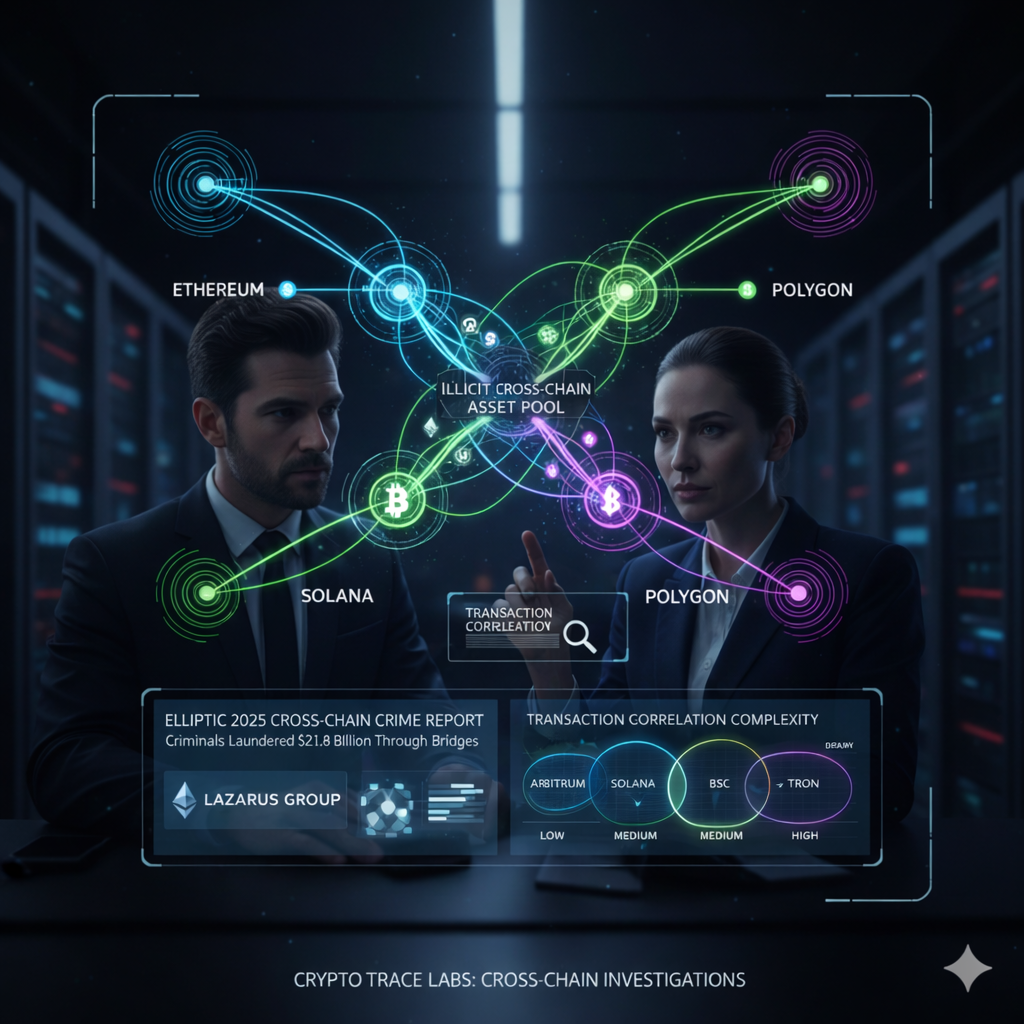
Blockchain bridges complicate cryptocurrency tracing by enabling criminals to move funds across multiple blockchain networks in rapid succession, obscuring the origin and destination of illicit assets through a technique called chain-hopping. According to Elliptic’s 2025 Cross-Chain Crime Report, criminals laundered over $21.8 billion through cross-chain bridges, decentralized exchanges, and swap services – a threefold increase from $7 billion in 2023. This massive growth reflects how sophisticated threat actors exploit bridges to fragment transaction trails across dozens of blockchains, transforming what should be transparent blockchain data into complex multi-chain puzzles that require specialized tools and expertise to solve.
At Crypto Trace Labs, our team has tracked stolen cryptocurrency through bridge transactions spanning 10+ blockchains during complex recovery investigations. Our founders from Blockchain.com, Kraken, and Coinbase have seen firsthand how the Lazarus Group and other professional criminals use bridges to launder stolen funds, requiring investigators to employ advanced cross-chain tracing techniques that go far beyond traditional single-blockchain analysis.
What Are Blockchain Bridges and Why Do Criminals Use Them?
Blockchain bridges are protocols that enable asset transfers between blockchain networks that cannot natively communicate. These bridges solve a fundamental problem – blockchains operate as isolated networks with distinct rules and consensus mechanisms.
According to Chainalysis research, bridges employ messaging systems that permit blockchains to pass information verifiably. The most common mechanism works through lock-and-mint protocols. When you bridge Ethereum to Solana, the bridge locks your original tokens in a smart contract on Ethereum and mints equivalent wrapped tokens on Solana.
Criminals exploit bridges because they create natural break points in transaction trails. Traditional blockchain forensics relies on following transaction flows on a single blockchain. When funds move through a bridge, investigators must manually correlate the lock transaction on the source chain with the mint transaction on the destination chain.
Major protocols like Wormhole support 40+ blockchains and have processed over 1 billion cross-chain messages. This legitimate infrastructure serves billions in daily volume but simultaneously provides criminals with powerful obfuscation tools.
How Does Chain-Hopping Work in Practice?
Chain-hopping is the rapid successive movement of cryptocurrency across multiple blockchains using bridges to obscure origin and destination. Elliptic’s research reveals 33% of complex cross-chain cases involve more than three blockchains, 27% involve over five, and 20% span more than ten networks. The Lazarus Group demonstrated this after the $1.46 billion Bybit hack, moving stolen funds rapidly across Bitcoin, Ethereum, Arbitrum, Base, and Tron.
A typical sequence: Criminals steal Ethereum from an exchange. They bridge the ETH to Polygon, swap for USDC through a DEX, bridge USDC to Arbitrum, convert to wrapped Bitcoin, bridge to Solana, swap for SOL, then bridge to BSC where it converts to USDT for exchange deposit. Each bridge creates a new trail requiring manual correlation. Each swap obscures value further.
Professional criminals optimize sequences for maximum obfuscation, selecting bridges with poor analytics coverage, using protocols without detailed transaction logs, and timing swaps during high-volume periods when suspicious patterns get lost in legitimate traffic.
What Technical Challenges Do Bridges Create for Investigators?
Blockchain bridges introduce four major technical challenges: transaction correlation complexity, wrapped token attribution, liquidity pool obscuration, and analytics coverage gaps.
Transaction correlation is the fundamental challenge. When funds bridge from Ethereum to Solana, no native blockchain link connects the lock and mint transactions. Investigators must use bridge-specific smart contract logs, timing analysis, and amount matching to identify corresponding transactions. When criminals split transactions or introduce delays, correlation becomes exponentially harder.
Wrapped token attribution creates identity confusion. The same $100,000 might exist as ETH on Ethereum, Wrapped ETH on Polygon, wETH on Arbitrum, and ETH.e on Avalanche. Each representation has different token contracts, transaction histories, and risk profiles in analytics systems.
Liquidity pool obscuration occurs when bridges use pooled models. Users’ assets mix with others’ funds in shared pools before release on destination chains. This breaks direct transaction lineage.
Analytics coverage gaps stem from the ecosystem’s breadth. Chainalysis tracks 220 million bridge transactions across 25+ blockchains, but hundreds of smaller bridges exist with limited coverage. Criminals deliberately route through these gaps.
How Do Professional Investigators Track Funds Through Bridges?
Professional investigators employ systematic cross-chain tracing combining blockchain analytics platforms, manual correlation, and bridge-specific intelligence.
Teams use platforms like Chainalysis, Elliptic, and TRM Labs providing multi-chain visibility. Elliptic’s cross-chain tracing employs Virtual Value Transfer Events (VVTEs) that automatically establish links between source and destination transactions, converting multi-hour manual investigations into single-click attribution.
Investigators identify bridge transactions through recognizable patterns. Bridge smart contracts show lock/burn events on source chains paired with mint/unlock events on destinations. Transaction amounts often match precisely after bridge fees. Timing correlation reveals transactions within minutes of each other.
Manual correlation becomes necessary when automated tools fail. Investigators examine bridge-specific transaction hashes in smart contract logs, analyze gas fee patterns unique to bridges, and track wrapped token contract deployments. They build timeline visualizations across blockchains, identifying correlation points through amount matching and temporal clustering.
At Crypto Trace Labs, our executive-level exchange contacts enable faster information requests, bypassing standard support tickets that delay time-critical investigations.
What Specific Bridge Protocols Present Greatest Challenges?
Different protocols create varying investigative difficulty based on architecture, liquidity models, and transparency.
Wormhole connects 40+ blockchains with over 1 billion messages processed. The platform’s broad coverage makes it popular with criminals and legitimate users alike. Sheer daily volume – often billions of dollars – makes identifying specific illicit flows challenging without powerful filtering.
Stargate Finance uses LayerZero’s messaging framework with unified liquidity pools. This pooled model breaks one-to-one transaction tracing – funds entering pools on Ethereum might exit through any withdrawal transaction on other chains. While improving capital efficiency for users, it breaks direct traceability.
Across Protocol specializes in Ethereum Layer 2 bridging with intent-based execution. The decentralized relayer network means the address bridging out may differ from the address that locked funds. This adds correlation complexity, though Across maintains strong transaction logs.
Privacy-focused bridges integrating mixing or zero-knowledge proofs create extreme challenges. Some bridges connecting to privacy chains like Monero create near-total investigative breaks. Bridge aggregators like LI.FI and Jumper routing through 15+ underlying protocols can split single transactions across multiple bridges, creating exponentially complex trails.
How Has Cross-Chain Crime Evolved?
Cross-chain criminal activity has accelerated as criminals recognize bridge-based obfuscation advantages over traditional laundering.
Elliptic’s research documents a 200% increase from $7 billion in 2023 to $21.8 billion in 2025. This reflects criminal adaptation as investigators became more proficient at tracing Bitcoin and Ethereum, shifting tactics toward multi-chain laundering that exploits coverage gaps.
State-sponsored actors lead in sophistication. North Korea’s Lazarus Group accounts for $2.5 billion (12%) of all cross-chain criminal activity. Their post-Bybit hack laundering involved at least five blockchains traversed through numerous bridges and DEXs within hours.
Investment scams increasingly incorporate cross-chain elements during operation. CBEX defrauded nearly $1 billion while using bridges and DEXs to launder funds even as it claimed legitimacy and accepted new victim deposits.
Sanctions evasion has intensified. Elliptic documented $300 million in cross-chain transfers from Iranian crypto services under U.S. sanctions. Russian actors used the seized Garantex exchange with bridge transactions to bypass international restrictions.
The operational challenge for law enforcement has grown. When tracking $100,000 through 10+ blockchains requires days of manual work, resource costs become prohibitive except for largest cases.
Frequently Asked Questions
Can blockchain bridges be regulated to prevent criminal use?
Bridge regulation presents significant technical and jurisdictional challenges. Unlike centralized exchanges that operate as identifiable legal entities subject to licensing requirements, many bridges run as decentralized protocols without central operators. Some bridges incorporate smart contracts deployed immutably on-chain that cannot be modified after deployment. Regulating decentralized bridge protocols requires entirely different frameworks than traditional financial regulation. However, bridge front-end interfaces, token issuers, and liquidity providers may be regulatable. Recent regulatory actions have targeted bridge operators who maintain control over bridge operations despite decentralized branding. Effective regulation likely requires international coordination given bridges’ global nature and the ability of protocols to operate across jurisdictions simultaneously.
How long does it take to trace funds through multiple bridges?
Tracing timeframes vary dramatically based on case complexity and available tools. Simple cases involving well-documented bridges between major blockchains may take investigators hours using automated platforms like Elliptic’s VVTE system. Complex cases spanning 10+ blockchains through obscure bridges can require days or weeks of manual correlation work. Time sensitivity matters critically for fund recovery – criminals often bridge stolen funds multiple times within the first 24 hours after theft, knowing that investigation delays favor their successful laundering. At Crypto Trace Labs, we prioritize bridge tracing in the immediate aftermath of reported thefts because the first 48 hours offer the best recovery opportunities before funds fragment across too many chains and intermediaries.
Do all blockchain analytics platforms support cross-chain tracing?
No. Cross-chain tracing capabilities vary significantly across platforms. Basic analytics tools often provide single-blockchain visibility with minimal or no bridge transaction correlation. Advanced platforms like Chainalysis, Elliptic, and TRM Labs offer varying degrees of multi-chain coverage and automated bridge tracing. Elliptic claims coverage of over 300 bridging protocol combinations across 54+ blockchains. TRM Labs supports 100+ blockchains with real-time indexing on 45+ chains. Chainalysis covers 220 million bridge transactions across 25+ blockchains. Organizations conducting serious cross-chain investigations require platforms specifically designed for multi-chain visibility rather than single-blockchain tools.
Can investigators track funds that use privacy bridges?
Privacy-focused bridges connecting to shielded chains like Monero or Zcash create severe tracking limitations. When funds bridge from Ethereum to Monero, investigators can identify the bridge transaction and see the ETH entering the bridge protocol. However, once value exists as Monero on a privacy chain, transaction-level tracing becomes impossible without specialized techniques. Investigators typically focus on entry and exit points – where privacy coins convert back to transparent assets. The bridge back from Monero to Ethereum or other transparent chains creates a new trackable trail, though the connection to the original bridged funds cannot be proven definitively. This makes privacy bridges highly effective for criminal laundering, though regulatory pressure has limited their availability and liquidity compared to standard bridges.
What information do bridge operators provide to law enforcement?
Information availability varies by bridge architecture. Centralized operators with identifiable legal entities may comply with law enforcement requests for transaction records and user data. Fully decentralized bridges with no central operators cannot provide information – protocols operate autonomously through smart contracts with no entity maintaining user records. Some bridges maintain detailed transaction logs on-chain that investigators access directly through blockchain analysis. Others minimize logged data for privacy. Investigators often find operators uncooperative or unable to assist due to decentralized architecture even when sympathetic to recovery efforts.
How do bridge exploits affect tracing capabilities?
Bridge security exploits that drain liquidity from bridge smart contracts create unique challenges. When attackers steal funds directly from bridge contracts, they acquire wrapped tokens or locked assets that legitimate users deposited. These stolen bridge reserves then circulate through the crypto ecosystem, potentially ending up in innocent users’ wallets through DEX trades or other transfers. Investigators must distinguish between stolen bridge funds and legitimate bridge usage by separate criminals. The Wormhole $326 million hack exemplifies this – attackers minted wrapped tokens without locking corresponding assets, creating phantom wrapped ETH that subsequently mixed with legitimate wETH in DeFi protocols. Tracing the exploited tokens requires identifying which specific wrapped token units originated from the hack versus legitimate bridging activity.
Can artificial intelligence improve bridge tracing?
AI and machine learning show promise for automated bridge correlation. Pattern recognition algorithms can identify likely bridge transaction pairs across chains based on amount matching, timing correlation, and behavioral fingerprints specific to different bridge protocols. Machine learning models trained on known bridge transactions can predict correlation probability when connecting source and destination transactions across networks. However, AI faces challenges with novel bridge protocols, deliberately obscured criminal transactions, and the rapidly evolving bridge ecosystem that creates continuous model drift. Current best practice combines AI-assisted pattern detection with human expert review to validate correlations before relying on them for legal or recovery actions. TRM Labs and other analytics providers increasingly incorporate AI into their platforms while maintaining human oversight of critical determinations.
What role do exchanges play in stopping bridge-based laundering?
Cryptocurrency exchanges represent critical chokepoints where bridge-laundered funds typically must convert back to fiat currency or consolidate before cashing out. Exchanges implementing comprehensive AML compliance can identify deposits of wrapped tokens from known exploits, flag accounts receiving funds that bridged through suspicious patterns, and freeze assets pending investigation.
How much does professional bridge tracing cost?
Professional bridge tracing costs reflect the specialized expertise and tool access required. Hourly rates for experienced blockchain investigators range from several hundred to over $1000 per hour depending on case complexity and required platforms. Fixed-fee engagements for comprehensive bridge tracing investigations typically start at $10,000-$25,000 for straightforward cases and can exceed $100,000 for complex multi-week investigations spanning dozens of blockchains. Tool licensing represents additional costs – enterprise blockchain analytics platforms charge tens of thousands to hundreds of thousands annually for multi-chain access. At Crypto Trace Labs, we offer no upfront charge for non-custodial wallet recovery cases where we only collect fees after successful fund recovery, though bridge tracing for third-party investigations requires upfront engagement given the resource intensity involved.
What legal frameworks govern cross-chain investigations?
Cross-chain investigations operate in complex legal territory spanning multiple jurisdictions simultaneously. When funds bridge across international borders through globally distributed validators, questions arise about which nation’s laws govern. Law enforcement mutual legal assistance treaties facilitate cooperation but move slowly, often taking months. Private investigators face restrictions on cross-border data access and must navigate each jurisdiction’s privacy laws and licensed investigator requirements. Cryptocurrency’s borderless nature creates enforcement gaps criminals exploit. Effective investigations increasingly require international coordination recognizing blockchain evidence may involve dozens of countries simultaneously.
How does Crypto Trace Labs approach bridge tracing differently?
Our team’s advantage comes from operational experience actually using bridges during our time building compliance programs at Blockchain.com, Kraken, and Coinbase. We understand bridge architecture from the inside – not just academically but from implementing bridge integrations, troubleshooting failed transactions, and building internal controls around cross-chain asset movements. This operational knowledge reveals protocol-specific quirks that pure blockchain analytics miss. We maintain direct relationships with bridge operators and exchange compliance teams built over years in the industry, enabling information requests that bypass standard support channels. Our ACAMS certifications and MLRO qualifications mean we understand regulatory reporting requirements when bridge tracing uncovers sanctioned addresses or illicit fund flows. We don’t just trace transactions – we build legally defensible evidence chains suitable for law enforcement referrals or civil asset recovery proceedings.
What Should You Do Next?
This analysis was prepared by Crypto Trace Labs, drawing on extensive cross-chain investigation experience from our team’s years at Blockchain.com, Kraken, and Coinbase. Our founders held VP and Director positions at these leading exchanges where they built compliance programs managing billions in daily cross-chain volume and investigated complex bridge-based laundering schemes. We hold ACAMS certifications as anti-money laundering specialists, MLRO qualifications across UK, US, and Europe, and Chartered status at Fellow Grade. Our team has provided expert witness testimony in court proceedings using cross-chain blockchain evidence and recovered stolen cryptocurrency that traversed 10+ blockchain networks through bridge protocols.
Blockchain bridges represent the future of crypto interoperability – but they simultaneously enable sophisticated financial crime that outpaces many investigators’ capabilities. Organizations facing bridge-based laundering need teams combining technical blockchain expertise, operational understanding of bridge protocols, and the investigative relationships to request information from decentralized infrastructure operators.
If your organization has suffered losses involving cross-chain movement of funds, or if your compliance team needs expertise evaluating bridge-related risk in customer transactions, professional assistance can significantly improve recovery outcomes. Crypto Trace Labs provides cryptocurrency asset recovery, blockchain analytics, and compliance consulting using institutional-grade multi-chain platforms. We offer no upfront charge for non-custodial wallet recoveries – you only pay after successful fund recovery.
Contact Crypto Trace Labs for professional cross-chain investigation and crypto asset recovery services.
This content is for informational purposes only and does not constitute legal, financial, or compliance advice. Crypto asset recovery outcomes depend on specific circumstances, regulatory cooperation, and technical factors. Consult qualified professionals regarding your situation.