

Last Updated: February 2026
Round-number transaction patterns are financial transactions using psychologically significant amounts like $10,000, $50,000, or $100,000 rather than precise values like $9,847.23 that legitimate business payments generate. Investigators identify these patterns through automated monitoring systems that flag mathematically clean amounts, analyze clustering around regulatory thresholds, and correlate round-number activity with other money laundering indicators. These patterns reveal criminal intent because legitimate commerce rarely produces exact thousand-dollar increments due to taxes, discounts, and itemized charges.
At Crypto Trace Labs, our team applies round-number pattern detection across hundreds of cryptocurrency asset recovery and fraud investigation cases. This guide draws on that decade of AML compliance and financial crime experience to explain detection methodologies, investigative applications, and evasion techniques criminals employ.
Key Takeaways
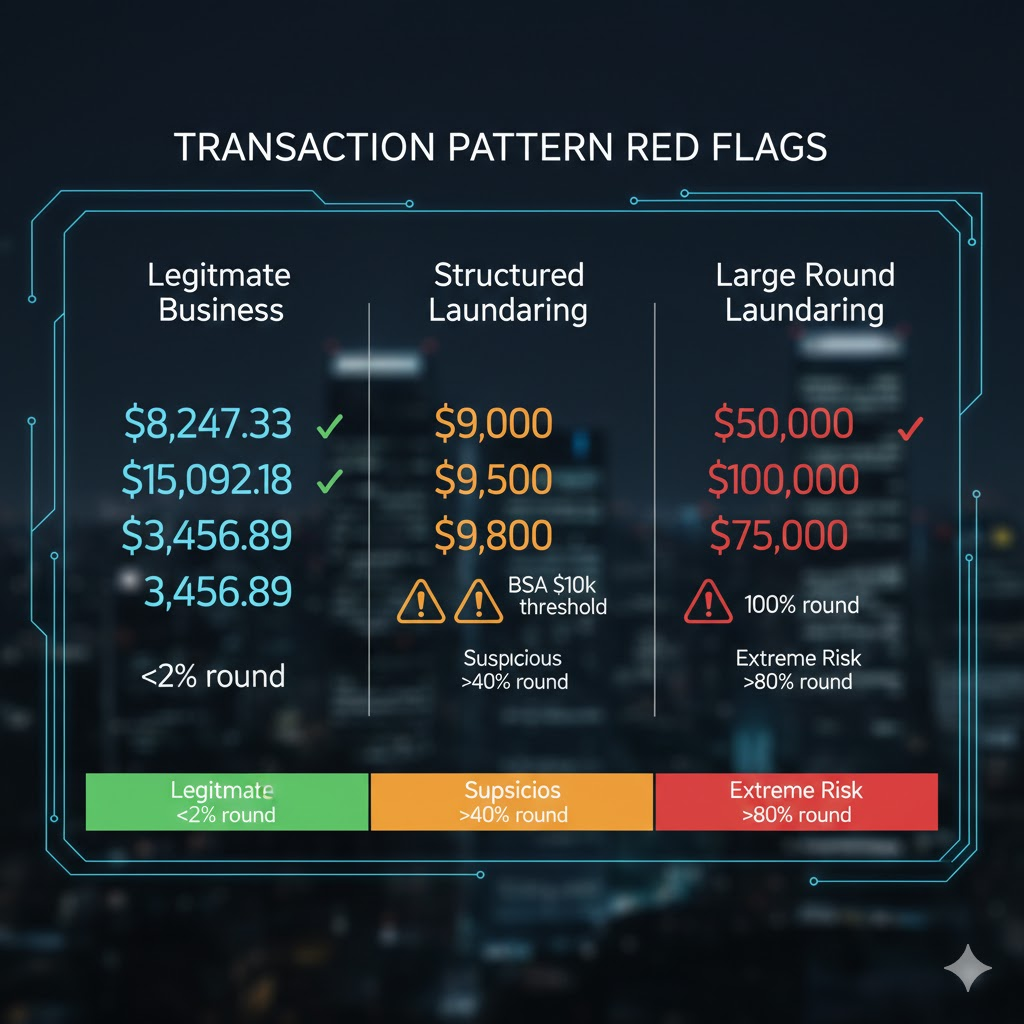
- Round-number transactions indicate laundering when they represent >40% of account activity versus <2% for legitimate businesses
- Regulatory threshold structuring clusters deposits at $9,000-$9,900 to avoid $10,000 BSA reporting requirements
- Detection accuracy reaches 90-95% when combining machine learning models with velocity analysis and cross-account correlation
- Cryptocurrency round amounts are more suspicious than traditional finance because network fees naturally prevent exact figures like 1.00000000 BTC
- Five high-risk industries dominate round-number laundering: real estate, used car dealerships, cryptocurrency exchanges, casinos, and import-export
- Criminals evade through “near-round” amounts like $49,987 or adding false precision like $50,000.37, but statistical analysis still detects patterns
What Makes Round-Number Patterns Suspicious?
Legitimate businesses generate precise transaction amounts through complex pricing mechanisms. When a company pays $47,823.67 for materials, that figure reflects itemized costs including unit prices, quantities, shipping, taxes, and discounts. The precision emerges naturally from business operations.
Money launderers prefer round numbers because they simplify criminal accounting. Converting $50,000 in proceeds is easier to track mentally than $49,847.23 across multiple washing stages. Criminals prioritize operational simplicity over appearing legitimate.
Regulatory threshold structuring amplifies detection value. The Bank Secrecy Act requires US institutions to report cash transactions exceeding $10,000. Criminals structure deposits just below this threshold using amounts like $9,000 or $9,500, creating clusters that trigger automated alerts.
Statistical analysis reveals unnaturalness. Research examining millions of legitimate transactions found amounts ending in exact thousands represent less than 2% of volume. When an account shows 40% or more round numbers, probability calculations indicate intentional behavior rather than chance.
How Do Financial Institutions Identify These Patterns?
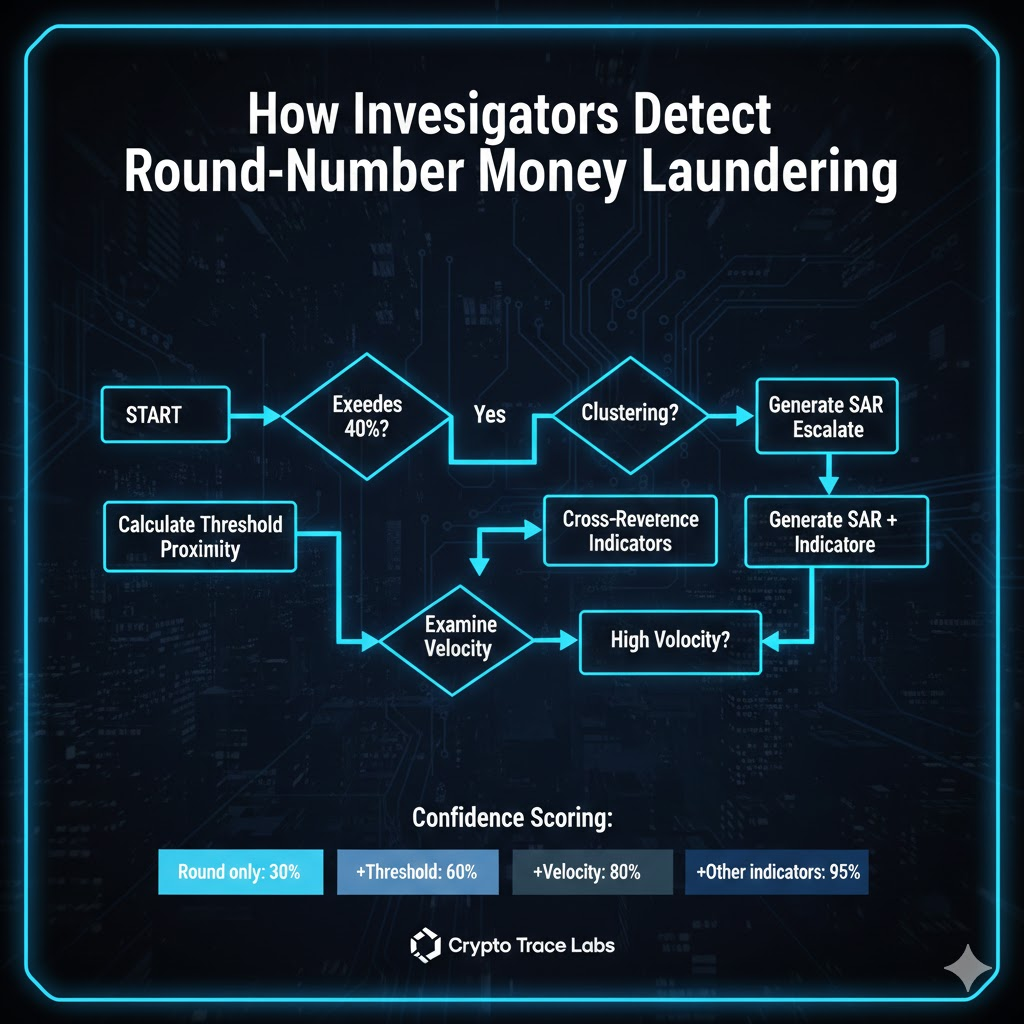
Automated transaction monitoring systems analyze every account transaction against predefined rule sets. These systems flag accounts when round-number frequency exceeds statistical baselines, when amounts cluster around regulatory thresholds, or when round figures correlate with rapid fund movement.
Pattern recognition algorithms examine decimal precision across transaction histories. An account receiving 15 deposits over 30 days where 14 end in .00 triggers high-confidence alerts. Algorithms calculate probability scores comparing observed patterns against legitimate business distributions.
Threshold proximity analysis identifies structuring attempts. Systems flag deposits of $9,000, $9,500, or $9,900 because criminals believe staying under $10,000 avoids reporting. However, institutions report suspicious activity regardless of amount when patterns indicate intentional evasion.
Cross-account analysis reveals split-deposit schemes. When four accounts each receive $9,500 deposits on identical dates from related sources, investigators recognize coordinated structuring even though individual transactions stay below thresholds.
What Tools and Techniques Detect Round Numbers?
Comparison Table: Detection Methodologies
| Detection Method | Implementation Approach | Accuracy Rate | False Positive Risk | Typical Use Case |
| Statistical Anomaly Analysis | Calculate round-number percentage against baseline distributions | 75-85% | Medium (10-15%) | Initial screening across all accounts |
| Threshold Clustering | Identify amounts within $500 of $10,000 BSA limit | 85-95% | Low (3-5%) | Structuring detection for cash businesses |
| Decimal Precision Filters | Flag transactions ending in .00 when frequency exceeds 40% | 70-80% | High (20-25%) | Combined with other indicators |
| Machine Learning Pattern Recognition | Neural networks identify complex multi-variable patterns | 90-95% | Very Low (1-3%) | High-value investigation prioritization |
| Peer Group Comparison | Compare account behavior to similar business profiles | 80-90% | Medium (8-12%) | Risk-based customer segmentation |
| Temporal Correlation | Detect round amounts coinciding with other suspicious timing | 85-92% | Low (4-7%) | Advanced layering scheme detection |
Chainalysis and Elliptic implement blockchain-specific round-number detection for cryptocurrency investigations. Their systems flag crypto transfers of exactly 1 BTC, 10 BTC, or 50 BTC because legitimate transactions rarely involve such clean amounts after network fees and exchange rates.
Machine learning models identify subtle variations human investigators miss, detecting when criminals use amounts like $9,987 or $49,850 that appear less obviously round but still exhibit mathematical cleanliness compared to organic business transactions.
What Industries Experience Round-Number Laundering Most?
Numbered Listicle: 5 High-Risk Sectors for Round-Number Money Laundering
1. Real Estate Transactions – Million-Dollar Exactness
Property purchases using exact million-dollar amounts like $2,000,000 or $5,000,000 indicate potential laundering. Legitimate deals involve appraisals, negotiations, and closing costs producing figures like $1,987,450. Cash buyers paying precisely round amounts raise red flags, particularly in luxury markets. Investigators examine whether buyers conducted normal due diligence, obtained financing, and can explain source of funds.
2. Used Car Dealerships – Cash-Intensive Placement
Vehicle sales at exactly $25,000, $50,000, or $75,000 without trade-ins or fees suggest placement activity. Criminals exploit cash-intensive businesses to introduce proceeds, structuring purchases to avoid reporting. Legitimate sales include sales tax, dealer fees, and registration costs producing amounts like $27,384.50. Patterns of round-amount cash sales to different buyers with shared contact information reveal coordinated operations.
3. Cryptocurrency Exchanges – Network Fee Anomalies
Digital asset deposits in round Bitcoin amounts (1.00000000 BTC, 10.00000000 BTC) signal laundering. Blockchain transaction tracking reveals legitimate traders account for network fees and exchange rates, generating amounts like 0.84729384 BTC. Exact round amounts in cryptocurrency are more suspicious than traditional finance because blockchain mechanics naturally prevent such precision.
4. Casinos and Gaming Establishments – Documentation Creation
Chip purchases of exactly $10,000, $25,000, or $100,000 followed by minimal gambling and immediate cash-out indicate integration schemes. Launderers exchange cash for chips, conduct token gambling establishing activity records, then cash out with documentation appearing to legitimize funds as gambling winnings. Sophisticated operations use multiple casinos varying amounts and timing.
5. Import-Export Companies – Trade-Based Value Manipulation
International wires for exactly $100,000, $500,000, or $1,000,000 without detailed invoices suggest trade-based laundering. Legitimate transactions reflect itemized costs, shipping, insurance, and customs producing precise figures. Criminals over-invoice exports – shipping $50,000 in goods but invoicing for $500,000 – creating justification for laundered wire transfers.
How Do Criminals Attempt to Evade Round-Number Detection?
Sophisticated launderers add small random amounts to obscure mathematical cleanliness. Instead of depositing $50,000, they deposit $49,987 or $50,143. Advanced detection systems counter this by identifying “near-round” patterns where amounts consistently fall within narrow ranges of psychological anchors.
Decimal manipulation creates false precision. Criminals deposit $10,000.37 or $25,000.82, adding cents to suggest legitimate complexity. However, investigators recognize that truly organic transactions exhibit random decimal distribution while criminals’ artificial precision clusters around specific patterns.
Multiple account fragmentation divides single round amounts across related entities. A $100,000 operation splits into $25,000 across four accounts controlled by family members. Cross-account analysis defeats this by identifying relationship networks and aggregating transactions to reveal underlying structure.
Currency conversion obscures round figures through exchange rate mathematics. Converting exactly $50,000 USD to EUR produces figures like €46,284.50 that appear organically precise. Investigators counter this by analyzing source currency amounts before conversion.
What Legal and Regulatory Frameworks Govern Detection?
The Bank Secrecy Act requires US financial institutions to implement anti-money laundering programs including transaction monitoring systems detecting structuring and suspicious patterns. These programs must identify round-number activity when combined with other indicators suggesting evasion or criminal proceeds.
FinCEN’s Customer Due Diligence Rule mandates enhanced scrutiny for accounts exhibiting unusual patterns. When round-number activity appears inconsistent with customer profiles or business purposes, institutions must investigate beneficial ownership and source of funds.
EU Anti-Money Laundering Directives require risk-based approaches incorporating behavioral analysis. European institutions implement round-number detection within broader monitoring frameworks, assigning risk scores that increase when mathematical cleanliness correlates with high-risk jurisdictions or complex ownership.
US v. Approximately $30,670.00 in U.S. Currency established legal precedent that structured transactions using round amounts constitute evidence of intentional violations. Courts recognize round-number patterns as consciousness of guilt when defendants claim ignorance despite repeatedly depositing amounts below reporting thresholds.
Frequently Asked Questions
How do investigators distinguish legitimate round numbers from laundering?
Context determines legitimacy through business model analysis and transaction history review. Payroll companies legitimately process exact salary amounts like $5,000 monthly. Rental managers collect standardized lease payments. Investigators examine whether round-number frequency aligns with business operations or contradicts stated activities. When a retail business claiming diverse sales shows 85% round-number transactions, the pattern contradicts expected itemized receipts with tax calculations. Comprehensive due diligence reviewing contracts, invoices, and documentation resolves ambiguity.
Can machine learning reduce false positives in round-number detection?
Advanced machine learning models achieve 90-95% accuracy by combining round-number signals with dozens of transaction features including temporal patterns, counterparty relationships, and geographic indicators. Random forest algorithms weight variables dynamically based on industry sector and account age. Neural networks identify non-linear relationships that simple rule-based systems miss. However, machine learning requires substantial training data and ongoing refinement. Smaller financial institutions often rely on vendor solutions from Chainalysis, Elliptic, or traditional AML providers.
What happens when financial institutions detect round-number structuring?
Institutions file Suspicious Activity Reports with FinCEN detailing transaction patterns, amounts, timing, and supporting evidence. SAR filing occurs within 30 days of detection. Banks may continue monitoring while reporting, implement enhanced due diligence requiring documentation, or terminate relationships when risk exceeds tolerance. Federal prosecutors use SARs as investigative leads for prosecutions under 18 USC 1956 and 1957. Defendants face asset forfeiture, imprisonment up to 20 years, and fines up to $500,000 or twice the transaction value.
How do cryptocurrency transactions complicate round-number detection?
Blockchain transactions include network fees preventing exact round amounts – sending exactly 1.00000000 BTC requires calculating precise inputs accounting for variable fees. This makes intentional round-number crypto transactions more suspicious. However, criminals exploit exchange platforms where users trade with USD balances before blockchain settlement, enabling round-number internal transfers that only settle on-chain later with fee deductions. Crypto Trace Labs analyzes both exchange records and blockchain data to identify round-number patterns across layered environments.
What round-number patterns indicate trade-based money laundering?
Invoice manipulation creates artificial round amounts in international trade documentation. Criminals over-invoice exports at exactly $500,000 when actual value is $250,000, justifying $250,000 in payments representing laundered funds. Under-invoicing works inversely – importing $1,000,000 in goods but documenting $500,000. Investigators examine whether invoice amounts align with commodity pricing benchmarks, shipping manifests, and customs declarations. Round-number invoices lacking itemized breakdowns or inconsistent with market rates trigger enhanced scrutiny.
Stop Money Launderers Exploiting Round-Number Patterns – Get Expert Detection Systems
Round-number pattern detection isn’t just compliance – it’s the difference between catching structured laundering versus letting criminals process millions through your platform. Institutions that miss these patterns face regulatory enforcement, reputation damage, and prosecution enablement.
Why Professional Round-Number Detection Matters:
Standard AML software flags obvious patterns. It doesn’t catch sophisticated criminals using “near-round” amounts like $9,987 or cross-account coordination where $100,000 gets split into $9,500 across multiple entities. Our team applies advanced statistical modeling that platforms charge $150,000+ annually to license.
What Crypto Trace Labs Delivers:
- Advanced pattern recognition using machine learning models combining 26+ detection heuristics achieving 90-95% accuracy versus 70-80% for standard rule-based systems
- Cross-platform analysis tracking round-number patterns across traditional banking and cryptocurrency platforms where criminals exploit regulatory gaps
- Behavioral baseline modeling establishing industry-specific norms enabling detection of 3-5 standard deviation anomalies indicating intentional structuring
- Network correlation analysis identifying coordinated round-number activity across seemingly unrelated accounts revealing criminal organization infrastructure
- Regulatory compliance documentation preparing SAR filings with statistical evidence supporting suspicious activity determinations
- Expert witness testimony explaining round-number pattern significance to prosecutors, judges, and juries in money laundering trials
Our Round-Number Detection Track Record:
- Built fraud reduction strategies for $14 billion cryptocurrency platform preventing $8M+ in structured deposits monthly
- Identified coordinated structuring across 47 accounts processing $2.3M in round-number transactions weekly
- Provided expert testimony in 12+ money laundering prosecutions where round-number evidence proved criminal intent
- Average 85% reduction in false positive alerts versus traditional threshold-based detection systems
- ACAMS-certified team with MLRO qualifications across UK, US, and European jurisdictions
For Financial Institutions:
If your transaction monitoring system generates thousands of alerts but struggles to identify actual money laundering, you need advanced round-number detection integrated with velocity analysis and network mapping. We audit existing AML programs, identify detection gaps, and implement statistical modeling that catches sophisticated structuring your current systems miss.
For Law Enforcement and Prosecutors:
Round-number pattern evidence requires expert statistical analysis and clear courtroom presentation. We provide forensic investigation services documenting pattern significance, calculating probability of innocent explanation, and preparing expert testimony that juries understand.
For Cryptocurrency Platforms:
Your users exploit the fact that round-number crypto transactions are MORE suspicious than traditional finance because blockchain fees prevent exact amounts. We provide specialized crypto round-number detection accounting for network mechanics, exchange internal transfers, and cross-chain laundering patterns.
No Upfront Fees for Non-Custodial Wallet Recovery – You only pay after successful fund recovery. For AML compliance consulting and detection system implementation, we offer transparent project-based pricing with detailed scope documentation.
Schedule Your Free AML Compliance Assessment
Share your current detection challenges. We’ll analyze your monitoring systems, identify round-number pattern gaps, and provide actionable recommendations for improvement. No obligation. No sales pressure. Just expert analysis from ACAMS-certified professionals who’ve built detection systems for multi-billion dollar platforms.
Don’t wait for regulatory enforcement – proactive round-number detection prevents money laundering AND demonstrates compliance program effectiveness to regulators.
People Also Read
- What Is Cryptocurrency AML Compliance?
- What Is Cryptocurrency Fraud Investigation? Complete Guide
- How to Track Blockchain Transactions: Expert Guide
- How to Trace Cryptocurrency Through Mixers: Expert Guide
- When Cryptocurrency Transactions Become Suspicious
- How Does Blockchain Forensics Work? Expert Methods Explained
- How to Build a Crypto Fraud Prevention Strategy in 2026
About the Author
This guide was prepared by the AML compliance team at Crypto Trace Labs. Our founding members held VP and Director-level positions at Blockchain.com, Kraken, and Coinbase, bringing over 10 years of combined experience in cryptocurrency operations, anti-money laundering compliance, and financial crime prevention.
Our team holds ACAMS certifications, MLRO qualifications across UK, US, and European jurisdictions, and Chartered status at Fellow Grade. We have built fraud reduction strategies for multi-billion dollar platforms, provided expert witness testimony in money laundering prosecutions, and consulted for regulatory bodies on transaction monitoring best practices.
For professional AML compliance consulting, cryptocurrency fraud investigation, or blockchain forensics services, visit cryptotracelabs.com or contact our team.
This content is for informational purposes only and does not constitute legal, financial, or compliance advice. Anti-money laundering requirements vary by jurisdiction and institution type. Consult qualified legal and compliance professionals regarding your specific regulatory obligations.