

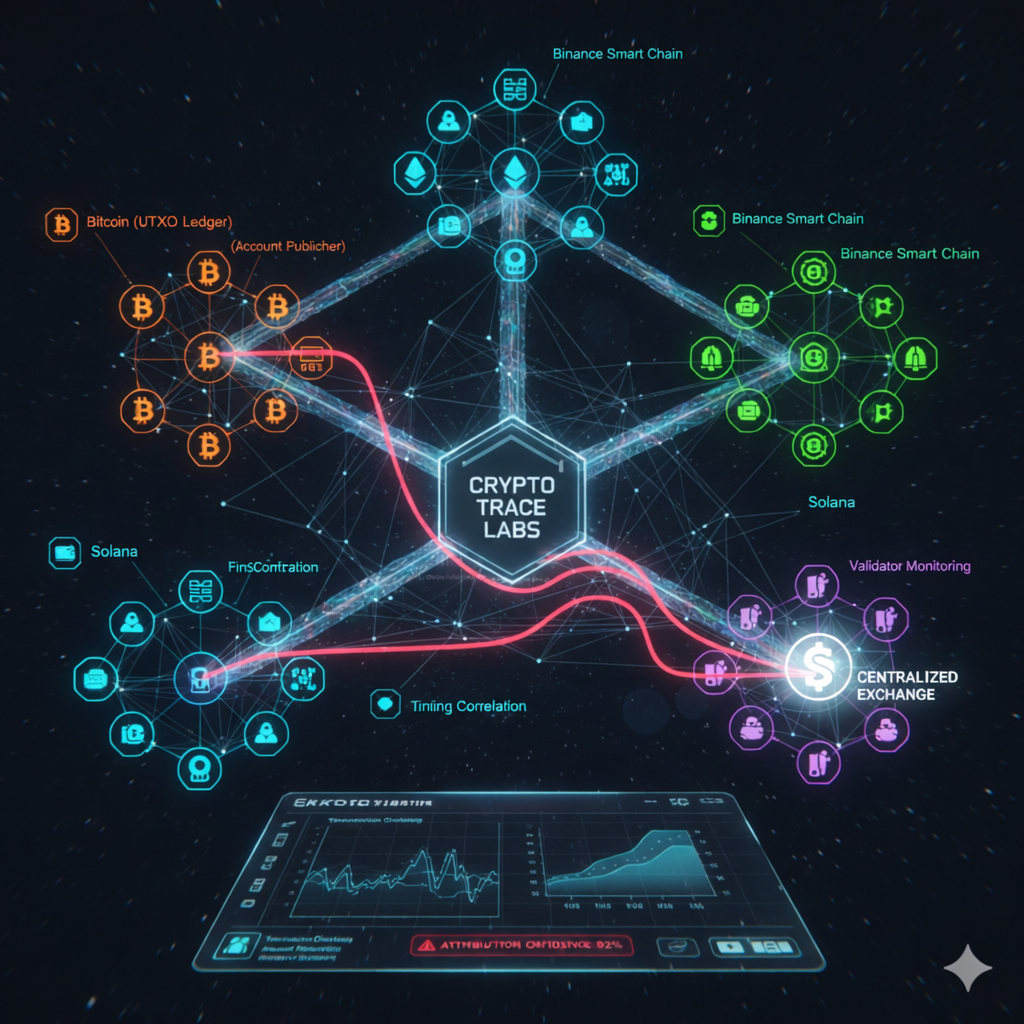
Decentralized exchanges create permanent on-chain records of all swaps, liquidity additions, and withdrawals through smart contract events that investigators can trace despite the absence of KYC requirements. Professional forensic teams track funds through DEXs by analyzing liquidity pool interactions, multi-hop swap patterns, and contract event logs using the same on-chain analysis techniques that power broader blockchain forensics investigations.
At Crypto Trace Labs, our team – featuring VP and Director-level executives from Blockchain.com, Kraken, and Coinbase – has traced illicit funds through decentralized exchanges in hundreds of cryptocurrency fraud investigations using methods developed through a decade of exchange-level operational experience. This guide draws on that knowledge to explain what law enforcement, compliance teams, and investigation professionals need to understand about DEX forensics.
What Makes DEX Tracing Different from Exchange Tracking?
Centralized exchanges operate as black boxes where internal transactions happen off-chain through database updates that blockchain analysts cannot see. Investigators must request transaction logs directly from the exchange through legal process.
Decentralized exchanges work fundamentally differently. Every swap executes through smart contracts that emit events recorded permanently on the blockchain. When criminals swap stolen Ethereum for DAI on Uniswap, the transaction appears on-chain with complete details – token amounts, wallet addresses, liquidity pool used, and timestamp. This creates forensic opportunities impossible with centralized platforms.
However, DEXs present unique challenges for cryptocurrency AML compliance teams. No KYC requirements mean wallet addresses have no attached identities. The pseudonymous nature forces investigators to rely purely on blockchain analysis and behavioral patterns rather than identity verification records.
Professional investigators exploit this transparency paradox. While DEXs lack identity data, they provide complete transaction visibility that reveals patterns criminals cannot hide. Multi-hop swaps through multiple liquidity pools leave clear trails. Eventual conversion back to centralized exchanges creates attribution opportunities.
How Do Different Types of DEXs Work?
DEX architectures determine forensic tracing difficulty. Understanding these technical differences helps investigators predict criminal behavior and identify tracing opportunities.
DEX Architecture Comparison:
| DEX Type | Representative Platforms | Trading Mechanism | Liquidity Source | Forensic Traceability | Criminal Appeal |
| AMM (Automated Market Maker) | Uniswap, SushiSwap, PancakeSwap | Algorithmic pricing through liquidity pools | Liquidity providers deposit token pairs | High – all swaps emit clear on-chain events | Very High – largest volumes, easy to use |
| Order Book DEX | dYdX, Loopring | Matched buy/sell orders, some off-chain matching | Traders provide liquidity through limit orders | Medium – some order matching happens off-chain | Medium – more complex, lower volumes |
| DEX Aggregators | 1inch, Matcha, Paraswap | Route swaps across multiple DEXs for best price | Pulls liquidity from other DEXs | Low – multi-hop routing obscures patterns | High – better rates attract sophisticated actors |
| Cross-Chain DEX | THORChain, Symbiosis | Swap tokens across different blockchains | Validator nodes provide cross-chain liquidity | Very Low – spans multiple blockchains | Very High – natural obfuscation from chain hops |
Uniswap processed over $1 trillion in trading volume during 2025 alone, making AMM-style DEXs the primary target for forensic investigations. The automated market maker model creates predictable patterns – criminals swap Token A for Token B at algorithmically determined prices based on liquidity pool ratios. These swaps emit PoolSwap events containing sender address, recipient address, token amounts, and pool contract address.
DEX aggregators complicate tracing by routing single trades through multiple platforms. A criminal might attempt to swap 100 ETH for USDC, but 1inch splits this across Uniswap (40 ETH), Curve (35 ETH), and Balancer (25 ETH) to minimize price impact. Investigators must reconstruct the complete swap path by following the routing contract’s interactions with each underlying DEX.
Cross-chain DEXs present the most significant forensic challenges. THORChain enables direct Bitcoin-to-Ethereum swaps without wrapped tokens or bridges. Funds leave Bitcoin blockchain, validators facilitate the swap off-chain, and equivalent value appears on Ethereum. This creates attribution gaps similar to those found in privacy coin conversions.
What On-Chain Evidence Do DEX Swaps Create?
Every DEX interaction generates blockchain evidence that professional investigators systematically analyze.
DEX Forensic Evidence Types:
- Swap Events – Smart contracts emit events showing exact token amounts exchanged, participating wallet addresses, liquidity pool used, and gas fees paid. These events cannot be deleted or hidden, creating permanent forensic records.
- Liquidity Pool Modifications – AddLiquidity events reveal wallet addresses, token amounts deposited, and LP tokens received. Tracking these LP tokens exposes the operator’s broader wallet network.
- Contract Interactions – Transaction receipts show which specific DEX smart contracts the criminal interacted with, revealing technical sophistication level and creating behavioral fingerprints.
- Token Approvals – Before swapping, users must approve DEX contracts to spend their tokens. These approval transactions occur separately and reveal which DEXs the wallet plans to use before actual swaps happen.
- Multi-Hop Routing – DEX aggregators create complex routing paths visible through internal transactions. Following these paths reveals all liquidity pools that touched the illicit funds.
Crypto Trace Labs uses specialized blockchain indexing that captures all contract events in real-time. Our executive-level relationships at major centralized exchanges allow rapid tracking when criminals convert DEX-acquired tokens back to fiat currency.
How Do Investigators Detect Wash Trading on DEXs?
Wash trading on decentralized exchanges generates artificial volume to inflate token popularity or manipulate prices. Chainalysis identified approximately $2.57 billion in suspected wash trading across three blockchains in 2024. Forensic detection relies on identifying patterns that legitimate traders would never create.
Wash Trading Detection Techniques:
| Technique | Detection Method | Effectiveness | False Positive Rate | Primary Use Case |
| Address Clustering | Identify wallets funded by the same source executing opposing trades | High – catches amateur wash traders | Medium – some legitimate arbitrage looks similar | Small-scale pump and dump schemes |
| Timing Analysis | Flag trades occurring within seconds between related addresses | Very High – time correlation is strong signal | Low – legitimate trades rarely have this pattern | Automated bot-based manipulation |
| Circular Fund Flows | Track tokens moving in loops between addresses | High – circular patterns are suspicious | Low – few legitimate reasons for circular flows | Complex multi-wallet wash trading |
| Liquidity Pool Manipulation | Detect rapid liquidity additions before trades followed by immediate removal | Very High – classic pump setup | Very Low – legitimate LPs don’t behave this way | Rug pulls and pump-and-dump schemes |
| Statistical Anomaly Detection | Machine learning models flagging trading patterns inconsistent with market behavior | Medium – requires large datasets | Medium – market volatility creates noise | Large-scale organized manipulation |
The SEC charged four market makers in October 2024 for generating artificial token trading volume through coordinated wash trading. The investigation revealed 18 individuals operating trading bots that created fake volume. Blockchain analysis exposed the scheme through wallet clustering, bot-like timing patterns, and circular fund flows.
Chainalysis reported that approximately 94 percent of suspected pump-and-dump schemes on DEXs are rugged by the address that created the liquidity pool. Professional investigations combining fraud prevention strategies with on-chain pattern detection can attribute entire operations to single criminal enterprises.
What Real-World DEX Money Laundering Cases Exist?
The March 2025 OKX DEX incident demonstrated how criminals exploit decentralized exchanges for large-scale money laundering. North Korea’s Lazarus Group moved approximately $100 million through OKX’s decentralized exchange following the Bybit hack, with roughly 8 percent of stolen funds flowing through OKX’s DEX aggregator.
Investigators tracked the operation by analyzing OKX Web3 proxy contracts, which enabled transactions with blockchain services anonymously. The laundering process followed a predictable pattern – stolen cryptocurrency was swapped through multiple DEX pools to break traceability, routed across different blockchains, then converted to more liquid tokens before attempting fiat conversion.
European regulators investigated and OKX suspended its DEX services on March 18, 2025. The platform subsequently implemented real-time abuse detection monitoring on-chain behaviors across hundreds of blockchains, automatic IP banning for suspicious activity, and real-time blacklist checking.
Elliptic research shows that DEXs without KYC requirements accounted for 55 percent of illicit DeFi trade volume in 2024. Criminals prefer these platforms specifically because they lack identity verification. However, the eventual need to convert to fiat currency creates inevitable touchpoints with regulated exchanges where identity verification exposes the operation.
How Do Criminals Use Liquidity Pools for Laundering?
Liquidity pool manipulation represents an advanced money laundering technique that exploits DEX mechanics. Criminals create custom liquidity pools pairing illicit tokens with legitimate cryptocurrencies, then execute swaps that appear to be normal trading activity.
The process works through several steps. Criminals create a new token or use existing illicit funds, add liquidity by depositing both the illicit token and a legitimate cryptocurrency like USDC into a new pool, execute swaps between controlled addresses to generate trading volume, then withdraw liquidity in the legitimate cryptocurrency.
This technique provides several advantages. The swaps generate transaction fees that go to liquidity providers (themselves), creating an appearance of legitimate trading income. The liquidity pool enables price manipulation through low-liquidity trades. The activity creates numerous on-chain transactions that can obscure the original illicit source.
Forensic detection focuses on liquidity pool lifecycle analysis identifying pools where the liquidity provider also represents the primary trader, rapid creation and removal patterns, and minimal external trading volume. Approximately 94 percent of DEX pools involved in suspected pump-and-dump schemes are rugged by the address that created the pool.
What Challenges Do Investigators Face with DEXs?
Despite blockchain transparency, decentralized exchange investigations present significant operational challenges requiring specialized expertise.
DEX Investigation Challenges:
- No KYC Data – DEXs lack the identity verification records that centralized exchanges provide, forcing investigators to rely purely on blockchain analysis and behavioral patterns. Attribution requires connecting DEX wallet addresses to real-world identities through centralized exchange deposits or device forensics.
- Multi-Chain Complexity – Criminals frequently use cross-chain DEXs to move funds between blockchains, creating attribution gaps. Investigators must coordinate analysis across Ethereum, Binance Smart Chain, Polygon, Arbitrum, and dozens of other networks simultaneously.
- Liquidity Pool Obscuration – Complex liquidity pools with dozens of token pairs create routing paths that obscure fund flows. A single swap might touch five different pools through internal routing, requiring complete path reconstruction from transaction logs.
- Smart Contract Complexity – DEX swaps generate numerous internal transactions and contract events that standard blockchain explorers often miss. Professional tools must decode contract events and reconstruct the economic substance behind complex technical operations.
- High Transaction Volume – Major DEXs process millions of swaps daily, creating massive datasets that require specialized indexing infrastructure. Identifying suspicious transaction patterns within this volume demands automated detection systems.
- New DEX Proliferation – New decentralized exchanges launch constantly across emerging blockchains, each with slightly different smart contract implementations. Investigators must continuously update analysis tools to support new DEX architectures.
Crypto Trace Labs maintains proprietary DEX contract decoders for over 200 different protocols, enabling consistent analysis across platforms that standard tools cannot interpret. The fundamental challenge is that DEX transparency creates massive amounts of data without providing the identity connections that traditional financial investigations rely on.
How Do DEX Aggregators Complicate Investigations?
DEX aggregators like 1inch, Matcha, and Paraswap optimize swap routing by splitting trades across multiple decentralized exchanges simultaneously. A criminal swapping 50 ETH for USDC might have that routed through Uniswap (20 ETH), Curve (18 ETH), Balancer (7 ETH), and SushiSwap (5 ETH) to achieve the best price.
This routing creates forensic complexity because a single transaction spawns dozens of internal transactions across multiple DEX contracts. The aggregator’s routing contract makes sequential calls to different DEXs, each generating its own swap events and state changes.
Criminals exploit aggregators because the multi-platform routing naturally obscures fund flows similar to cryptocurrency mixers. Instead of a clean point-to-point swap visible on one DEX, the funds fragment across platforms making pattern recognition harder.
Professional analysis requires specialized tools that understand aggregator routing logic. Investigators decode the aggregator’s transaction calldata to extract intended swap parameters, then follow all resulting DEX interactions to verify actual execution. The conversion point remains the critical vulnerability – aggregators may obscure the swap path, but criminals must eventually convert to fiat currency through regulated exchanges.
Frequently Asked Questions About DEX Tracing
Can investigators actually trace transactions through DEXs despite no KYC?
Yes. DEXs create permanent blockchain records of every swap through smart contract events that cannot be hidden or deleted. While DEXs lack KYC data linking wallets to identities, professional investigators trace fund flows by analyzing on-chain patterns, following conversion touchpoints to regulated exchanges, and combining blockchain evidence with traditional investigative methods. The OKX case demonstrated successful tracing of $100 million through DEX swaps by analyzing proxy contract interactions and routing patterns.
What makes wash trading detection on DEXs different from centralized exchanges?
DEX wash trading leaves more obvious on-chain evidence because every trade executes through public smart contracts. Investigators detect wash trading through address clustering (identifying related wallets), timing analysis (trades within seconds between connected addresses), and liquidity pool manipulation patterns. Chainalysis identified $2.57 billion in suspected DEX wash trading in 2024 using these techniques. Centralized exchanges can hide internal manipulation, while DEX manipulation must occur on-chain where forensic tools can observe it.
How do criminals use liquidity pools for money laundering?
Criminals create custom liquidity pools pairing illicit tokens with legitimate cryptocurrencies, then swap between controlled addresses to generate apparent trading volume. They withdraw liquidity in clean cryptocurrency, creating the appearance of legitimate trading profits. Detection focuses on pools where the liquidity provider also represents the primary trader, rapid lifecycle patterns (quick creation and removal), and minimal external trading suggesting the pool serves laundering rather than exchange purposes.
Why do DEX aggregators make tracking harder?
Aggregators split single swaps across multiple DEXs simultaneously, creating complex routing paths with dozens of internal transactions. A 50 ETH swap might fragment across Uniswap, Curve, Balancer, and SushiSwap, with each portion generating separate blockchain events. Investigators must reconstruct complete swap paths by analyzing aggregator routing contracts and following all resulting DEX interactions. However, criminals still must convert to fiat at regulated exchanges, creating attribution opportunities regardless of routing complexity.
Can cross-chain DEXs be traced between different blockchains?
Cross-chain DEX tracing presents significant challenges because assets leave one blockchain and appear on another without direct on-chain linkage. THORChain swaps between Bitcoin and Ethereum happen through validator nodes rather than atomic on-chain swaps. Investigators track these by analyzing timing correlations between blockchain exits and entries, monitoring validator pool addresses, and identifying repeated cross-chain patterns. The eventual fiat conversion remains the critical attribution point for professional investigations.
What tools do professional investigators use for DEX analysis?
Professional teams use Chainalysis Reactor for comprehensive DEX swap tracing, Elliptic Navigator for multi-asset tracking across 100+ cryptocurrencies, and specialized DEX contract decoders that interpret smart contract events. Real-time monitoring systems flag suspicious patterns within minutes. Crypto Trace Labs maintains proprietary decoders for over 200 DEX protocols, enabling analysis across platforms that standard tools cannot interpret. Graph visualization helps map complex multi-hop routing and liquidity pool interactions.
How long does it typically take to trace funds through DEXs?
Simple DEX swaps with clear patterns can be traced in hours using blockchain explorers and basic analysis tools. Complex investigations involving multi-hop aggregator routing, cross-chain swaps, and liquidity pool manipulation require days to weeks for comprehensive reconstruction. Real-time monitoring systems can flag suspicious DEX activity within minutes, but attributing wallet addresses to real-world identities through centralized exchange connections typically requires additional investigation time and legal process for exchange data requests.
What percentage of DEX volume comes from illicit activity?
Precise measurement is difficult, but Elliptic reported that DEXs without KYC requirements accounted for 55 percent of illicit DeFi trade volume in 2024. However, this represents a small fraction of total DEX volume. Chainalysis estimated suspected pump-and-dump schemes and wash trading at approximately $2.57 billion in 2024 across three blockchains. Most DEX volume comes from legitimate DeFi users, arbitrage traders, and liquidity providers. The concentration of illicit activity in non-KYC platforms demonstrates criminal preference for identity-free trading.
How do compliance teams monitor customer DEX interactions?
Compliance teams flag when customer deposits come from known DEX contract addresses or when customers withdraw to DEX wallets. Blockchain analytics platforms provide risk scoring based on DEX exposure and interaction patterns with high-risk protocols. Real-time transaction monitoring identifies customers executing large volumes through DEXs without clear legitimate business purposes. Enhanced due diligence procedures apply to customers with significant DEX activity, particularly when combined with other risk factors.
Conclusion
DEX tracking requires different methodologies than centralized exchange analysis, emphasizing on-chain pattern recognition over identity verification records. Professional investigations succeed by analyzing smart contract events, reconstructing multi-hop routing paths, detecting behavioral patterns across wallet clusters, and exploiting the inevitable conversion points where criminals must touch regulated platforms.
This guide was prepared by the team at Crypto Trace Labs, drawing on 10+ years of crypto and financial crime experience from executive roles at Blockchain.com, Kraken, and Coinbase. Our team holds ACAMS certifications, MLRO qualifications across UK, US, and Europe, and Chartered status at Fellow Grade. We offer no upfront charge for non-custodial wallet recoveries – you only pay after successful fund recovery.
Contact Crypto Trace Labs for professional DEX investigation, DeFi forensics consulting, or expert analysis of decentralized finance cases.
This content is for informational purposes only and does not constitute legal, financial, or compliance advice. Crypto asset recovery outcomes depend on specific circumstances, regulatory cooperation, and technical factors. Consult qualified professionals regarding your situation.