


Last Updated: March 2026
Exchange deposit addresses are cryptocurrency wallet addresses assigned by centralised exchanges to individual customers for depositing funds, and they exhibit highly distinctive on-chain transaction patterns that make them identifiable through blockchain analysis even without KYC data. Understanding how to identify exchange deposit addresses is fundamental to blockchain forensics because stolen or fraudulent funds that reach an exchange deposit address can be subject to legal freezing requests, law enforcement production orders, and direct recovery through the exchange’s compliance team. According to Chainalysis’s 2024 Crypto Crime Report, 72% of illicit cryptocurrency eventually passes through a centralised exchange – making deposit address identification the most consequential analytical step in most recovery investigations.
Crypto Trace Labs identifies exchange deposit addresses in blockchain forensic investigations, supporting asset freezing applications and law enforcement referrals across the UK, EU, and US. The team – ACAMS (Association of Certified Anti-Money Laundering Specialists) accredited, MLRO (Money Laundering Reporting Officer) qualified across three jurisdictions, and Chartered Fellow Grade at the CMI, with founding members from Blockchain.com, Kraken, and Coinbase – has direct operational experience of how major exchanges structure their deposit address architecture.
Key Takeaways
- Deposit addresses receive from one sender, send to one destination: A typical exchange deposit address receives multiple deposits from the assigned customer and sends all received funds to a small number of exchange hot wallet consolidation addresses – the fan-in, fan-out pattern is highly distinctive.
- Consolidation sweeps happen on a predictable schedule: Exchanges typically sweep deposit address balances to hot wallets in scheduled batches – 15-minute, hourly, or daily sweeps – creating a timing signature visible in block timestamps.
- Commercial attribution databases cover major exchanges: Chainalysis, Elliptic, and Crystal Intelligence maintain extensive databases of exchange deposit address ranges, covering Binance, Coinbase, Kraken, and hundreds of other exchanges.
- Address reuse distinguishes deposit addresses from personal wallets: According to TRM Labs‘s 2024 blockchain analytics methodology, personal wallets using best practices show minimal address reuse, while exchange deposit addresses typically receive many deposits to the same address.
- On-chain heuristics have a known false positive rate: Deposit address attribution based solely on heuristics without KYC confirmation has a false positive rate that must be disclosed in forensic reports – exchange confirmation remains the gold standard.
Why This Matters
Identifying where stolen crypto has been deposited at an exchange is the critical step between knowing funds were stolen and being able to take legal action to freeze them. An exchange deposit address identification – confirmed rather than merely probabilistic – enables an immediate law enforcement referral, a production order application for the depositing customer’s KYC records, and a freezing application preventing the customer from withdrawing the deposited funds. Without the ability to identify deposit addresses accurately, blockchain forensics can trace funds up to the point of exchange deposit but cannot produce the exchange attribution that gives legal proceedings their teeth. Every hour of delay between deposit and legal action increases the probability that the customer withdraws the funds before they can be frozen.
The Fan-In, Fan-Out Address Pattern
The fan-in, fan-out pattern is the most reliable on-chain heuristic for identifying exchange deposit addresses, and it reflects the operational architecture of how exchanges manage customer deposits.
In the fan-in phase, the deposit address receives funds from one or more sources associated with a specific customer – typically from the customer’s personal wallet, from a peer-to-peer transaction, or from another exchange. In the fan-out phase, the deposit address sends its accumulated balance to an internal exchange consolidation address, typically a hot wallet or an intermediate aggregation address, in a single sweep transaction. The deposit address itself typically holds a near-zero balance between sweeps.
The ratio of receiving transactions to sending transactions is characteristically high for deposit addresses – often 10:1 or higher, where 10 or more deposit receipts are swept out in a single consolidation transaction. Personal wallets show a much lower ratio, typically 1:1 to 3:1. When a forensic analyst identifies an address receiving funds from a theft and observes this high fan-in ratio with consolidation sweeps to a consistent set of destination addresses, exchange attribution is highly probable.
| Address Characteristic | Exchange Deposit Address | Personal Wallet |
|---|---|---|
| Receive-to-send ratio | High (10:1 or more) | Low (1:1 to 3:1) |
| Balance between transactions | Near-zero after each sweep | Varies |
| Destination address count | 1-3 consistent consolidation addresses | Many different recipients |
| Transaction timing | Batch sweeps on schedule | Variable |
| Address reuse | High (many deposits to same address) | Low (HD wallet generates new addresses) |
| Counterparty diversity | Many different senders | Few regular counterparties |
Consolidation Sweep Timing Signatures
Consolidation sweep timing signatures are the periodic patterns in block timestamps that reveal how an exchange manages its deposit address sweeping infrastructure.
Exchanges typically run automated sweep scripts on fixed schedules – every 15 minutes, every hour, or nightly – that collect all accumulated balances from deposit addresses above a minimum threshold and consolidate them into a smaller number of hot wallet addresses. This schedule creates a distinctive timing signature: outgoing transactions from suspected deposit addresses cluster at specific intervals rather than being randomly distributed throughout the day.
For Bitcoin, sweep transactions can be identified by their characteristic input count (many inputs from many deposit addresses aggregated into a single transaction) and their use of SegWit or Taproot transaction formats that major exchanges prefer for fee efficiency. For Ethereum, sweep transactions typically appear as ERC-20 token transfers or ETH transfers with gas prices set to match the exchange’s standard gas strategy, which often differs from the prevailing market rate at the time of the sweep.

Commercial Attribution Database Coverage
Commercial blockchain analytics platforms maintain proprietary databases of exchange deposit address ranges, and these databases are the most reliable source of exchange attribution for forensic purposes.
Chainalysis, Elliptic, and Crystal Intelligence collect exchange deposit address data through multiple methods: direct information sharing agreements with exchanges; analysis of on-chain patterns to identify deposit address ranges; monitoring of exchange promotional addresses publicly disclosed in marketing materials; and correlation with KYC-confirmed transactions. These databases cover thousands of exchanges and are updated continuously as exchanges add new deposit address ranges.
For major exchanges such as Binance, Coinbase, Kraken, and Blockchain.com, attribution coverage is extensive and reliable. For smaller or newer exchanges, coverage may be incomplete. Where commercial database attribution is available, it provides confirmed exchange attribution that can be cited directly in a forensic report. Where commercial attribution is not available, on-chain heuristic attribution must be disclosed as probabilistic with the heuristics and confidence level stated.
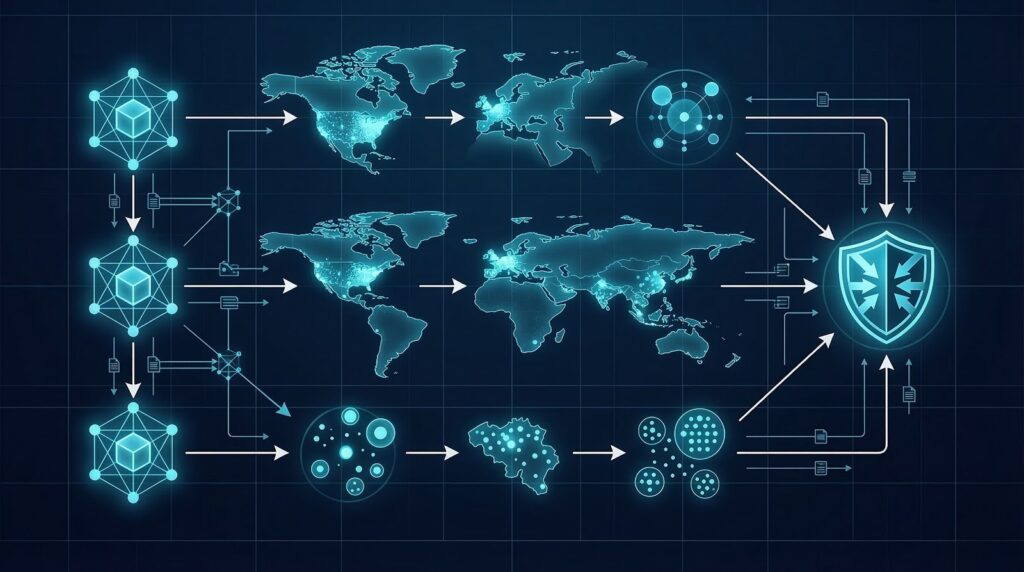
Deposit Address Identification Through Transaction Graph Analysis
Transaction graph analysis uses the network topology of address relationships to identify exchange deposit addresses in cases where commercial database coverage is incomplete.
The key graph signatures to look for are: a central aggregation node that receives from many leaf nodes and sends only to a small number of consistent successor nodes (characteristic of an exchange hot wallet receiving sweeps from deposit addresses); and a high-degree node with many incoming edges from diverse counterparties but very few outgoing edges (characteristic of a deposit address receiving from one customer and sweeping to one hot wallet). In Chainalysis Reactor or Maltego with blockchain data connectors, these signatures are visually distinctive once the analyst knows what to look for.
When commercial attribution does not identify an exchange, secondary heuristics include: the address’s appearance in public blockchain explorers with exchange labels applied by the community; the address’s appearance in law enforcement intelligence databases (accessible through appropriate channels); and direct query to exchanges through voluntary cooperation requests, where the address range pattern suggests a specific exchange without confirming attribution.
Frequently Asked Questions
How can I tell if a blockchain address belongs to an exchange?
Exchange deposit addresses show distinctive patterns: they receive from a small number of consistent senders, send accumulated balances to 1-3 consolidation addresses in periodic sweeps, maintain near-zero balances between sweeps, and show high address reuse. Commercial attribution databases from Chainalysis, Elliptic, and Crystal Intelligence directly label exchange addresses. For unattributed addresses, on-chain pattern analysis combined with commercial database lookup is the standard forensic approach.
What is the difference between a deposit address and an exchange hot wallet?
A deposit address is assigned to an individual customer for receiving their deposits – it typically has a small number of incoming transactions from that customer and sweeps its balance to an internal exchange address. A hot wallet is an internal exchange address that aggregates balances from hundreds or thousands of deposit addresses, holds operational liquidity, and processes customer withdrawals. Hot wallets receive from many deposit addresses and send to many different customer withdrawal destinations.
Can forensic analysis identify which customer made a specific exchange deposit?
Blockchain forensic analysis can identify the exchange that owns a deposit address, but identifying which specific customer made a deposit requires the exchange’s KYC records. The forensic trace establishes that funds went to Exchange X’s deposit address system. Identifying the depositing customer requires a production order or voluntary cooperation request to the exchange for their KYC records associated with that specific deposit address.
What happens after I identify that stolen funds went to an exchange deposit address?
Once a deposit address is attributed to a specific exchange, the next steps are to contact the exchange’s compliance team with a formal freeze request and forensic evidence; refer the matter to law enforcement for a production order requiring the exchange to disclose the depositing customer’s KYC records; and if the jurisdiction allows, apply for a civil freezing injunction preventing the exchange from releasing funds to the customer. Speed is critical – most recovery is achieved within 48-72 hours of the deposit before the customer withdraws.
How accurate are on-chain heuristics for exchange attribution?
For major exchanges with extensive commercial database coverage, confirmed attribution through Chainalysis, Elliptic, or Crystal Intelligence is typically reliable with very low false positive rates. Heuristic-only attribution (without commercial database confirmation) has a false positive rate that depends on the specific heuristics applied and the transaction type. For forensic reports, heuristic-only attribution must be disclosed as probabilistic with confidence levels stated. Courts treat confirmed attribution and probabilistic attribution as evidence of different weight.
Do exchanges cooperate with informal freeze requests without court orders?
Major exchanges – Binance, Coinbase, Kraken, and Blockchain.com – have compliance teams that respond to credible informal freeze requests with supporting forensic evidence. According to Elliptic’s 2024 exchange compliance survey, 67% of informal freeze requests with comprehensive forensic evidence are acted upon within 24 hours. However, informal freezes are at the exchange’s discretion and can be reversed. Court orders provide the legally binding and persistent freeze required for sustained recovery proceedings.
What is an exchange address cluster and how is it formed?
An exchange address cluster is a group of wallet addresses that blockchain analytics determines are controlled by the same exchange entity, identified through co-spend analysis, sweep destination patterns, and known address attribution. Commercial platforms maintain clusters that can contain millions of addresses for large exchanges. When a forensic trace reaches any address in the cluster, it is attributed to the exchange, regardless of which specific deposit address the funds entered through.
How long does exchange attribution remain valid after a transaction?
Exchange attribution data is point-in-time – an address attributed to Exchange X in March 2026 may have been attributed differently in 2024, or may be reallocated in the future if the exchange changes its address management. For forensic purposes, the attribution must be recorded with the date it was queried and the tool version used, as described in the chain of custody and tool disclosure requirements for court-ready evidence.
Executive Summary
Exchange deposit address identification is the most consequential step in most crypto asset recovery investigations because it is the point at which an untraceable blockchain trail becomes a legally actionable exchange account. The fan-in, fan-out transaction pattern, consolidation sweep timing signatures, and commercial attribution database coverage from Chainalysis, Elliptic, and Crystal Intelligence are the primary identification methods. Confirmed attribution enables immediate freeze requests to exchange compliance teams and production order applications for depositing customer KYC records. Speed between deposit identification and freeze request is the primary determinant of recovery success.
What Should You Do Next?
If you have traced stolen cryptocurrency to an exchange deposit address and need confirmed attribution, a freeze request, or litigation support, Crypto Trace Labs provides rapid exchange attribution analysis and direct exchange liaison for UK, EU, and US investigations.
The team at Crypto Trace Labs – ACAMS-accredited, MLRO-qualified across three jurisdictions, Chartered Fellow Grade at the CMI, with founding members from Blockchain.com, Kraken, and Coinbase who have executive-level contacts at major exchanges – has recovered 101 Bitcoin for clients in the last 12 months, the majority through timely exchange attribution and freeze requests. We offer no upfront charge for non-custodial wallet recoveries. Contact us to discuss your case.
People Also Read
- How Does Blockchain Forensics Work? Expert Methods Explained
- What Is On-Chain Analysis? Complete Guide to Blockchain Data
- On-Chain Heuristics: How Pattern Recognition Identifies Wallet Owners
- How Do Investigators Use Address Clustering to Link Crypto Wallets?
About the Author
Crypto Trace Labs is a specialist crypto asset recovery and blockchain forensics firm founded by VP and Director-level executives formerly of Blockchain.com, Kraken, and Coinbase. Our team holds ACAMS accreditations, MLRO qualifications across the UK, US, and EU, and Chartered Fellow Grade status at the CMI. With over 10 years of experience in financial crime investigation and court-recognized blockchain forensics expertise, we have recovered 101 Bitcoin for clients in the last 12 months and delivered record fraud reduction for a $14bn crypto exchange. We work with law enforcement agencies, regulated financial institutions, and private clients on crypto asset recovery, blockchain forensics, AML compliance, and expert witness testimony – globally. We offer no upfront charge for non-custodial wallet recoveries. Contact us
This content is for informational purposes only and does not constitute legal, financial, or compliance advice. Crypto asset recovery outcomes depend on specific circumstances, regulatory cooperation, and technical factors. Consult qualified professionals regarding your specific situation.