

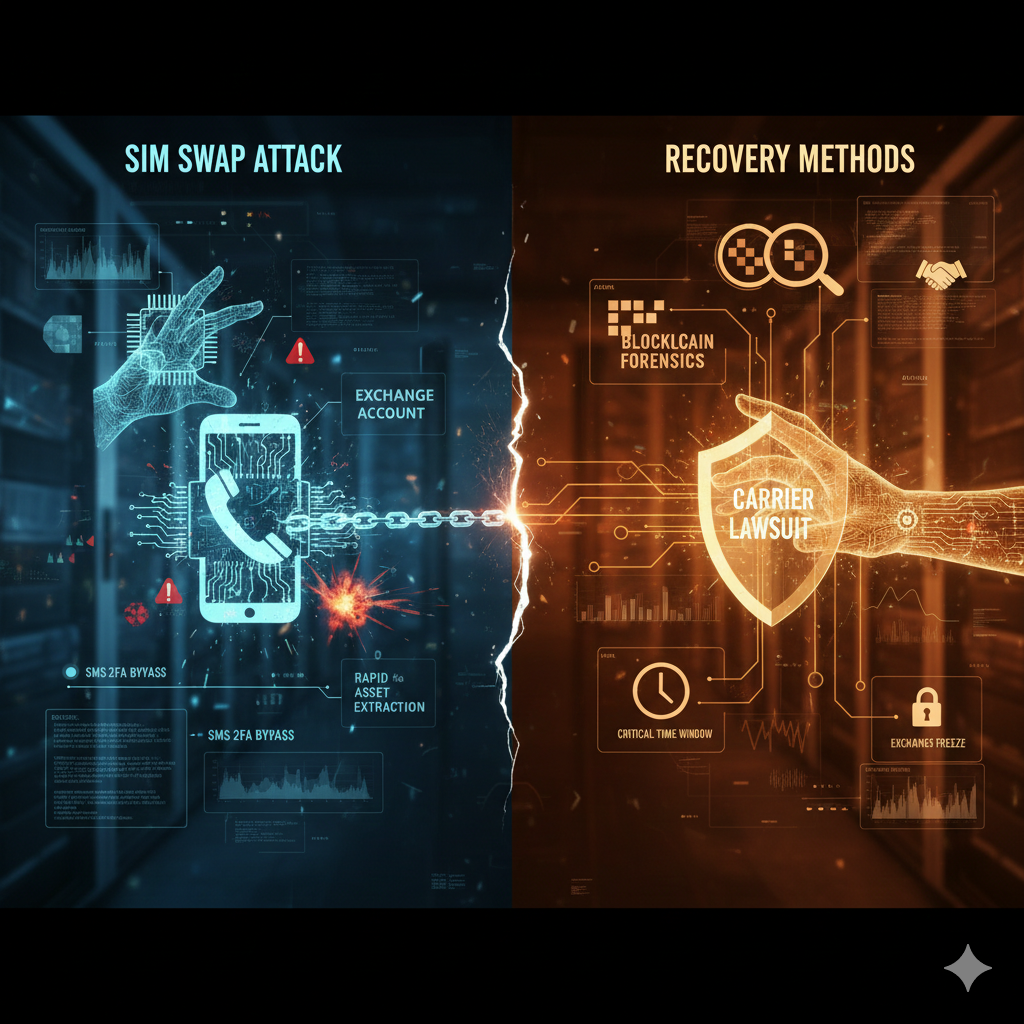
Recovering cryptocurrency stolen through a SIM swap attack offers multiple pathways unavailable in most crypto theft cases: carrier liability claims against negligent mobile providers, blockchain forensics to trace stolen funds, and exchange coordination to freeze assets before laundering completes. SIM swap attacks hijack your phone number by tricking or bribing carrier employees to transfer your number to an attacker-controlled SIM card, bypassing SMS-based two-factor authentication and enabling account takeovers across exchanges, wallets, and email. A March 2025 federal jury awarded $33 million to a victim who sued T-Mobile for negligence after losing cryptocurrency to a SIM swap, establishing precedent that carriers bear responsibility for inadequate security – a legal pathway that can compensate victims even when stolen crypto itself cannot be recovered.
At Crypto Trace Labs, our team of VP and Director-level executives from Blockchain.com, Kraken, and Coinbase has supported SIM swap victims with blockchain forensic analysis documenting theft patterns, transaction tracing identifying where funds moved, and expert reports supporting carrier liability litigation. This guide explains how SIM swap attacks work, what immediate steps protect remaining assets, how to pursue carrier liability claims, how forensic investigators trace stolen funds, and what realistic recovery outcomes victims can expect through both legal and blockchain-based approaches.
What Is a SIM Swap Attack and How Does It Steal Crypto?
A SIM swap attack occurs when criminals convince your mobile carrier to transfer your phone number to a SIM card they control. Once they have your number, they receive your calls and text messages – including the SMS verification codes that many cryptocurrency exchanges and email providers use for two-factor authentication. Within minutes, attackers can reset passwords, bypass security, and drain accounts.
The attack exploits a fundamental weakness in telecommunications security: carrier employees can transfer phone numbers between SIM cards, and social engineering or bribery can convince them to do so without proper verification. Despite years of warnings and high-profile thefts, carriers continue failing to implement adequate protections, leaving millions of cryptocurrency holders vulnerable.
How SIM Swap Crypto Theft Unfolds:
- Target Research – Attackers identify victims through social media, data breaches, or crypto community activity; they gather personal information needed to impersonate victims to carriers
- Carrier Social Engineering – Attackers call the carrier claiming to be the victim, using gathered personal data to pass security questions; alternatively, they bribe or coerce carrier employees directly
- Number Transfer – The carrier transfers the victim’s phone number to the attacker’s SIM card; the victim’s phone loses service while the attacker gains control
- Account Takeover – Attackers use the hijacked number to receive SMS verification codes, reset passwords on email accounts, and access cryptocurrency exchanges
- Rapid Asset Extraction – Once inside exchange accounts, attackers withdraw all available cryptocurrency to wallets they control, often within minutes of gaining access
- Immediate Laundering – Stolen funds are quickly moved through multiple wallets, converted to other assets, or routed through mixers to prevent recovery
The FBI reported $28.4 million in SIM swap-related losses in recent years, though actual losses are estimated far higher as many victims do not report. UK authorities documented a 1,055% increase in SIM swap attacks, reflecting the global scale of this threat. Individual attacks have stolen millions of dollars from single victims, with cryptocurrency holders specifically targeted due to the high-value, irreversible nature of crypto transactions.
The vulnerability persists because carriers prioritize customer convenience over security, making number transfers relatively easy to execute. Despite implementing some protections after major lawsuits, carriers continue experiencing breaches that enable SIM swap attacks.
What Are the Warning Signs of a SIM Swap in Progress?
Recognizing a SIM swap attack in progress can mean the difference between losing everything and protecting most of your assets. The attack creates detectable signals, and victims who respond within minutes can sometimes prevent or limit theft by contacting carriers and freezing accounts before attackers complete their takeover.
The most obvious warning sign is sudden loss of cellular service. If your phone unexpectedly shows “No Service” or “Emergency Calls Only” when you normally have coverage, a SIM swap may be underway. Attackers typically execute swaps during evenings, weekends, or holidays when victims are less likely to notice immediately and carrier support is harder to reach.
Warning Signs of Active SIM Swap Attack:
- Sudden Loss of Cell Service – Phone shows no signal in areas where you normally have coverage; calls and texts stop working while WiFi still functions
- Unable to Send or Receive SMS – Text messages fail to send or you stop receiving messages; SMS-based verifications stop arriving
- Unexpected Account Notifications – Email alerts about password changes, login attempts, or security modifications you did not initiate
- Account Lockouts – Unable to log into email, exchange accounts, or other services despite using correct credentials
- Carrier Notification of Changes – Emails or alerts from your carrier about account changes, new device activation, or plan modifications you did not request
- Unfamiliar Devices in Account Settings – New devices appearing in your Google, Apple, or exchange account security settings
- Social Media Compromise – Friends reporting strange messages from your accounts or posts you did not make
If you notice any of these signs, act immediately. Call your carrier from a different phone to verify your account status and freeze any unauthorized changes. Simultaneously attempt to secure your most valuable accounts, prioritizing cryptocurrency exchanges and email.
What Should You Do Immediately During a SIM Swap Attack?
The first 15-30 minutes of a SIM swap attack determine whether you lose some assets or everything. Attackers work quickly because they know victims will eventually notice and respond. Every minute you delay gives attackers more time to drain accounts and begin laundering funds.
Your immediate priorities are stopping the SIM swap, securing accounts before attackers reach them, and documenting everything for later recovery efforts and potential litigation. These actions must happen simultaneously if possible – enlist family members or trusted contacts to help if available.
Emergency Response Protocol:
- Contact Your Carrier Immediately – Call from another phone; report unauthorized SIM swap; demand immediate reversal and account freeze; request supervisor if representative is unhelpful
- Change Email Passwords – If you still have email access, change passwords immediately using a computer (not your compromised phone); enable non-SMS 2FA if possible
- Secure Cryptocurrency Exchanges – Log into exchanges from computer; change passwords; disable withdrawals if possible; contact exchange support to freeze account
- Document the Timeline – Note exact times you lost service, when you noticed, what actions you took; this documentation supports carrier liability claims
- File Carrier Fraud Report – Request official fraud investigation; obtain case number and representative names; document all interactions in writing
- Report to Law Enforcement – File reports with local police, FBI IC3, and FTC; obtain report numbers for insurance and litigation purposes
- Contact Your Bank – Alert your bank to potential fraud; freeze accounts if necessary; SIM swap attackers sometimes target bank accounts too
- Preserve All Evidence – Screenshot account notifications, save emails, photograph your phone showing no service; evidence preservation is critical for recovery
If attackers have already accessed your exchange accounts, immediately contact exchange support through verified channels (not phone numbers that may be compromised). Major exchanges like Coinbase, Kraken, and Binance have emergency fraud procedures that can freeze accounts and prevent withdrawals when properly notified.
Can You Sue Your Mobile Carrier for SIM Swap Losses?
Yes, and recent court victories have established that carriers can be held liable for negligence when inadequate security enables SIM swap attacks. The March 2025 federal jury verdict awarding $33 million to a T-Mobile SIM swap victim demonstrates that carrier liability claims represent a viable recovery pathway – sometimes more promising than attempting to trace and recover the stolen cryptocurrency itself.
Carrier liability claims argue that mobile providers have a duty to implement reasonable security measures protecting customer accounts, and that failures to verify identity before transferring phone numbers constitute negligence. When this negligence enables theft, carriers can be held financially responsible for resulting losses.
Legal Theories Supporting Carrier Liability:
- Negligence – Carriers failed to implement reasonable security measures or follow their own verification procedures before transferring numbers
- Breach of Contract – Carrier terms of service or privacy policies create contractual obligations to protect customer accounts that were violated
- Violations of Consumer Protection Laws – State consumer protection statutes may provide additional claims and enhanced damages
- Negligent Hiring/Supervision – When carrier employees are bribed or coerced, claims may extend to inadequate employee screening and oversight
- Breach of Fiduciary Duty – Some jurisdictions recognize carriers’ duty to protect customer information and account access
Notable SIM Swap Carrier Verdicts and Settlements:
- $33 Million (March 2025) – T-Mobile jury verdict for cryptocurrency theft enabled by SIM swap; established carrier negligence standard
- $38 Million (2023) – T-Mobile settlement with investor who lost crypto after SIM swap; confidential terms but substantial recovery
- $22 Million (2024) – AT&T settlement in SIM swap case; carrier agreed to enhanced security measures
- Multiple Six-Figure Settlements – Numerous unreported settlements as carriers prefer avoiding public verdicts
Successful carrier litigation requires documenting the carrier’s failures, proving your losses, and connecting the negligence to the theft. Blockchain forensics proving exactly what was stolen and when supports damage calculations. Expert testimony explaining how proper security would have prevented the attack strengthens negligence claims.
Crypto Trace Labs provides forensic documentation and expert support for SIM swap carrier litigation, producing court-admissible reports that attorneys use to establish theft timelines, quantify losses, and demonstrate the connection between carrier failures and cryptocurrency theft.
How Do You Build a Carrier Liability Case?
Building a successful carrier liability case requires comprehensive documentation of the attack, the carrier’s failures, and your losses. Attorneys specializing in SIM swap litigation need specific evidence to prove negligence and damages. Gathering this evidence immediately after the attack – while memories are fresh and records are accessible – dramatically strengthens your case.
The strongest cases demonstrate that carriers failed to follow their own security procedures, that proper verification would have prevented the swap, and that the resulting losses were foreseeable and substantial. Cases where carrier employees were directly complicit through bribery or coercion present particularly strong liability theories.
Evidence Needed for Carrier Litigation:
- Attack Timeline Documentation – Precise times of service loss, account compromises, and theft transactions; contemporaneous notes and timestamps
- Carrier Interaction Records – Names of representatives spoken to, case numbers, recordings of calls (where legal), written communications
- Carrier Security Failures – Evidence that proper verification was not performed; if possible, obtain records of what “verification” the attacker provided
- Account Compromise Evidence – Login records, IP addresses of unauthorized access, password change notifications, withdrawal confirmations from exchanges
- Blockchain Forensic Analysis – Professional documentation of exactly what cryptocurrency was stolen, transaction hashes, destination addresses, and subsequent fund movement
- Loss Quantification – Fair market value of stolen assets at time of theft; exchange records, wallet balances, and price documentation
- Prior Carrier Failures – Evidence of previous SIM swap vulnerabilities at the carrier; news reports, prior lawsuits, regulatory actions
- Expert Testimony – Telecommunications security experts explaining industry standards and how the carrier’s practices fell short
Attorneys typically work on contingency for strong SIM swap cases, meaning victims pay nothing upfront and attorneys receive a percentage of any recovery. The $33 million T-Mobile verdict and similar results have made these cases attractive to plaintiffs’ firms specializing in telecommunications and cryptocurrency litigation.
How Do Forensic Investigators Trace SIM Swap Stolen Crypto?
While carrier litigation provides one recovery pathway, blockchain forensics can trace stolen cryptocurrency and potentially recover funds directly if they reach identifiable services before laundering completes. The two approaches are complementary – forensic documentation supports litigation while tracing efforts may recover assets independently.
SIM swap attackers typically withdraw cryptocurrency from compromised exchanges to wallets they control, then rapidly launder through mixing services, decentralized exchanges, or cross-chain bridges. Professional investigators can follow these movements and identify points where intervention may freeze or recover funds.
SIM Swap Fund Tracing Process:
- Exchange Withdrawal Documentation – Obtain records from compromised exchanges showing exactly what was withdrawn, when, and to which addresses
- Initial Wallet Analysis – Examine the first destination addresses receiving stolen funds; identify whether addresses are fresh or have prior history
- Laundering Pattern Identification – Track fund movements through subsequent hops; identify splitting patterns, consolidation points, and service interactions
- Service Attribution – Determine when funds reach identifiable services including exchanges, DeFi protocols, or known entity addresses using Chainalysis and Elliptic databases
- Exchange Notification – Alert compliance teams at identified destination exchanges; provide transaction evidence supporting freeze requests
- Stablecoin Issuer Coordination – If stolen funds include USDT or USDC, coordinate with Tether or Circle for potential blacklist freeze action
- Law Enforcement Liaison – Provide forensic findings to investigating agencies; support potential criminal prosecution and asset forfeiture
The critical factor is timing. SIM swap attackers understand that speed matters and typically complete primary laundering within hours. Funds traced to exchanges within the first 24-72 hours have the highest recovery probability. After funds pass through mixers or convert to privacy coins, direct recovery becomes extremely difficult regardless of forensic capabilities.
Crypto Trace Labs maintains executive-level contacts at Coinbase, Kraken, Binance, and other major exchanges, enabling faster communication during the critical window when freeze requests can still catch funds. Our direct compliance relationships accelerate response times compared to standard support channels.
What Role Does Law Enforcement Play in SIM Swap Cases?
Law enforcement agencies have increased focus on SIM swap attacks, with FBI, Secret Service, and international agencies pursuing criminal prosecutions against SIM swap rings. While criminal prosecution may not directly return funds to victims, law enforcement actions can result in asset seizures, restitution orders, and identification of attackers enabling civil recovery.
The FBI’s Internet Crime Complaint Center (IC3) specifically tracks SIM swap complaints and coordinates with field offices investigating organized SIM swap operations. High-value cases involving significant cryptocurrency theft often receive active investigation, particularly when multiple victims report the same attacker patterns.
Law Enforcement Resources for SIM Swap Victims:
- FBI IC3 – Primary federal reporting portal; submit detailed complaints including carrier information, stolen cryptocurrency addresses, and loss amounts
- FBI Field Offices – For large losses, contact your local FBI field office directly; cyber crime squads investigate significant SIM swap operations
- Secret Service – Financial crimes jurisdiction includes cryptocurrency theft; may investigate cases involving substantial losses
- State Attorneys General – Consumer protection divisions may investigate carrier security failures affecting multiple state residents
- FTC – Tracks telecommunications fraud patterns and may pursue enforcement against carriers with systemic security failures
- Local Police – File reports for documentation purposes; local departments increasingly have cybercrime units
What Helps Law Enforcement Investigate:
- Complete timeline documentation with specific dates and times
- All carrier communications and case numbers
- Blockchain forensic reports showing fund movements
- Any identifying information about attackers (IP addresses, communication patterns)
- Connection to other known victims or attack patterns
Criminal investigations can take months or years, but successful prosecutions sometimes result in restitution orders requiring convicted attackers to compensate victims. Asset forfeitures from SIM swap operations may also create victim compensation funds. Maintaining contact with investigating agencies and providing requested information supports these potential recovery pathways.
How Do You Protect Yourself From Future SIM Swap Attacks?
Surviving a SIM swap attack provides painful motivation to implement protections preventing future incidents. While no protection is absolute, multiple layers of security dramatically reduce SIM swap risk and limit damage if an attack does occur.
The fundamental vulnerability is SMS-based two-factor authentication. Eliminating SMS 2FA wherever possible removes the primary attack vector that makes SIM swaps devastating. Hardware security keys and authenticator apps provide far stronger protection that SIM swaps cannot bypass.
Essential SIM Swap Protections:
- Eliminate SMS 2FA – Replace SMS verification with authenticator apps (Google Authenticator, Authy) or hardware security keys (YubiKey) on all cryptocurrency and email accounts
- Carrier PIN/Password – Set a unique PIN or password with your carrier required for any account changes; do not use easily guessed numbers
- Port Freeze – Request your carrier implement a port freeze preventing number transfers without in-person verification with government ID
- Number Lock – Some carriers offer number lock features preventing any changes without specific unlock procedures
- SIM Lock – Enable SIM card lock requiring PIN to use the SIM in any device
- Account Alerts – Enable all available notifications for carrier account changes, new device activations, and SIM changes
- Separate Phone for Crypto – Consider a dedicated phone number used only for cryptocurrency accounts, not shared publicly
- Hardware Wallet Storage – Keep significant holdings in hardware wallets not connected to exchange accounts vulnerable to SIM swap takeover
- Withdrawal Address Whitelisting – Enable exchange features restricting withdrawals to pre-approved addresses, with time delays for adding new addresses
- Reduced Public Exposure – Limit social media disclosure of cryptocurrency holdings that make you a target
Contact your carrier to understand what protections they offer and implement all available options. Document your security requests in writing – if a future SIM swap succeeds despite your requested protections, this documentation strengthens carrier liability claims.
What Are Realistic Recovery Expectations for SIM Swap Theft?
SIM swap victims have two potential recovery pathways – carrier litigation and cryptocurrency tracing – with different timelines, costs, and success probabilities. Understanding realistic expectations helps victims make informed decisions about which approaches to pursue and how to allocate resources.
Carrier litigation offers the most reliable recovery pathway when carriers clearly failed to follow security procedures. The $33 million T-Mobile verdict and numerous settlements demonstrate that substantial recoveries are possible. However, litigation takes time – typically 1-3 years from filing to resolution – and outcomes depend on case-specific facts.
Carrier Litigation Recovery Factors:
- Carrier Security Failures – Cases with clear verification failures or employee complicity present strongest liability theories
- Documentation Quality – Well-documented attacks with preserved evidence and professional forensic analysis support higher damage claims
- Loss Magnitude – Larger losses justify litigation costs and attract experienced plaintiffs’ attorneys; six-figure minimums typically required for contingency representation
- Prior Carrier Conduct – Carriers with documented SIM swap problems and prior adverse verdicts face greater liability exposure
- Jurisdiction – Some courts and juries are more favorable to telecommunications negligence claims than others
Cryptocurrency Tracing Recovery Factors:
- Response Speed – Funds reported within 24-72 hours have highest freeze probability; delays dramatically reduce prospects
- Asset Type – USDT and USDC can potentially be frozen by issuers; decentralized assets like ETH and BTC cannot
- Laundering Sophistication – Funds reaching exchanges before mixing have better recovery prospects than funds immediately processed through Tornado Cash
- Exchange Cooperation – Major regulated exchanges respond to properly documented freeze requests; offshore or uncooperative platforms may not
Many victims ultimately recover through carrier litigation even when cryptocurrency tracing fails. The attacks that are hardest to trace (sophisticated, rapid laundering) often reflect the same attacker sophistication that demonstrates carrier security was inadequate – supporting negligence claims.
Crypto Trace Labs provides forensic documentation supporting both recovery pathways. Our analysis quantifies losses for litigation damages while our tracing efforts pursue direct cryptocurrency recovery. For certain non-custodial wallet recovery scenarios, we offer arrangements with no upfront fees – you only pay after successful recovery.
Frequently Asked Questions
What is a SIM swap attack?
A SIM swap attack occurs when criminals convince your mobile carrier to transfer your phone number to a SIM card they control. Once they have your number, they receive your calls and text messages including SMS verification codes used for two-factor authentication. Attackers then reset passwords and access cryptocurrency exchanges, email accounts, and other services protected by SMS 2FA. The FBI reported $28.4 million in SIM swap losses, though actual totals are estimated far higher.
Can you sue your phone carrier for a SIM swap?
Yes, carrier liability lawsuits have resulted in substantial recoveries. A March 2025 federal jury awarded $33 million to a T-Mobile customer who lost cryptocurrency through a SIM swap attack. Courts have found carriers negligent when they fail to verify identity before transferring numbers or when employees are bribed to perform unauthorized swaps. Attorneys specializing in SIM swap cases often work on contingency, requiring no upfront payment from victims.
How do I know if I’ve been SIM swapped?
Warning signs include sudden loss of cellular service, inability to send or receive texts, unexpected account notifications about password changes you did not request, and lockouts from email or exchange accounts. If your phone shows “No Service” in areas with normal coverage while WiFi still works, a SIM swap may be in progress. Immediate action contacting your carrier can sometimes stop the attack before accounts are compromised.
What should I do immediately if I’m SIM swapped?
Contact your carrier immediately from another phone to report unauthorized transfer and demand reversal. Simultaneously, change passwords on email and cryptocurrency accounts from a computer. Contact exchange support to freeze your accounts. Document everything with timestamps for later litigation. File reports with carrier fraud department, local police, and FBI IC3. Speed is critical – attackers typically drain accounts within minutes of gaining number control.
How long do SIM swap carrier lawsuits take?
SIM swap carrier litigation typically takes 1-3 years from filing to resolution through verdict or settlement. Many cases settle before trial once discovery reveals carrier security failures. Strong cases with clear negligence and substantial losses may settle faster as carriers seek to avoid public verdicts. Attorneys working on contingency receive payment only upon successful recovery, typically 30-40% of amounts recovered.
Can stolen crypto from SIM swap be traced?
Yes, blockchain forensics can trace cryptocurrency stolen through SIM swap attacks from exchange withdrawal through subsequent wallets and services. Professional investigators use tools like Chainalysis and Elliptic to follow fund movements and identify exchange touchpoints where freezes may be possible. Recovery probability depends on response speed and whether funds reach identifiable services before laundering through mixers or privacy coins.
How do I prevent SIM swap attacks?
Replace SMS two-factor authentication with authenticator apps or hardware security keys on all accounts. Set a unique PIN with your carrier required for account changes. Request port freeze preventing number transfers without in-person verification. Enable all carrier account change notifications. Consider a dedicated phone number for cryptocurrency accounts. Keep significant holdings in hardware wallets not connected to exchange accounts vulnerable to SIM swap takeover.
Does T-Mobile protect against SIM swaps?
T-Mobile offers some SIM swap protections including account PINs and port freeze options, but the March 2025 $33 million verdict demonstrates these protections have failed customers. Carriers including T-Mobile continue experiencing SIM swap breaches despite implementing security measures after previous lawsuits. Victims should implement all available carrier protections while recognizing that carrier security alone may be insufficient.
How much can you recover from a SIM swap lawsuit?
Recovery amounts vary based on losses and case strength. The $33 million T-Mobile verdict in March 2025 represents the largest known SIM swap jury award. Settlements ranging from hundreds of thousands to tens of millions have been reported. Recovery typically includes the value of stolen cryptocurrency at time of theft, potentially plus consequential damages, emotional distress, and punitive damages depending on jurisdiction and carrier conduct.
Should I hire a lawyer for a SIM swap case?
Legal representation is strongly recommended for SIM swap cases involving significant losses. Plaintiffs’ attorneys specializing in telecommunications and cryptocurrency litigation typically work on contingency, requiring no upfront payment. Strong cases with documented carrier failures and substantial losses attract experienced counsel. For smaller losses, the cost-benefit analysis may favor focusing on carrier complaints and regulatory reports rather than litigation.
What Should You Do Next?
This guide was prepared by the team at Crypto Trace Labs, drawing on 10+ years of crypto and financial crime experience. Our founders held VP and Director positions at Blockchain.com, Kraken, and Coinbase, and hold ACAMS certifications, MLRO qualifications across UK, US, and Europe, and Chartered status at Fellow Grade. We have supported numerous SIM swap victims with blockchain forensic analysis documenting theft patterns, transaction tracing identifying fund destinations, and expert reports supporting carrier liability litigation.
If you have lost cryptocurrency through a SIM swap attack, professional assistance can pursue both carrier litigation and direct cryptocurrency recovery simultaneously. Crypto Trace Labs produces court-admissible forensic documentation that attorneys use to establish damages and prove theft timelines, while our exchange relationships enable rapid freeze coordination during the critical early hours. For certain non-custodial wallet recovery scenarios, we offer arrangements with no upfront fees – you only pay after successful recovery.
Contact Crypto Trace Labs for a confidential consultation on SIM swap cryptocurrency theft recovery.
This content is for informational purposes only and does not constitute legal or financial advice. Recovery outcomes depend on specific circumstances including carrier conduct, response timing, and fund destinations. Consult qualified attorneys regarding carrier liability claims.