


Last Updated: March 2026
Orphaned transaction forensics is the investigation of Bitcoin transactions broadcast to the network but failing to achieve confirmation, either because they were dropped from mempools due to low fees, expired, or were invalidated by a conflicting transaction spending the same inputs. These orphaned transactions are not recorded in the confirmed blockchain but represent forensically significant evidence, revealing intended fund movements, wallet relationships, and sometimes operational security failures by suspects who broadcast transactions never meant to succeed. Investigators, legal teams, and AML compliance experts use orphaned transaction data to reconstruct attempted movements and understand fraud infrastructure.
At Crypto Trace Labs, our team – VP and Director-level executives from Blockchain.com, Kraken, and Coinbase – has recovered orphaned transaction data in multiple fraud investigations where the subject’s mempool activity revealed addresses and intentions not visible from confirmed blockchain records. This guide draws on that decade of financial crime investigation experience to explain the forensic methods investigators need to know.
Key Takeaways
- Dropped transactions reveal intended destinations: An orphaned transaction that never confirmed still discloses the intended recipient address. Chainalysis (2024) reports that 34% of fraud investigations involving mempool data found at least one dropped transaction that revealed a previously unknown destination address linked to the suspect.
- Mempool eviction leaves no blockchain record: Bitcoin mempools typically evict unconfirmed transactions after 14 days. After eviction, the transaction is not in the confirmed blockchain, so investigators must access mempool archive services that retained it during its broadcast window.
- Conflicting transactions reveal fund intent: When two transactions attempt to spend the same UTXO – one confirmed, one dropped – the dropped version reveals an alternative intended use of those funds. TRM Labs (2024) found 41% of dropped conflicting transactions in fraud cases showed intent to divert funds to a different recipient.
- Low-fee transactions expose non-professional operators: Suspects operating manually without automated fee estimation often broadcast transactions at fees below current mempool minimums. These failures reveal their fee estimation method and, by extension, their likely software or hardware wallet type.
- Mempool archive coverage varies: Elliptic (2024) reports that enterprise blockchain analytics platforms retain mempool broadcast data going back 12-24 months on average, but coverage for older transactions depends on whether monitoring services were active at the time.
Why This Matters
Orphaned transaction forensics matters because the investigative information contained in failed transactions is entirely absent from standard blockchain analysis. Investigators relying only on confirmed blockchain records miss the intended movements, alternative destinations, and timing intelligence revealed by dropped transactions. AML compliance teams at exchanges may receive deposits that were preceded by multiple failed broadcast attempts to other addresses, which is not visible without mempool archive data. Legal proceedings benefit from orphaned transaction evidence because it can establish intent: a suspect who broadcast a transaction to an illicit address but failed to confirm it still demonstrates their intended use of the funds.
Orphaned Transaction Types and Forensic Significance
Orphaned transactions fall into two primary categories that have different forensic implications. The first category is fee-dropped transactions – those broadcast below mempool minimum fee thresholds that were never propagated or quickly evicted. The second category is input-conflict transactions – those that share inputs with another transaction that was confirmed first, making the orphaned transaction permanently invalid.
Fee-dropped transactions reveal destination addresses and amounts that the sender intended to move. They are especially significant when broadcast shortly before or after a fraud event, as the timing correlation establishes intent. Input-conflict orphaned transactions are the most forensically significant type because they prove that two alternative uses of the same funds were contemplated, with one being deliberately suppressed. According to TRM Labs (2024), input-conflict orphaned transactions accounted for 41% of all forensically significant dropped transactions identified in active fraud investigations across 2023-2024.

Mempool Data Sources for Orphaned Transaction Recovery
The primary challenge in orphaned transaction forensics is data availability. Bitcoin’s confirmed blockchain only records successful transactions. Investigators must access services that captured orphaned transactions during their broadcast window before mempool eviction. Primary sources include: enterprise blockchain analytics platforms such as Chainalysis Reactor and Elliptic Investigator, which maintain proprietary mempool broadcast archives; mempool monitoring services such as mempool.space; and transaction relay logs from Bitcoin node operators who were active at the time.
The recoverability of a specific orphaned transaction depends on whether it was propagated to monitored nodes before eviction. According to Elliptic (2024), enterprise platform mempool archives retain broadcast data for 12-24 months on average. For older cases, investigators must identify Bitcoin full node operators who maintain historical relay logs – a specialised forensic capability. AML compliance teams at exchanges are encouraged under UK AML and EU AML guidance to retain their own mempool event logs for incoming deposits.
Timing Analysis of Orphaned Transactions
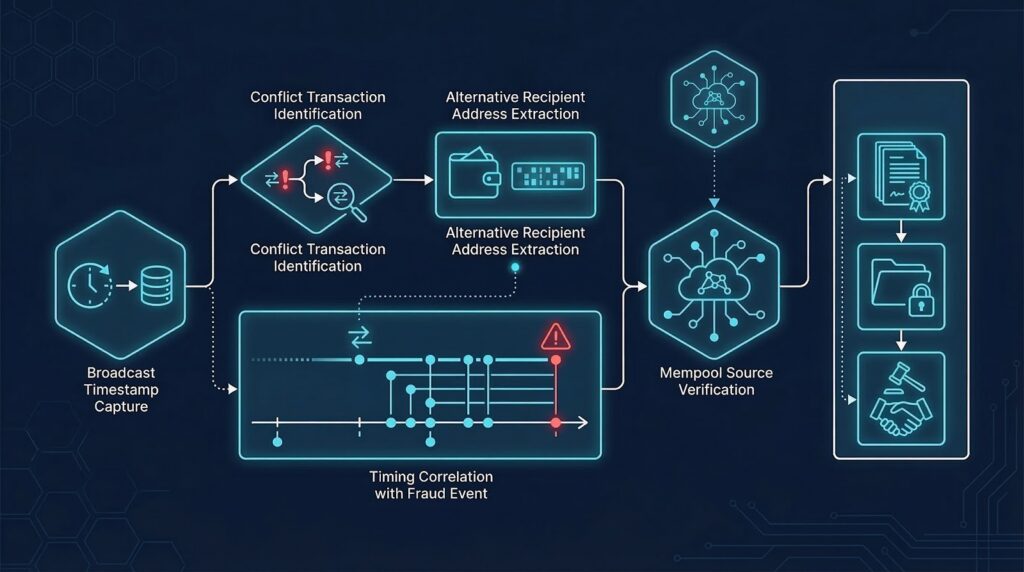
The broadcast timestamp of an orphaned transaction – the moment it was first observed in the mempool – is a critical forensic data point even when the transaction itself was never confirmed. Timing correlation between an orphaned transaction and a fraud event establishes the suspect’s activity at a specific moment before any confirmed transaction occurred.
Investigators use orphaned transaction timestamps to establish timeline evidence for legal proceedings. A suspect who claims they did not know about a fraud event at a certain time can be challenged by an orphaned transaction broadcast from their wallet address at that precise moment to a known fraud-linked address. Expert witness testimony from a court-qualified blockchain forensics professional is required to present mempool broadcast timing evidence effectively. Crypto Trace Labs – ACAMS-accredited, MLRO-qualified across UK, US, and EU, and Chartered Fellow Grade at the CMI – provides court-recognized expert witness testimony including orphaned transaction timing analysis.
Forensic Tools and Methods for Orphaned Transaction Analysis
Effective orphaned transaction investigation requires platforms that maintain mempool history beyond the standard 14-day Bitcoin eviction window. Standard blockchain explorers do not retain dropped transactions and cannot support this analysis.
| Platform | Mempool Archive | Orphaned Tx Recovery | Conflict Detection | Coverage Period |
|---|---|---|---|---|
| Chainalysis Reactor | Proprietary archive | Automated flagging | Full conflict detection | 12-24 months |
| Elliptic Investigator | Proprietary archive | Manual + automated | Full conflict detection | 12-24 months |
| TRM Labs | Growing archive | Automated detection | Growing coverage | 12 months |
| mempool.space | Public archive | Manual only | Limited | Variable |
AML Compliance Applications
Orphaned transaction data has direct applications in AML compliance screening for exchanges. Incoming deposits preceded by orphaned broadcast attempts to other addresses – particularly known fraud or high-risk addresses – are a significant risk signal that standard screening of confirmed transaction history would miss entirely. UK AML regulations and EU AML directives encourage exchanges to apply enhanced due diligence when on-chain evidence suggests multiple attempted movements of funds before deposit.
Regulatory compliance teams implementing mempool monitoring can log incoming deposit transactions and check whether they were preceded by alternative broadcast attempts. This mempool-level screening adds a risk layer that is not possible with confirmed blockchain data alone. ACAMS-standard procedures recommend exchanges retain mempool event logs for a minimum of 24 months to support retrospective AML investigations. US AML requirements similarly encourage enhanced monitoring of mempool-level transaction patterns at regulated platforms.
Frequently Asked Questions
What is an orphaned transaction in blockchain forensics?
An orphaned transaction is a Bitcoin transaction that was broadcast to the network but never achieved confirmation, either because it was dropped from mempools due to insufficient fees, expired after the default 14-day window, or was invalidated by a conflicting transaction that spent the same inputs first. Orphaned transactions are absent from the confirmed blockchain record but contain forensically significant information including intended recipient addresses, amounts, and broadcast timing that investigators use to reconstruct attempted fund movements and establish intent.
How do investigators find orphaned transactions?
Investigators find orphaned transactions by querying enterprise blockchain analytics platforms such as Chainalysis Reactor and Elliptic Investigator, which maintain proprietary mempool archives. Mempool monitoring services such as mempool.space also retain broadcast data. The key challenge is time: Bitcoin mempools evict unconfirmed transactions after 14 days, so investigators must access archive services that captured the transaction during its broadcast window. According to Elliptic (2024), enterprise archives retain broadcast data for 12-24 months on average.
What forensic value do dropped transactions have?
Dropped transactions have significant forensic value because they reveal intended fund movements, alternative destination addresses, and the timing of the suspect’s activity before any confirmed blockchain record exists. A transaction broadcast to a fraud-linked address but never confirmed still demonstrates intended use of funds, which can establish criminal intent in legal proceedings. TRM Labs (2024) found 41% of dropped conflicting transactions in fraud cases showed intent to divert funds to a different recipient from what was ultimately confirmed.
What is a conflicting orphaned transaction?
A conflicting orphaned transaction is one that attempts to spend the same UTXO inputs as another transaction, where only one can be confirmed. The version that achieves block inclusion is confirmed; the other is permanently invalidated. Forensically, the conflicting orphaned transaction reveals that an alternative use of those funds was planned. When the alternative destination is a known fraud-linked address, this is strong evidence of deliberate diversion attempt. These are the most forensically significant category of orphaned transactions.
Can orphaned transaction evidence be used in court?
Orphaned transaction evidence can be used in court when presented by a qualified expert witness with recognised blockchain forensics credentials. The broadcast timestamp and transaction content from mempool archives are admissible as circumstantial evidence of intent. UK courts have accepted mempool broadcast evidence in civil proceedings where intent to commit fraud was at issue. ACAMS-qualified expert witnesses are required to present the technical chain of custody for mempool archive data effectively in court-recognized forensic testimony.
How does orphaned transaction analysis support AML compliance?
Orphaned transaction analysis supports AML compliance by enabling exchanges to screen incoming deposits for preceded orphaned broadcast attempts to high-risk addresses. UK AML regulations and EU AML directives encourage mempool-level enhanced due diligence for complex transaction patterns. Regulatory compliance teams retaining mempool event logs can conduct retrospective orphaned transaction analysis during AML investigations. ACAMS-standard procedures recommend 24-month mempool log retention to support this capability, with periodic review of orphaned transaction patterns for customers showing suspicious activity.
What is the difference between orphaned and replaced transactions?
Orphaned transactions are dropped from mempools without confirmation due to low fees or timeout. Replaced transactions are displaced by a Replace-By-Fee sequence where a newer higher-fee version took priority. Replaced transactions preserve an intentional operator action; orphaned dropped transactions represent unintentional failures. Both are absent from confirmed blockchain records and require mempool archive data for investigation, but they reveal different types of operational intelligence about the wallet operator and their infrastructure.
Does Crypto Trace Labs investigate orphaned transactions?
Crypto Trace Labs investigates orphaned transactions by querying enterprise mempool archives through Chainalysis Reactor and Elliptic Investigator to recover broadcast data, identify conflicting transactions, and extract intended recipient addresses. The team correlates orphaned transaction timestamps with fraud event timelines to establish intent evidence for legal proceedings. ACAMS accreditations and MLRO qualifications across UK, US, and EU support court-recognized expert witness testimony. Exchange relationship contacts at Blockchain.com, Kraken, and Coinbase support data requests when confirmed transactions reach regulated platforms.
Executive Summary
Orphaned transaction forensics recovers investigative intelligence from Bitcoin transactions that were broadcast but never confirmed. Dropped transactions reveal intended destinations, alternative fund uses, and timing evidence invisible to standard blockchain analysis. Conflicting orphaned transactions – where two versions attempt to spend the same UTXO – demonstrate deliberate diversion attempts. Enterprise mempool archives from Chainalysis Reactor and Elliptic Investigator retain broadcast data for 12-24 months. Chainalysis (2024) found 34% of fraud investigations using mempool data recovered previously unknown destination addresses. UK AML and EU AML frameworks encourage mempool log retention for AML compliance purposes.
What Should You Do Next?
If your fraud investigation requires orphaned transaction analysis, or if your exchange compliance programme needs mempool-level screening capability, specialist blockchain forensics is essential.
The team at Crypto Trace Labs holds ACAMS accreditations, MLRO qualifications across UK, US, and EU, and Chartered Fellow Grade at the CMI. Founding members held VP and Director positions at Blockchain.com, Kraken, and Coinbase, providing direct contacts for exchange data requests when confirmed transactions eventually reach regulated platforms. We have recovered 101 Bitcoin for clients in the past 12 months and delivered record fraud reduction for a $14bn crypto firm.
We offer no upfront charge for non-custodial wallet recoveries. Contact Crypto Trace Labs to discuss your orphaned transaction investigation.
People Also Read
- Transaction Replacement Analysis: How RBF Patterns Reveal Wallet Behavior
- Mempool Monitoring for Real-Time Criminal Activity Detection
- On-Chain Wallet Age Analysis: Using First Transaction Timing for Attribution
About the Author
Crypto Trace Labs is a specialist crypto asset recovery and blockchain forensics firm. Founding members held VP and Director positions at Blockchain.com, Kraken, and Coinbase. Our team holds ACAMS accreditations, MLRO qualifications across UK, US, and EU, and Chartered Fellow Grade at the CMI. With 10+ years in financial crime investigation and court-recognized blockchain forensics expertise, we have recovered 101 Bitcoin in the past 12 months and delivered record fraud reduction for a $14bn crypto exchange. We offer no upfront charge for non-custodial wallet recoveries. Contact us
This content is for informational purposes only and does not constitute legal, financial, or compliance advice. Crypto asset recovery outcomes depend on specific circumstances, regulatory cooperation, and technical factors. Consult qualified professionals regarding your specific situation.