


Last Updated: March 2026
Real-time and historical on-chain analysis are two fundamentally different modes of blockchain investigation, each serving distinct operational purposes and requiring different infrastructure, tooling, and analytical approaches. Real-time on-chain analysis monitors the blockchain as transactions are broadcast and confirmed, enabling immediate detection of suspicious activity, interception of asset movements, and rapid alerts for compliance or law enforcement action. Historical on-chain analysis reconstructs the transaction history of specific wallets or fund flows from archived blockchain data, enabling forensic tracing of past events for litigation, regulatory investigation, or asset recovery. According to Chainalysis‘s 2024 Crypto Crime Report, combining both modes – real-time monitoring that triggers investigation, and historical analysis that builds the evidentiary case – is the methodology used in 87% of successful crypto asset recovery operations.
Crypto Trace Labs provides both real-time blockchain monitoring services and historical forensic analysis for crypto asset recovery, litigation support, and AML (Anti-Money Laundering) compliance. The team – ACAMS (Association of Certified Anti-Money Laundering Specialists) accredited, MLRO (Money Laundering Reporting Officer) qualified across UK, US, and EU, and Chartered Fellow Grade at the CMI, with founding members from Blockchain.com, Kraken, and Coinbase – has deployed both modes operationally at scale.
Key Takeaways
- Real-time analysis enables interception: Assets can only be frozen, diverted, or flagged while they are still moving – real-time monitoring is the mechanism that identifies the window for action before it closes.
- Historical analysis builds the evidentiary case: Courts and regulators require documented reconstruction of past transaction flows, which requires archive node access and point-in-time data integrity that real-time systems do not preserve.
- Mempool analysis extends the real-time window: According to TRM Labs‘s 2024 monitoring guide, analysing unconfirmed transactions in the Bitcoin and Ethereum mempools provides a 5-30 second pre-confirmation alert window that can be critical for exchange freezing.
- Archive node storage is the limiting factor for historical analysis: A full Ethereum archive node requires approximately 12-15 TB of storage as of early 2026, with the dataset growing by approximately 1 TB per month.
- Most commercial platforms offer only partially real-time data: Chainalysis, Elliptic, and Crystal Intelligence typically process on-chain data with a 5-15 minute delay – genuinely real-time monitoring below 30-second latency requires custom node integration.
Why This Matters
The choice between real-time and historical on-chain analysis is not a preference – it is determined by the operational objective. Using historical analysis to attempt real-time monitoring means decisions are made on data that is minutes to hours old, and interception opportunities are missed. Using real-time monitoring tools to attempt forensic evidence reconstruction produces outputs that lack the data integrity, completeness, and point-in-time accuracy required for court proceedings. Understanding the trade-offs between the two modes prevents the single most expensive mistake in blockchain investigation: deploying the wrong tool for the objective and discovering the limitation when it is too late to recover.
Real-Time Analysis Architecture
Real-time on-chain analysis architecture is the technical infrastructure that monitors blockchain transactions as they are broadcast and confirmed, enabling sub-minute detection and alerting.
The core of a real-time system is a WebSocket connection to a running blockchain node, which pushes new transaction and block events to the monitoring application as they occur. For Bitcoin, this means subscribing to the node’s ZeroMQ notification interface for new block and transaction events. For Ethereum, this means subscribing to the new_pending_transactions and new_heads WebSocket events via a Geth or Erigon node. The application must be able to process and screen these events within the available confirmation window.
For mempool monitoring – which provides pre-confirmation detection – the system must subscribe to unconfirmed transaction events and screen them against watchlists immediately. Mempool transactions are not guaranteed to confirm, but for Bitcoin and Ethereum the vast majority of non-spam transactions confirm within 10 minutes, making mempool monitoring a reliable early warning system for high-value wallet movements.
| Capability | Real-Time System | Historical System |
|---|---|---|
| Data latency | Under 30 seconds (custom node) | N/A – point-in-time queries |
| Mempool access | Yes – pre-confirmation alerts | No |
| Data completeness | Current state only | Full historical state |
| Storage requirement | Moderate (pruned node sufficient) | Very high (archive node required) |
| Use case | Asset interception, fraud alerts | Litigation, regulatory investigation |
| Court-ready output | Not without additional processing | Yes with integrity measures |
Historical Analysis Architecture
Historical on-chain analysis architecture is built around archive node access that preserves the complete state of the blockchain at every block height, enabling accurate reconstruction of any past transaction or wallet state.
The defining technical requirement is the archive node. A Bitcoin Core archive node retains the full UTXO (Unspent Transaction Output) set history, allowing the analyst to reconstruct exactly what unspent outputs existed at any block height in the past. An Ethereum archive node retains the complete account state tree at every block height, enabling queries of wallet balances, smart contract states, and internal transaction traces at any historical point. Without archive access, historical analysis is limited to transaction data alone, without the surrounding state context required for accurate forensic reconstruction.
Data integrity for historical analysis requires that the archived data be hash-verified at the point of collection and the integrity record preserved. A historical analysis that queries an archive node in real time during the investigation produces current results for historical queries – but an analysis conducted in March 2026 querying data from 2024 will produce the same results as a March 2026 query, because the historical blockchain data does not change. This makes historical data inherently more stable for forensic purposes than real-time data.

When to Use Real-Time Monitoring
Real-time monitoring is the appropriate tool when the objective is prevention or interception rather than retrospective investigation.
For crypto exchanges and custodians, real-time monitoring of incoming deposits enables immediate flagging of funds originating from known illicit sources before they are credited to user accounts. This is the most effective point of intervention – once funds are credited and the user withdraws, recovery requires court orders. According to Elliptic’s 2024 exchange compliance report, exchanges with real-time deposit screening that fires before crediting prevent approximately 3x more illicit fund deposits than those that screen after crediting.
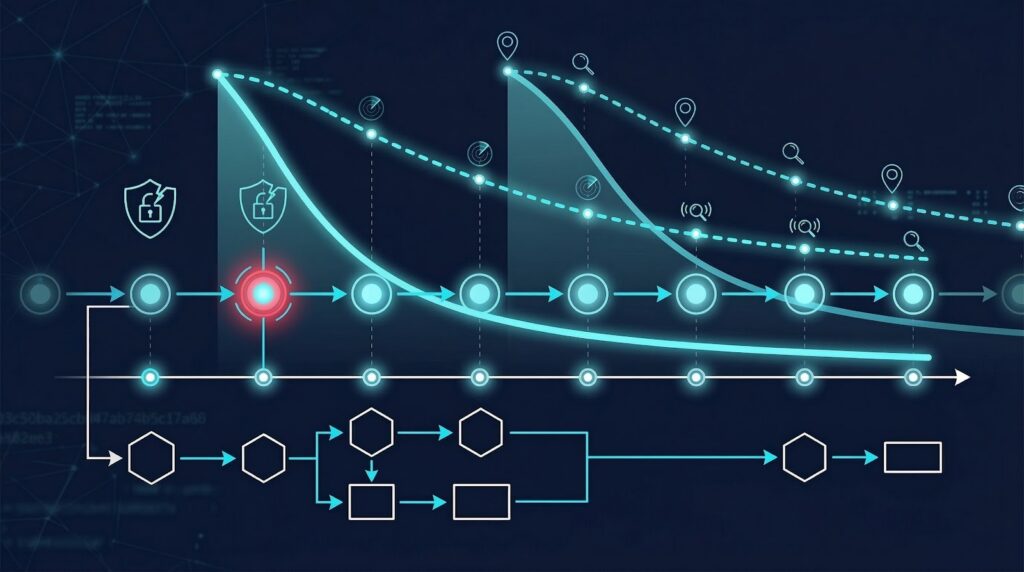
For victims of crypto theft who engage forensic teams immediately, real-time wallet monitoring tracks where stolen assets move after the theft event, enabling timely freezing applications while assets are still in reachable wallets. Each subsequent wallet hop reduces recovery probability as funds move further from the original theft and closer to exit points such as mixing services or privacy coin conversions.
When to Use Historical Analysis
Historical analysis is the appropriate tool when the objective is to reconstruct a complete record of past fund flows for evidentiary or investigative purposes.
For litigation support, historical analysis builds the transaction trace that supports freezing applications, civil fraud claims, and criminal prosecutions. This trace must be complete, documented, and reproducible – qualities that real-time monitoring logs cannot provide without significant additional processing. For regulatory investigations, historical analysis reconstructs the full scope of suspicious activity over the relevant investigation period, including transactions that occurred months or years before the investigation was triggered.
For blockchain forensics engagements where the client has experienced theft or fraud but was not monitoring at the time, historical analysis is the only available option. The forensic team must reconstruct what happened from archived blockchain data, tracing funds from the point of compromise through every subsequent wallet hop to the current or last known location. This requires archive node access, data integrity measures, and the analytical methods described in CPR Part 35 forensic reporting standards.
Combining Both Modes Effectively
The most effective blockchain investigation operations use real-time and historical analysis in combination: real-time monitoring to detect and track, and historical analysis to document and prove.
In a typical crypto asset recovery engagement, the process begins with historical analysis to reconstruct the theft or fraud event and identify where stolen funds currently sit. Real-time monitoring is then deployed on the identified destination wallets to alert if assets move again while recovery proceedings are initiated. If assets do move, historical analysis is immediately applied to the new transactions to extend the trace. This cycle continues until the assets are frozen, recovered, or lost to a point of no return such as a privacy coin conversion.
For AML compliance operations, real-time transaction monitoring triggers investigations that are then documented through historical analysis. A real-time alert may flag a suspicious deposit – historical analysis of the depositing wallet then builds the full picture of prior activity that informs the SAR filing and any subsequent law enforcement referral.
Frequently Asked Questions
What is the difference between real-time and historical blockchain analysis?
Real-time blockchain analysis monitors transactions as they are broadcast and confirmed, enabling immediate detection and action within the live transaction window. Historical analysis reconstructs past transaction flows from archived blockchain data for investigative, evidentiary, or compliance purposes. The two modes require different infrastructure – pruned nodes are sufficient for real-time monitoring, while archive nodes are required for complete historical analysis. Most effective investigations use both modes in sequence.
How fast is truly real-time blockchain monitoring?
Genuine real-time blockchain monitoring, using direct WebSocket connections to a running blockchain node, can achieve latency under 5 seconds for block-confirmed transactions and under 30 seconds for mempool detection of unconfirmed transactions. Commercial platforms such as Chainalysis and Elliptic typically have 5-15 minute processing delays. For time-critical interceptions, custom node integration is required rather than commercial platform APIs.
Can historical analysis reconstruct transactions from years ago?
Yes. Blockchain data is immutable – transactions recorded in the blockchain in 2010 are accessible in exactly the same form today. Historical analysis can reconstruct fund flows from any point in the blockchain’s history, provided the analyst has access to an archive node that has indexed the relevant blockchain from its genesis block. The analysis is limited only by the quality of attribution data available for addresses at the time of the historical transactions.
What storage is required for an Ethereum archive node?
As of early 2026, a full Ethereum archive node requires approximately 12-15 TB of storage, growing at approximately 1 TB per month as new blocks are added. Bitcoin archive nodes require approximately 700 GB. For organisations conducting regular historical analysis, cloud-hosted archive nodes (AWS, GCP, or specialist providers such as QuickNode or Alchemy) provide an alternative to self-hosted infrastructure.
How is mempool analysis used in asset recovery?
Mempool analysis monitors unconfirmed transactions that have been broadcast but not yet included in a block. For Bitcoin, transactions typically spend 1-10 minutes in the mempool before confirmation. For Ethereum, the window varies with gas price. Monitoring the mempool of identified victim wallets provides an early warning that stolen funds are being moved, typically giving a 5-30 minute window to alert exchanges or initiate emergency court applications before the transaction confirms.
Can real-time monitoring be set up for any blockchain?
Real-time monitoring can be set up for any blockchain that exposes a node notification interface, which includes Bitcoin, Ethereum, all major EVM-compatible chains (Polygon, BNB Chain, Arbitrum), Solana, and many others. Chains without public node software or with restricted node access (some private consortium chains) cannot be monitored in this way. Monitoring coverage for new or obscure chains typically requires custom development.
How long should real-time monitoring be maintained after a theft?
Real-time monitoring should be maintained on identified destination wallets for as long as assets remain there or the investigation is active. Historically, significant asset movements often occur within 48-72 hours of a theft as attackers consolidate funds, but further movements can occur weeks or months later when the attacker believes the investigation has ended. Monitoring should continue through any legal proceedings and at minimum until a court order is in place.
What is the cost difference between real-time monitoring and historical analysis?
Historical analysis costs vary with the complexity of the trace and are typically charged as a project fee ranging from £5,000 for simple single-chain analyses to £50,000+ for complex multi-chain investigations. Real-time monitoring is typically charged as a monthly retainer, ranging from £2,000-£10,000 per month depending on the number of monitored addresses and the alert threshold configuration. Both costs are typically a small fraction of the asset value being monitored or traced.
Executive Summary
Real-time and historical on-chain analysis serve fundamentally different investigative objectives and require different technical infrastructure. Real-time monitoring enables interception during the live transaction window but cannot produce the data integrity and completeness required for court evidence. Historical analysis produces forensically sound reconstructions of past fund flows but cannot intercept assets in motion. The most effective blockchain investigations deploy both modes: real-time monitoring to track and alert, historical analysis to document and prove. Understanding when to use each mode – and having the infrastructure to execute both – is the operational foundation of effective crypto asset recovery and AML compliance.
What Should You Do Next?
If you need real-time blockchain monitoring for an active theft situation, or historical forensic analysis for litigation or regulatory proceedings, Crypto Trace Labs provides both services for crypto asset recovery clients, legal teams, and compliance-regulated institutions.
The team at Crypto Trace Labs – ACAMS-accredited, MLRO-qualified across UK, US, and EU, Chartered Fellow Grade at the CMI, with founding members from Blockchain.com, Kraken, and Coinbase – has recovered 101 Bitcoin for clients in the last 12 months using combined real-time and historical analysis methodologies. We offer no upfront charge for non-custodial wallet recoveries. Contact us to discuss your case.
People Also Read
- How Does Blockchain Forensics Work? Expert Methods Explained
- What Is On-Chain Analysis? Complete Guide to Blockchain Data
- On-Chain Heuristics: How Pattern Recognition Identifies Wallet Owners
- On-Chain Risk Scoring: How Investigators Rate Transaction Suspiciousness
About the Author
Crypto Trace Labs is a specialist crypto asset recovery and blockchain forensics firm founded by VP and Director-level executives formerly of Blockchain.com, Kraken, and Coinbase. Our team holds ACAMS accreditations, MLRO qualifications across the UK, US, and EU, and Chartered Fellow Grade status at the CMI. With over 10 years of experience in financial crime investigation and court-recognized blockchain forensics expertise, we have recovered 101 Bitcoin for clients in the last 12 months and delivered record fraud reduction for a $14bn crypto exchange. We work with law enforcement agencies, regulated financial institutions, and private clients on crypto asset recovery, blockchain forensics, AML compliance, and expert witness testimony – globally. We offer no upfront charge for non-custodial wallet recoveries. Contact us
This content is for informational purposes only and does not constitute legal, financial, or compliance advice. Crypto asset recovery outcomes depend on specific circumstances, regulatory cooperation, and technical factors. Consult qualified professionals regarding your specific situation.