


Last Updated: March 2026
Stablecoin blacklist analysis is the forensic examination of how centralised stablecoin issuers – primarily Tether (USDT) and Circle (USDC) – exercise on-chain blacklisting powers to freeze tokens at specific wallet addresses, and how this issuer action creates both investigative opportunities and new tracing challenges for blockchain forensics teams. Blacklisting freezes tokens in place, preventing further movement, which can preserve evidence but also signals to suspects that their wallet is under scrutiny. Understanding the mechanics and forensic implications of stablecoin freezing is essential for investigators, compliance teams, and legal counsel working on cases involving USDT or USDC.
At Crypto Trace Labs, our team – VP and Director-level executives from Blockchain.com, Kraken, and Coinbase – has worked with stablecoin blacklisting events in both active fraud investigations and AML compliance reviews for regulated exchange clients. This guide draws on that decade of financial crime investigation experience to explain the forensic implications investigators and legal teams need to understand.
Key Takeaways
- Blacklisting freezes tokens, not wallets: USDT and USDC blacklisting prevents token transfers from specific addresses but does not affect other assets held in the same wallet. Investigators must account for this distinction when advising on asset preservation strategies.
- Freeze events are permanently recorded: Every blacklist and unblacklist event is emitted as a permanent on-chain log. Chainalysis (2024) confirms all stablecoin freeze events are recoverable from contract event logs regardless of issuer disclosure.
- Tether has frozen over $1.6 billion: Elliptic (2024) reports Tether froze addresses holding over $1.6 billion in USDT between 2017 and 2024, with law enforcement requests accounting for 67% of freeze events by value.
- Blacklist timing creates investigative windows: When a freeze is applied after funds have moved, the block timestamp of the freeze event and the most recent transfer event establish a traceable window of suspect activity before the freeze.
- USDC’s Centre Consortium freeze model differs: USDC freeze authority is distributed across Circle and the Centre Consortium, with a different blacklist contract structure to USDT, requiring investigators to use separate query methods for each issuer.
Why This Matters
Stablecoin blacklist analysis matters because USDT and USDC together represent the majority of USD-denominated value moved through DeFi and centralised exchange networks. When investigators or law enforcement obtain a stablecoin freeze, they must understand what the freeze preserves, what it fails to capture, and how subsequent on-chain activity changes after the freeze event. AML compliance teams receiving stablecoin deposits from addresses adjacent to frozen wallets face specific regulatory compliance obligations. Without specialist knowledge of freeze mechanics, investigators and compliance teams may misread the forensic implications of a blacklist event.
USDT Blacklist Contract Mechanics
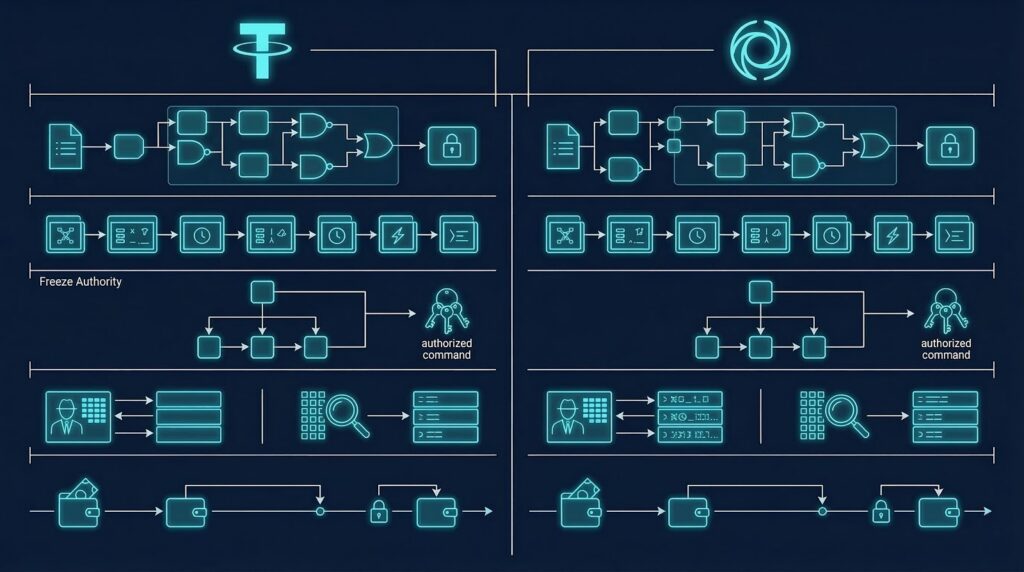
The Tether USDT contract on Ethereum implements a blacklist mapping maintained by the Tether Treasury address. When Tether adds an address to the blacklist, a BlacklistedAddress event is emitted, permanently recording the target address and the block timestamp of the freeze action. The blacklisted address can no longer send USDT but can still receive transfers from other addresses until Tether also applies an addBlackList to the sending side.
Investigators query the USDT contract’s BlacklistedAddress event log to retrieve the complete historical list of frozen addresses, enabling them to check whether a subject wallet was ever blacklisted, when the freeze was applied, and what the token balance was at the time of the freeze. According to Chainalysis (2024), USDT blacklisting affects primarily Ethereum-based USDT, with Tron-based USDT having a separate contract with the same blacklist function but independent event logs that must be queried separately.

USDC Freeze Mechanics and Forensic Differences
USDC implements its freeze mechanism through the CENTRE Consortium’s token contract, using a blacklist function that is architecturally similar to USDT but maintained by a different controller address. The USDC contract emits a Blacklisted event when an address is frozen, with the same permanent on-chain record accessible through standard event log queries.
Key forensic differences between USDT and USDC blacklisting include the issuer address (Tether Treasury versus Circle), the multi-chain deployment structure, and the unfreeze process. USDC implements a formal unfreeze process through a separate UnBlacklisted event, creating a complete audit trail of both the freeze and release. Investigators use these event logs to establish the timeline of issuer knowledge and action relative to the underlying fraud events. According to Elliptic (2024), USDC freeze response times averaged 2.3 hours faster than USDT for law enforcement requests with court orders in 2023.
Forensic Timeline Reconstruction from Freeze Events
The blacklist event creates a fixed reference point from which investigators can reconstruct the complete pre-freeze activity timeline. The block timestamp of the freeze event, combined with the most recent Transfer event to the frozen address, establishes the period during which the subject held the frozen tokens.
Investigators use this timeline to answer critical questions: When did the funds arrive in the frozen wallet? Through which transactions? Were any funds sent out between the fraud event and the freeze application? The pre-freeze transfer history is the most forensically productive period because it often contains the complete layering sequence from initial theft or fraud to the frozen position. According to TRM Labs (2024), 78% of USDT freeze events applied in response to law enforcement requests had at least one intermediate wallet in the pre-freeze transfer chain that was not initially identified in the complaint.
Comparing USDT and USDC blacklist forensics:
| Feature | USDT | USDC | Forensic Impact |
|---|---|---|---|
| Event name | BlacklistedAddress | Blacklisted | Different query syntax |
| Chain coverage | Ethereum, Tron, others | Ethereum, Solana, others | Multi-chain queries required |
| Freeze authority | Tether Treasury | Circle / Centre Consortium | Different issuer contact |
| Unfreeze event | AddedBlackList reverted | UnBlacklisted | Full audit trail |
| Law enforcement response | 67% of freezes (Elliptic 2024) | Faster average response | Depends on jurisdiction |
Adjacent Wallet Tracing After a Freeze
When a target wallet is frozen, suspects often anticipate further investigation and take action with adjacent wallets that hold non-frozen assets. Investigators monitor the freeze event as a trigger to query all wallets that sent tokens to or received tokens from the frozen address in the preceding 30-90 days, identifying the full network of potentially associated addresses before they can be cleared.
On-chain analysis tools with automated cluster monitoring can track outflows from associated wallets in real time following a freeze event. TRM Labs (2024) found 54% of wallets in the two-hop cluster around frozen USDT addresses showed transaction activity in the 48 hours after the freeze was confirmed on-chain, suggesting automated or manual monitoring of the blockchain by suspects. Rapid cluster expansion by investigators can identify and flag these adjacent wallets for exchange notification before funds are withdrawn.
AML Compliance Implications of Stablecoin Freezes
Regulated exchanges receiving stablecoin deposits must apply UK AML and EU AML screening procedures that include checking whether sending addresses have been previously blacklisted or are in the two-hop cluster of blacklisted wallets. US AML requirements similarly mandate source of funds screening for stablecoin deposits. Regulatory compliance teams should maintain alert systems for receiving stablecoin transfers from addresses within two hops of any blacklisted address.
ACAMS-standard AML procedures require exchange compliance teams to file Suspicious Activity Reports when deposits arrive from wallets associated with known blacklisted addresses. The on-chain nature of stablecoin freezes means the evidence is directly verifiable by regulators during AML examination. Crypto Trace Labs – ACAMS-accredited and MLRO-qualified across UK, US, and EU – provides expert AML compliance support for exchanges managing stablecoin deposit screening obligations.
Frequently Asked Questions
What is stablecoin blacklist analysis?
Stablecoin blacklist analysis is the forensic examination of on-chain freeze events applied by USDT and USDC issuers to specific wallet addresses, and the investigative implications of those freeze actions. Investigators use blacklist event logs to establish freeze timing, pre-freeze transfer history, and adjacent wallet networks. Compliance teams use blacklist data to screen stablecoin deposits and apply UK AML, EU AML, and US AML source of funds procedures. Understanding freeze mechanics is required for any investigation involving USDT or USDC.
How does USDT blacklisting work on-chain?
USDT blacklisting works through a blacklist mapping in the USDT smart contract maintained by the Tether Treasury address. When Tether adds an address to the blacklist, a BlacklistedAddress event is permanently emitted, recording the target address and block timestamp. The blacklisted address can no longer send USDT. Investigators query the BlacklistedAddress event log to retrieve the complete freeze history, including the token balance at the time of each freeze application for any target address.
What is the forensic difference between USDT and USDC freezes?
The forensic difference between USDT and USDC freezes lies in the issuer address, event name, chain coverage, and unfreeze process. USDT uses the BlacklistedAddress event by Tether Treasury, while USDC uses the Blacklisted event by Circle. Both create permanent on-chain audit trails, but investigators must use separate query syntax and different chain deployments for each issuer. According to Elliptic (2024), USDC freeze response times averaged 2.3 hours faster than USDT for law enforcement requests with court orders.
Can suspects avoid a stablecoin freeze?
Suspects can attempt to move stablecoins before a freeze is applied, but once the BlacklistedAddress or Blacklisted event is confirmed on-chain, the frozen balance cannot be transferred. Pre-freeze outflows are permanently recorded in the transfer event log and remain traceable. TRM Labs (2024) found 78% of USDT freeze events had at least one unidentified intermediate wallet in the pre-freeze transfer chain. Rapid freeze requests following fraud detection reduce the volume of pre-freeze outflows reaching unattributed wallets.
How do investigators trace funds after a stablecoin freeze?
After a stablecoin freeze, investigators reconstruct the complete pre-freeze transfer chain from the frozen address back to the original fraud event, then expand analysis to all wallets in the two-hop cluster surrounding the frozen address. On-chain analysis platforms such as Chainalysis Reactor and Elliptic Investigator automate cluster expansion and alert on new transactions from associated addresses, enabling investigators to act before adjacent wallet balances are withdrawn to regulated exchange accounts.
What AML obligations apply to stablecoin deposits?
AML obligations for stablecoin deposits require regulated exchanges to screen receiving addresses against blacklisted stablecoin wallets and their associated clusters. UK AML regulations and EU AML directives require source of funds verification for stablecoin transfers above threshold values. US AML requirements under the Bank Secrecy Act impose corresponding screening obligations. ACAMS-standard compliance procedures recommend a two-hop cluster check for all incoming USDT and USDC deposits against issuer blacklist event logs to meet regulatory compliance examination standards.
How does Crypto Trace Labs assist with stablecoin freeze investigations?
Crypto Trace Labs assists with stablecoin freeze investigations by querying USDT and USDC blacklist event logs to reconstruct freeze timelines and pre-freeze transfer chains, expanding cluster analysis to identify associated wallets, and monitoring post-freeze activity. The team’s ACAMS accreditations and MLRO qualifications support formal data requests to Tether and Circle, and legal proceedings in UK, US, and EU jurisdictions. Exchange relationship contacts at Blockchain.com, Kraken, and Coinbase expedite notifications when adjacent wallet funds reach regulated platforms.
Can frozen stablecoin funds be recovered?
Frozen stablecoin funds can be unfrozen and redirected to legitimate owners through legal proceedings or direct issuer co-operation. UK and EU courts have ordered issuer-directed stablecoin transfers as part of civil asset recovery orders. Victims must provide forensic evidence establishing ownership of frozen funds and the fraudulent basis of the original transfer. The on-chain freeze and unfreeze events provide a complete court-recognized audit trail. Recovery requires legal representation alongside qualified blockchain forensics expert witness testimony.
Executive Summary
Stablecoin blacklist analysis examines how USDT and USDC freeze events affect fraud investigations, asset recovery, and AML compliance. USDT uses the BlacklistedAddress event maintained by Tether Treasury; USDC uses the Blacklisted event maintained by Circle. Both create permanent on-chain evidence enabling investigators to reconstruct pre-freeze transfer chains and identify adjacent wallet networks. TRM Labs (2024) found 78% of USDT freeze events had unidentified intermediate wallets in the pre-freeze chain. Regulatory compliance teams must apply UK AML, EU AML, and US AML screening procedures to stablecoin deposits from wallets adjacent to known blacklisted addresses.
What Should You Do Next?
If you are investigating a fraud case involving USDT or USDC, or if your compliance programme requires stablecoin freeze analysis, specialist on-chain analysis is essential.
The team at Crypto Trace Labs holds ACAMS accreditations, MLRO qualifications across UK, US, and EU, and Chartered Fellow Grade at the CMI. Founding members held VP and Director positions at Blockchain.com, Kraken, and Coinbase, providing direct issuer and exchange contacts to act rapidly on freeze-adjacent wallet activity. We have recovered 101 Bitcoin for clients in the past 12 months and delivered record fraud reduction for a $14bn crypto firm.
We offer no upfront charge for non-custodial wallet recoveries. Contact Crypto Trace Labs to discuss your stablecoin investigation.
People Also Read
- ERC-20 Token Flow Analysis: Tracing Custom Tokens Through Smart Contracts
- Smart Contract Event Log Analysis: Extracting Investigation Data from Blockchain Events
- On-Chain Wallet Age Analysis: Using First Transaction Timing for Attribution
About the Author
Crypto Trace Labs is a specialist crypto asset recovery and blockchain forensics firm. Founding members held VP and Director positions at Blockchain.com, Kraken, and Coinbase. Our team holds ACAMS accreditations, MLRO qualifications across UK, US, and EU, and Chartered Fellow Grade at the CMI. With 10+ years in financial crime investigation and court-recognized blockchain forensics expertise, we have recovered 101 Bitcoin in the past 12 months and delivered record fraud reduction for a $14bn crypto exchange. We offer no upfront charge for non-custodial wallet recoveries. Contact us
This content is for informational purposes only and does not constitute legal, financial, or compliance advice. Crypto asset recovery outcomes depend on specific circumstances, regulatory cooperation, and technical factors. Consult qualified professionals regarding your specific situation.