


Last updated: March 2026
What UK courts require from cryptocurrency tracing reports is a set of evidentiary and procedural standards that determine whether blockchain forensic evidence will be admitted, relied upon, and survive cross-examination. The requirements draw from CPR Part 35 and Practice Direction 35 for civil proceedings, the Criminal Procedure Rules Part 19 for criminal matters, POCA 2002 for asset recovery proceedings, and emerging guidance from the FCA and judiciary on the specific characteristics of blockchain evidence. A cryptocurrency tracing report that does not meet these standards will be challenged, reduced in weight, or excluded entirely.
Crypto Trace Labs produces court-compliant cryptocurrency tracing reports for civil and criminal proceedings in the UK, written by ACAMS-accredited analysts with MLRO qualifications and prior expert witness experience in Crown Court and civil proceedings. This guide sets out exactly what UK courts expect from a cryptocurrency tracing report in 2026.
Key Takeaways
- CPR Part 35 and Practice Direction 35 require that blockchain forensic experts owe their overriding duty to the court, not to the instructing party, and must comply with strict report formatting requirements
- Methodology documentation is the most frequently challenged element – every analytical conclusion must be traceable to a documented method that can be independently verified
- Probabilistic attribution must be clearly labelled as such – presenting probable conclusions as definitive is the most common cause of successful defence challenges
- Chain of custody documentation for digital evidence must be unbroken from data collection to court submission, following established digital forensics protocols
- Exchange data corroboration is typically required to establish identity attribution – on-chain analysis alone is rarely sufficient to identify a specific individual in UK court proceedings
Why This Matters
UK courts have increasingly scrutinised blockchain forensic evidence as the volume of cryptocurrency-related proceedings has grown. The Crown Prosecution Service (CPS, 2024) has noted that blockchain evidence failures in prosecution cases – where evidence was challenged or excluded – most frequently result from inadequate methodology documentation and overstated attribution confidence, not from fundamental flaws in the underlying technology. Solicitors, prosecutors, and forensic experts who do not understand what courts specifically require will produce reports that appear technically sound but fail under legal challenge. The FCA (2024) guidance on digital asset investigations requires documented methodology capable of independent verification as a baseline standard for any forensic report intended for regulatory or court use.

CPR Part 35 Requirements for Expert Reports
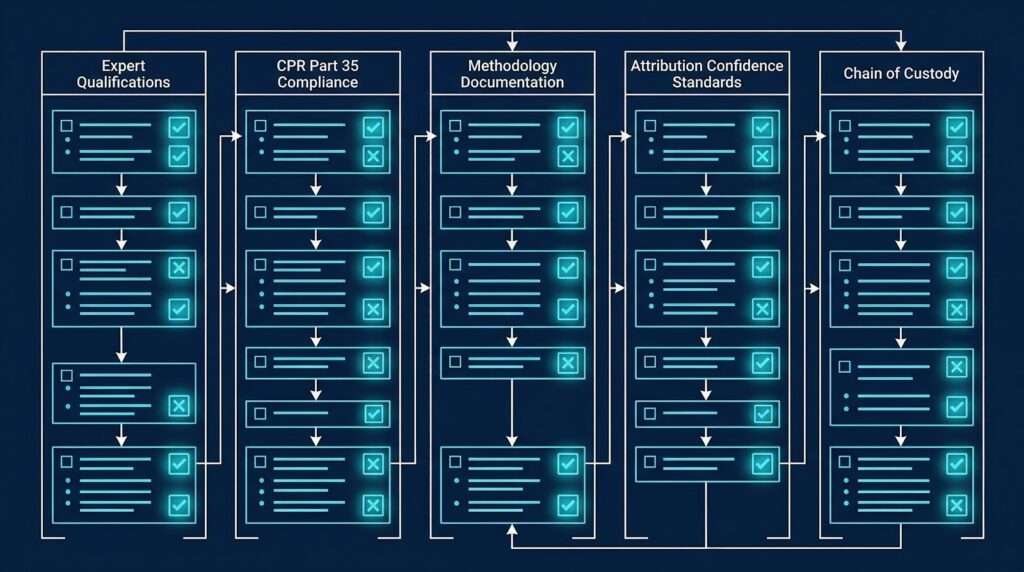
CPR Part 35 and Practice Direction 35 govern expert evidence in UK civil proceedings and impose specific requirements on the form and content of blockchain forensic expert reports. The report must include: the expert’s name, qualifications, and experience; a statement that the expert understands their duty to the court and has complied with it; the substance of instructions received (which need not set out privileged communications); the facts and instructions on which each opinion is based; the expert’s opinion on the relevant issues; any ranges of opinion on a topic and the reason the expert prefers their particular view; a summary of conclusions; a statement that the expert is aware CPR Part 35 requires their report to be addressed to the court; and a signed statement of truth.
Blockchain forensic reports that omit any of these elements face procedural challenge before their substantive content is even considered. Courts have struck out expert evidence for non-compliance with Part 35 formatting requirements, regardless of the technical quality of the underlying analysis.
Methodology Documentation Standards
Methodology documentation is the most scrutinised element of any blockchain forensic report in UK court proceedings. The court must be able to understand how the expert reached each conclusion, verify that the method is accepted within the relevant technical community, and assess whether the conclusion follows logically from the method applied. For blockchain forensic evidence, this means: identifying the specific tracing tools used and their version; stating which entity attribution database was consulted and its last update date; explaining the heuristic basis for any cluster attribution; distinguishing between co-spend-based attributions and exchange-confirmed attributions; and documenting the chain of custody for all digital evidence from collection to report.
Vague methodology references such as “using industry-standard tools” without identifying the tool, version, and attribution basis are consistently challenged and consistently result in reduced evidentiary weight. For how investigators document on-chain findings step by step, see our guide on blockchain forensics methods.
Probabilistic vs Deterministic Attribution Standards
UK courts distinguish between deterministic attribution – where a conclusion can be proven with certainty – and probabilistic attribution – where the conclusion is based on heuristic analysis with a stated confidence level. Both types of evidence are admissible, but they must be clearly distinguished in the report. A forensic report that states a wallet address “belongs to” a named individual when the basis is a co-spend heuristic with an 85% confidence level is misrepresenting the evidence. The correct formulation identifies the heuristic basis, states the confidence level, and presents the conclusion as probable rather than definitive.
Courts have reduced the weight of blockchain forensic evidence when probabilistic findings were presented as certain, and have excluded evidence entirely where the expert appeared to be advocating rather than advising. Defence experts routinely challenge attribution confidence levels, and a well-documented probabilistic statement is significantly more defensible than an overconfident definitive one. See also our guidance on on-chain risk scoring standards for how confidence levels are assigned in professional forensic practice.
Chain of Custody for Digital Evidence
Chain of custody for digital evidence in cryptocurrency investigations requires documentation of: how blockchain data was collected (direct node query, blockchain explorer export, or platform API), the specific data source and URL or API endpoint, the timestamp of data collection, the format in which data was stored, who handled the data between collection and report preparation, and whether any data processing steps were applied. Courts apply the same chain of custody standards to blockchain data as to other digital evidence, even though the data itself is immutable on the public blockchain. The immutability of blockchain data does not eliminate the need for chain of custody documentation – it eliminates only the risk of data alteration, not the need to document how the data was obtained and handled.
Identity Attribution and Exchange Evidence
On-chain analysis alone is rarely sufficient to identify a specific individual in UK court proceedings. Courts require corroborating identity evidence to connect a blockchain address to a named defendant. The standard corroboration pathway is exchange KYC data obtained via Norwich Pharmacal order, production order, or POCA information order. The exchange data identifies the account holder associated with the deposit address linked to the defendant’s transaction flows. This creates a two-part evidentiary chain: on-chain analysis establishing transaction flows and wallet relationships, and exchange data establishing identity attribution to a specific real-world person. Crypto asset freezing injunctions at the without-notice stage may proceed on on-chain evidence alone, but contested recovery proceedings typically require exchange data corroboration for identity attribution.
| Evidence Type | Admissibility Status | Typical Weight | Corroboration Required |
|---|---|---|---|
| On-chain transaction data | Admissible | High for flow evidence | Rarely for flows alone |
| Heuristic cluster attribution | Admissible | Medium | Yes – exchange data preferred |
| Exchange-confirmed identity | Admissible | High | Supplements on-chain trace |
| Probabilistic Monero attribution | Admissible with caveat | Low-medium | Strongly recommended |
| IP address correlation | Admissible | Medium | Combined with on-chain |
Frequently Asked Questions
What must a cryptocurrency tracing report include for UK courts?
A UK court-compliant cryptocurrency tracing report must include the expert’s qualifications and accreditations, a CPR Part 35 compliant statement of truth, documented methodology for each analytical step, the tools and platform versions used, the entity attribution database version consulted, confidence levels for all probabilistic attributions, a chain of custody record for digital evidence collection, and a summary of conclusions. Reports must address the court rather than the instructing party and must acknowledge any limitations or data gaps. Missing any of these elements creates grounds for procedural challenge before the substantive content is considered.
What is CPR Part 35 and how does it apply to blockchain evidence?
CPR Part 35 is the Civil Procedure Rule governing expert evidence in UK civil proceedings. It requires experts to owe their overriding duty to the court rather than the instructing party, and imposes specific requirements on the format and content of expert reports. For blockchain forensic evidence, this means the report must document methodology, acknowledge uncertainty, state the basis for each opinion, and comply with a signed statement of truth. Failure to comply with Part 35 formatting can result in evidence being struck out regardless of its technical quality.
Can probabilistic blockchain evidence be used in UK courts?
Yes. Probabilistic blockchain evidence based on heuristic analysis is admissible in UK courts and has been relied upon in criminal and civil proceedings. The key requirement is that probabilistic conclusions must be clearly labelled as such, with the confidence level and the basis for the attribution stated explicitly. Presenting probabilistic conclusions as definitive is the most common cause of successful defence challenges to blockchain forensic evidence. Courts give appropriate weight to well-documented probabilistic findings – the problem arises when they are overstated.
What exchange data can be obtained to support UK court proceedings?
UK courts can compel crypto exchanges to disclose KYC identity data, transaction records, IP address logs, and payment method history through Norwich Pharmacal orders, Bankers Trust orders, and information orders under POCA. UK-registered exchanges respond to English court orders directly. EU exchanges may require letters of request post-Brexit. US exchanges require MLAT requests coordinated through the National Crime Agency. Offshore exchanges with minimal regulatory oversight may not respond to any legal instrument. The blockchain forensic expert should identify which exchanges hold relevant data and advise on the appropriate legal instrument for each jurisdiction.
What is a Norwich Pharmacal order in cryptocurrency cases?
A Norwich Pharmacal order is a disclosure order requiring a third party such as a crypto exchange to disclose information about a wrongdoer. In cryptocurrency cases, it is typically used to identify the account holder behind a specific deposit address that received stolen or defrauded funds. The applicant must show a good arguable case of wrongdoing, that the respondent exchange is mixed up in that wrongdoing even if innocently, and that disclosure is necessary and proportionate. Norwich Pharmacal orders are among the most commonly used legal instruments in UK civil crypto asset recovery and are frequently granted at the without-notice stage in urgent cases.
How is chain of custody documented for blockchain evidence?
Chain of custody for blockchain evidence is documented by recording the specific data source (blockchain node, explorer API, or analytics platform), the timestamp and method of data collection, the format in which data was stored, who handled the data between collection and report preparation, and any data processing steps applied. Although blockchain data is immutable on the public ledger, courts require chain of custody documentation to verify that the data presented in the report corresponds to actual blockchain records and has not been processed or filtered in ways that could affect the conclusions. This is the same standard applied to all digital evidence.
What qualifications do UK courts expect from a blockchain forensic expert?
UK courts expect blockchain forensic experts to hold recognised professional qualifications, relevant technical experience, and prior expert witness experience in UK proceedings. ACAMS accreditation is the recognised minimum professional standard for blockchain forensic analysts in financial crime contexts. MLRO qualifications in the UK are expected for experts advising on AML-related proceedings. Prior UK court experience is essential – courts are more confident in experts who have previously given evidence and whose qualifications have been subject to prior judicial assessment. CMI Chartered Fellow Grade indicates senior-level professional standing and is valued in complex cases.
How should confidence levels be stated in cryptocurrency tracing reports?
Confidence levels in cryptocurrency tracing reports should be stated explicitly using consistent terminology throughout the report. A useful framework distinguishes between: confirmed attribution (exchange KYC data directly linking the address to an identified individual), highly probable attribution (co-spend heuristics with strong supporting indicators and no contrary evidence), probable attribution (heuristic-based with some corroborating indicators but no direct confirmation), and possible attribution (limited heuristic basis requiring further corroboration). Courts accept all four levels provided they are clearly labelled and the basis for each level is documented. Using qualitative terms like ‘likely’ without defining what likelihood means invites challenge.
Is on-chain analysis sufficient to identify a defendant in UK proceedings?
On-chain analysis alone is generally insufficient to identify a specific defendant in contested UK court proceedings. Courts require corroborating identity evidence, typically exchange KYC data, to connect a blockchain address to a named individual. On-chain analysis establishes transaction flows and wallet relationships with high reliability. Identity attribution requires a second evidentiary layer linking the wallet address to a real person, usually through exchange records obtained via court order. Urgent freezing injunctions may be granted on on-chain evidence alone at the without-notice stage, but contested proceedings at trial require identity corroboration beyond blockchain analysis.
What happens when blockchain forensic evidence is challenged in court?
When blockchain forensic evidence is challenged in court, the challenge typically targets the methodology documentation, the attribution confidence levels, or the expert’s qualifications. Poorly documented methodology will be exposed under cross-examination as the expert cannot explain the basis for their conclusions. Overstated confidence levels will be reduced by the court or challenged by a defence expert with a counter-report. If the expert’s qualifications are challenged and found wanting, the court may reduce the weight given to their evidence or exclude it entirely. Well-documented reports from ACAMS-accredited experts with prior court experience survive challenge far more consistently than those produced by analysts without these credentials.
Executive Summary
UK courts require cryptocurrency tracing reports to comply with CPR Part 35 formatting, document methodology to a standard capable of independent verification, distinguish clearly between probabilistic and deterministic attribution, and maintain a documented chain of custody for all digital evidence. Expert qualifications including ACAMS accreditation and prior court experience will be challenged by opposing counsel. Exchange KYC data obtained via Norwich Pharmacal or POCA orders is typically required to establish identity attribution beyond the blockchain trace alone. Reports that overstate confidence levels or omit methodology documentation are the most frequent cause of preventable evidence failures in UK cryptocurrency proceedings.
What Should You Do Next?
Meeting UK court requirements for cryptocurrency tracing reports is not simply a matter of competent technical analysis – it requires forensic methodology documentation, CPR Part 35 compliance, and expert witness experience that many blockchain analytics providers do not hold. The gap between a technically sound investigation and a court-ready forensic report is significant.
Crypto Trace Labs produces UK court-compliant cryptocurrency tracing reports to CPR Part 35 standards, with full methodology documentation, confidence-graded attribution, and a complete chain of custody record. Our ACAMS-accredited, MLRO-qualified team has provided expert witness testimony in Crown Court and civil asset recovery proceedings. Contact Crypto Trace Labs to discuss your report requirements.
People Also Read
- How Solicitors Should Work with Blockchain Forensic Experts
- Crypto Freezing Injunctions: How Courts Protect Victims of Cryptocurrency Theft
- How to Evaluate Blockchain Forensic Firms: 12 Questions Law Enforcement Should Ask
- How Does Blockchain Forensics Work? Expert Methods Explained
About the Author
Crypto Trace Labs is a specialist crypto asset recovery and blockchain forensics firm founded by VP and Director-level executives formerly of Blockchain.com, Kraken, and Coinbase. Our team holds ACAMS accreditations, MLRO qualifications across the UK, US, and EU, and Chartered Fellow Grade status at the CMI. With over 10 years of experience in financial crime investigation and court-recognized blockchain forensics expertise, we have recovered 101 Bitcoin for clients in the last 12 months and delivered record fraud reduction for a $14bn crypto exchange. We work with law enforcement agencies, regulated financial institutions, and private clients on crypto asset recovery, blockchain forensics, AML compliance, and expert witness testimony – globally. We offer no upfront charge for non-custodial wallet recoveries. Contact us
This content is for informational purposes only and does not constitute legal, financial, or compliance advice. Crypto asset recovery outcomes depend on specific circumstances, regulatory cooperation, and technical factors. Consult qualified professionals regarding your specific situation.