

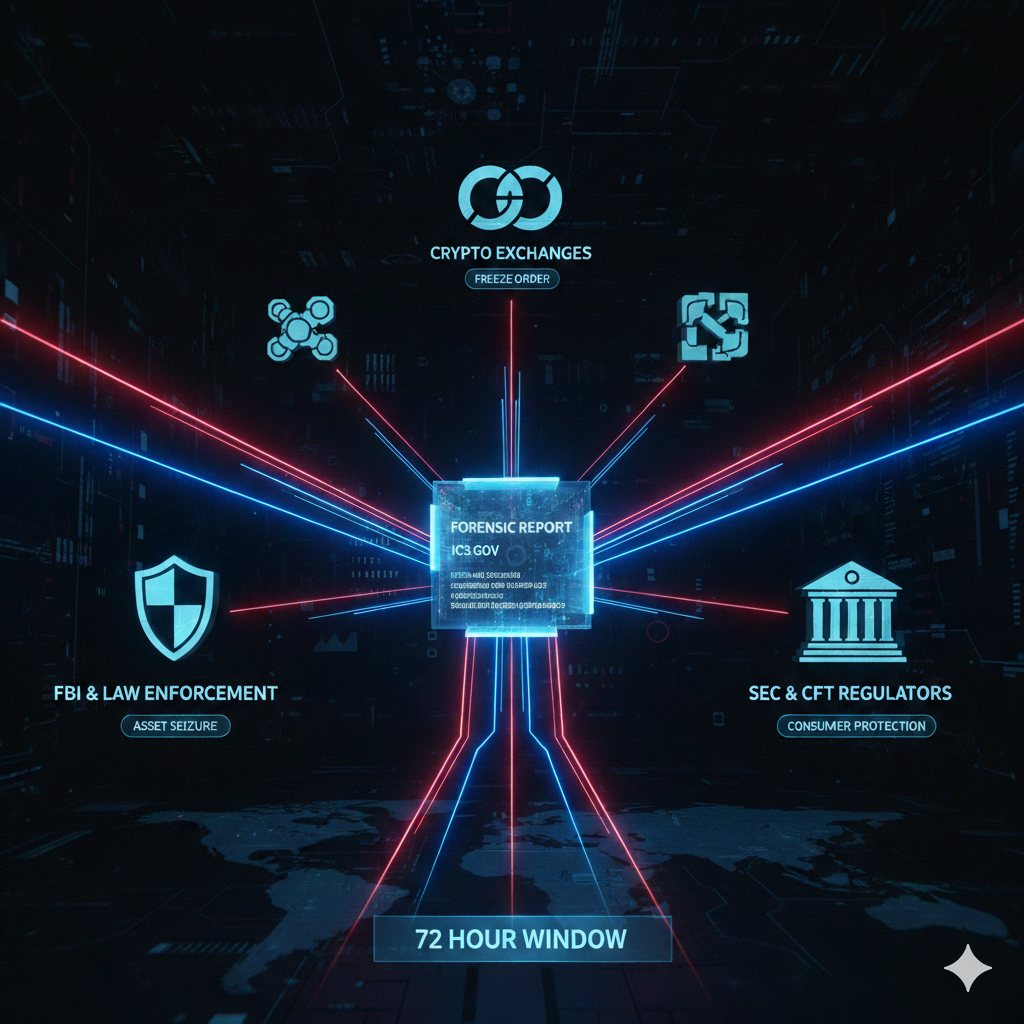
Reporting cryptocurrency fraud requires filing complaints with multiple federal agencies including the FBI’s Internet Crime Complaint Center (IC3), the Federal Trade Commission (FTC), the Securities and Exchange Commission (SEC), and the Commodity Futures Trading Commission (CFTC), while also notifying your cryptocurrency exchange and local law enforcement. Early reporting significantly improves recovery chances because authorities can coordinate with exchanges to freeze funds before scammers move them through mixers or convert to fiat currency. The information you provide helps investigators identify patterns, build cases, and potentially recover assets across multiple victim reports.
At Crypto Trace Labs, our team of VP and Director-level executives from Blockchain.com, Kraken, and Coinbase has supported hundreds of fraud investigations by preparing forensic documentation that strengthens victim reports and assists law enforcement. This guide explains exactly where to report different types of cryptocurrency fraud, what information to gather, and how professional support can improve your chances of recovery.
Why Does Reporting Crypto Fraud Matter?
Reporting cryptocurrency fraud serves purposes beyond individual recovery. Each complaint contributes to investigative databases that help authorities identify criminal networks, track fund flows across multiple victims, and build cases that lead to arrests and asset seizures. The FBI’s Operation Level Up demonstrates this impact – by analyzing IC3 complaints, agents identified and contacted over 6,400 victims by mid-2025, saving an estimated $400 million through early intervention.
Individual reports rarely trigger immediate investigation because agencies receive tens of thousands of complaints annually. However, when multiple victims report the same scam operation, wallet addresses, or contact methods, investigators can connect cases and prioritize targets. Your complaint might be the piece that links a pattern or provides the transaction detail that traces funds to a seizable account.
Reporting also creates official documentation of your loss. This record supports potential tax deductions for theft losses, establishes your status as a victim for any future restitution from criminal proceedings, and provides evidence if civil recovery options emerge. Without official reports, you may be excluded from class action settlements or government-coordinated victim compensation programs.
The psychological benefit of taking action matters too. Fraud victims often experience shame, self-blame, and helplessness. Filing comprehensive reports shifts focus from victimhood to active response, providing concrete steps that contribute to broader justice even when individual recovery remains uncertain.
Which Agencies Should You Contact?
Different federal agencies handle different aspects of cryptocurrency fraud. Filing with multiple agencies ensures your complaint reaches investigators with appropriate jurisdiction and expertise for your specific situation.
Federal Reporting Agencies:
- FBI Internet Crime Complaint Center (IC3) – Primary hub for cyber-enabled crime including cryptocurrency fraud. File at ic3.gov with detailed transaction information. IC3 data feeds FBI field offices and supports operations like Level Up that proactively contact victims.
- Federal Trade Commission (FTC) – Handles consumer fraud and deceptive practices. Report at reportfraud.ftc.gov. FTC tracks scam patterns and issues consumer alerts based on complaint data.
- Securities and Exchange Commission (SEC) – Investigates securities fraud including fraudulent crypto investment schemes and unregistered token offerings. File complaints through the SEC online form or call 1-800-732-0330.
- Commodity Futures Trading Commission (CFTC) – Regulates derivatives markets and certain digital assets. Report crypto fraud at CFTC.gov or call 866-366-2382.
For victims aged 60 and older, the National Elder Fraud Hotline (833-372-8311) provides assistance filing IC3 complaints and connects seniors with additional support resources. Elder fraud specialists understand the specific tactics used against older victims and can help navigate the reporting process.
State-level reporting adds another layer of documentation. Contact your state attorney general’s office and state financial regulator, particularly if the fraud involved a business operating in your state. Some states have dedicated cryptocurrency fraud units or consumer protection divisions actively pursuing cases.
What Information Should You Gather Before Reporting?
Comprehensive documentation dramatically improves report usefulness. Gathering evidence before filing ensures you can provide the specific details that help investigators trace funds and identify perpetrators.
Transaction records form the foundation of any cryptocurrency fraud report. For each transaction sent to scammers, document the cryptocurrency type, exact amount, date and time, sending wallet address, receiving wallet address, and transaction hash (also called transaction ID). These alphanumeric strings allow investigators to trace fund movements on the blockchain. If you used an exchange, include the exchange name and any internal transaction references.
Communication records help establish the fraud pattern and identify perpetrators. Save all messages with scammers including texts, emails, social media DMs, and chat app conversations. Screenshot communications before scammers delete accounts or block you. Note phone numbers, email addresses, usernames, and any names the scammer used. Document which platforms facilitated initial contact – dating apps, social media, messaging services.
Website and platform evidence captures the scam infrastructure. Screenshot fraudulent investment platforms, fake exchange interfaces, and any websites you were directed to use. Record website URLs before they disappear. Note if you downloaded any applications or software at the scammer’s direction.
Financial documentation beyond crypto supports investigation and potential recovery. Include records of any bank transfers, wire payments, credit card charges, or gift card purchases related to the scam. These traditional payment records sometimes offer additional tracing opportunities that complement blockchain transaction tracking.
Personal information about the scammer, even if likely fake, helps investigators identify patterns. Physical descriptions if you video chatted, claimed locations and backgrounds, employment claims, and any identifying details contribute to building profiles of scam operations.
How Do You File an IC3 Complaint Effectively?
The FBI’s IC3 serves as the central federal hub for cryptocurrency fraud complaints. Filing effectively means providing information in the format investigators can use most efficiently.
Access IC3 at ic3.gov and select the option to file a complaint. The system guides you through required fields, but the quality of information you provide in open text fields determines how useful your report becomes. Take time to write clear, detailed descriptions rather than rushing through the form.
Transaction details are the most critical information for cryptocurrency cases. The IC3 specifically requests cryptocurrency addresses, amounts, types of cryptocurrency, dates, times, and transaction hashes. Format this information clearly – investigators reviewing thousands of complaints can more easily extract properly organized data. List each transaction separately with all associated details.
Describe the scam chronologically from first contact through final transaction. Explain how the scammer reached you, what platform you used to communicate, what investment or opportunity they presented, and how they convinced you to send funds. Include any red flags you noticed in hindsight. This narrative helps investigators understand scam methodology and identify similar operations.
After submission, you receive a complaint ID number. Save this reference for future correspondence and tracking. IC3 does not contact complainants directly about investigation status, but your report joins the database that supports ongoing operations. If additional information emerges later, you can submit supplemental complaints referencing your original ID.
Be truthful and accurate in all submissions. Providing false information to federal agencies carries legal penalties. If you are uncertain about specific details, indicate that uncertainty rather than guessing.
Should You Report to Your Cryptocurrency Exchange?
Notifying the cryptocurrency exchange you used to send funds serves different purposes than federal reporting but remains an important step. Exchanges maintain compliance teams that can flag addresses, coordinate with law enforcement, and potentially assist recovery efforts.
If you sent funds from an exchange account, report the fraud through the exchange’s official support channels. Explain that funds were sent to a fraudulent recipient and provide the transaction details. Request that the exchange flag the receiving address in their systems. This flagging helps if the scammer attempts to cash out through the same exchange or if investigators later request information.
Major exchanges like Coinbase, Kraken, and Binance have established relationships with law enforcement and regularly respond to legal requests for account information. When scammers receive funds at regulated exchanges, compliance teams may freeze accounts if alerted quickly enough. Your report to the exchange could reach their fraud team before funds move further.
Ask the exchange to preserve records related to your account and transactions. This documentation supports both law enforcement investigation and any potential civil recovery efforts. Some exchanges provide transaction reports or can generate detailed histories that supplement your own records.
Exchanges cannot reverse cryptocurrency transactions or recover funds that have left their platform. However, their cooperation with authorities can contribute to broader investigation success. Think of exchange reporting as one piece of a multi-agency approach rather than a standalone recovery method.
What Role Does Local Law Enforcement Play?
Local police departments have limited capacity for cryptocurrency investigation, but filing a local report creates important documentation and may connect your case with regional task forces or federal partnerships.
Contact your local police department to file a fraud report. You will receive a police report number that serves as official documentation of the crime. This report supports insurance claims if you have coverage, strengthens IRS theft loss deduction documentation, and establishes victim status for any future legal proceedings.
Some metropolitan areas have dedicated cybercrime units with cryptocurrency expertise. These units may have relationships with federal agencies and can escalate significant cases. Ask the responding officer whether your jurisdiction has specialized cybercrime or financial fraud investigators.
State and regional law enforcement increasingly participate in cryptocurrency investigations through task forces and federal partnerships. The Secret Service, Homeland Security Investigations, and FBI all coordinate with state and local agencies on major fraud operations. Your local report might feed into these collaborative efforts even if your police department lacks direct cryptocurrency expertise.
Local reports matter most when the scammer has identifiable local connections – a business operating in your area, someone you met in person, or fraud targeting your specific community. Geographic nexus sometimes determines which agency takes lead on investigation and prosecution.
How Can Professional Support Strengthen Your Case?
Professional blockchain forensics and investigation support adds capabilities beyond what individual victims can accomplish alone. Specialists prepare documentation that meets law enforcement evidentiary standards and provide analysis that helps authorities understand complex fund flows.
On-chain analysis using professional tools like Chainalysis and Elliptic traces fund movements far beyond what victims can track manually. These platforms aggregate data across millions of addresses, identify connections to known entities, and map transaction patterns that reveal where funds ultimately landed. A professional analysis report showing funds reached a specific regulated exchange gives investigators concrete leads to pursue.
Digital evidence preservation ensures that communications, screenshots, and transaction records meet standards for legal proceedings. Proper documentation of how evidence was collected and maintained supports both criminal prosecution and civil recovery. Professionals understand chain of custody requirements and authentication standards that courts require.
Crypto Trace Labs prepares forensic reports specifically designed to support law enforcement investigation. Our analysis identifies the exchanges and services where funds moved, provides visualizations of transaction flows, and documents findings in formats investigators can immediately use. This professional documentation often accelerates investigation timelines and improves recovery outcomes.
Direct exchange relationships that recovery specialists maintain can facilitate faster response than individual victims typically receive. When forensic analysis shows funds at a specific exchange, professional contacts at those platforms can expedite flagging and potential freezing. Executive-level relationships bypass standard support queues and reach decision-makers with authority to act.
What Happens After You File Reports?
Understanding the post-reporting process helps set realistic expectations about investigation timelines and potential outcomes.
Federal agencies do not contact individual complainants about investigation status. The volume of reports makes individual updates impractical. Your complaint enters databases that analysts review for patterns, and significant cases may prompt outreach from field agents, but silence after filing is normal rather than concerning.
Investigation timelines for cryptocurrency fraud typically span months to years. Building cases against international criminal networks requires coordination across agencies and countries. The FBI’s Operation Level Up represents proactive victim contact during ongoing investigations, but most cases proceed without direct victim communication until prosecution or recovery efforts near completion.
Recovery remains uncertain even with comprehensive reporting. Cryptocurrency’s speed and global nature means funds often move beyond reach before authorities can act. However, reporting maximizes whatever chance exists. Some victims receive partial recovery through exchange cooperation, asset seizures in criminal cases, or civil judgments years after initial fraud. Without reports, these possibilities do not exist.
The FBI emphasizes that even unsuccessful individual cases contribute to broader impact. Pattern identification from aggregated complaints leads to public warnings, takedowns of scam infrastructure, and international cooperation that disrupts criminal operations. Your report helps protect future potential victims even if your personal funds prove unrecoverable.
What Warning Signs Indicate You Should Stop and Report?
Recognizing fraud indicators early allows reporting before losses escalate. Understanding these patterns helps current victims and protects against future scams.
Common Cryptocurrency Fraud Warning Signs:
- Unsolicited contact – Someone you did not seek out reaches you with investment opportunities or romantic interest that transitions to crypto investing
- Guaranteed returns – Promises of specific profits, risk-free gains, or consistent high yields indicate fraudulent schemes
- Pressure and urgency – Claims that opportunities will disappear, limited time offers, or emotional manipulation to prevent careful consideration
- Difficulty withdrawing – Inability to access funds, demands for additional payment before withdrawal, or surprise fees and taxes
- Communication through encrypted apps – Requests to move conversations to Telegram, WhatsApp, or Signal after initial contact elsewhere
- Unverifiable platforms – Investment platforms you cannot find reviewed elsewhere, without clear regulatory registration, or with recently created websites
If you notice these signs but have not yet lost significant funds, stop all transactions immediately and file reports. The FBI’s Operation Level Up specifically contacts victims who appear to be in ongoing scam relationships. Early reporting might result in direct FBI outreach warning you before major losses occur. In 2025, 77% of victims contacted through Level Up were unaware they were being scammed until agents reached them.
Continuing to send money after recognizing fraud indicators dramatically reduces recovery likelihood. Scammers often convince victims to send “one more payment” to unlock withdrawals or recover previous losses. These recovery fees represent additional theft. Report immediately and cease all communication with suspected scammers.
Frequently Asked Questions
Does the FBI actually investigate cryptocurrency fraud?
The FBI actively investigates cryptocurrency fraud through its Virtual Assets Unit established in 2022, field office cybercrime squads, and coordinated operations like Operation Level Up. However, the volume of complaints means not every individual case receives direct investigation. The FBI prioritizes cases involving significant losses, multiple victims, or patterns indicating organized criminal operations. Filing with IC3 ensures your complaint enters federal databases where analysts identify connections and escalate appropriate cases for active investigation.
How long does it take to hear back after filing a report?
Most complainants never receive direct communication from federal agencies because the volume makes individual updates impractical. Investigation timelines span months to years for complex cryptocurrency cases. The FBI may contact victims if their case connects to active investigations or if agents identify intervention opportunities, but this remains the exception. Continue monitoring news about cryptocurrency enforcement actions, as arrests and asset seizures sometimes lead to victim notification and potential restitution programs.
Can I get my money back by reporting crypto fraud?
Reporting does not guarantee recovery, but it creates the only pathway for potential return of funds. Some victims receive partial or full recovery through exchange cooperation when funds are frozen quickly, asset seizures in criminal prosecutions, civil judgments against identified perpetrators, or government-coordinated restitution programs. Without official reports, you cannot participate in these recovery mechanisms. The sooner you report, the better the chances that funds might be traceable and recoverable.
What information is most important for cryptocurrency fraud reports?
Transaction details are the most critical information for cryptocurrency fraud reports. Include cryptocurrency addresses for both sending and receiving wallets, exact amounts and cryptocurrency types, dates and times of each transaction, and transaction hashes that identify specific blockchain records. This information allows investigators to trace fund movements, identify patterns across multiple victims, and potentially locate funds at exchanges where freezing might be possible. Communication records showing how scammers contacted you provide secondary importance.
Should I report to multiple agencies or just one?
Report to multiple agencies because different organizations handle different aspects of cryptocurrency fraud. IC3 feeds FBI investigation of cyber-enabled crime. The FTC tracks consumer fraud patterns and issues public warnings. The SEC handles securities fraud involving investment schemes. The CFTC covers commodity-related fraud. Local police create official crime documentation. Each agency maintains separate databases and jurisdictions, so comprehensive reporting ensures appropriate authorities receive your information and your loss is officially documented across systems.
Will reporting get the scammer arrested?
Individual reports rarely lead directly to arrests, but aggregate complaints build cases that result in prosecution. When multiple victims report the same operation, wallet addresses, or scammer identities, investigators can prioritize targets and develop evidence for prosecution. International cryptocurrency fraud investigations have led to significant arrests and convictions, often years after initial victim reports. Your complaint contributes to these outcomes even if you never receive direct notification about case progress or prosecution results.
Can my cryptocurrency exchange help recover stolen funds?
Exchanges cannot reverse cryptocurrency transactions or recover funds that have left their platform. However, reporting fraud to your exchange serves important purposes. Compliance teams can flag receiving addresses in their systems, potentially preventing scammer cash-out if they use the same exchange. Exchanges cooperate with law enforcement requests and may freeze accounts when presented with legal process. Early notification to exchanges sometimes catches funds before they move further. Think of exchange reporting as supporting broader recovery efforts rather than a direct refund mechanism.
What if I am embarrassed to report cryptocurrency fraud?
Fraud victimization causes embarrassment for many people, but reporting remains important regardless of these feelings. Federal agencies receive hundreds of thousands of fraud complaints and do not judge victims. Sophisticated scams deceive intelligent, educated people through psychological manipulation refined across thousands of targets. Your report helps protect others from the same tactics. Many scam operations specifically rely on victim embarrassment to avoid reporting, allowing them to continue operating. Overcoming embarrassment to file complaints disrupts this dynamic and contributes to collective protection.
How do I report cryptocurrency fraud from outside the United States?
International victims can file IC3 complaints at ic3.gov regardless of location, particularly if funds touched US-based exchanges or infrastructure. Additionally, report to your national cybercrime authority and financial regulator. The UK has Action Fraud, Canada has the Canadian Anti-Fraud Centre, Australia has ScamWatch, and most countries maintain similar reporting mechanisms. International cooperation between law enforcement agencies means reports filed in one jurisdiction can support investigations elsewhere, especially for operations targeting victims across multiple countries.
Is there a time limit for reporting cryptocurrency fraud?
No strict deadline exists for reporting cryptocurrency fraud to most agencies, but earlier reporting significantly improves potential outcomes. Cryptocurrency moves quickly, and funds become harder to trace and freeze as time passes. Scammers withdraw from exchanges, mix funds through privacy services, and convert to other assets. Report as soon as you recognize fraud has occurred. Even older cases should be reported because they may connect with ongoing investigations or contribute to pattern identification, but recovery likelihood decreases substantially with delay.
What Should You Do Next?
This guide was prepared by the team at Crypto Trace Labs, drawing on 10+ years of crypto and financial crime experience. Our founders held VP and Director positions at Blockchain.com, Kraken, and Coinbase, and hold ACAMS certifications, MLRO qualifications across UK, US, and Europe, and Chartered status at Fellow Grade. We have provided expert witness testimony in court proceedings and maintain direct executive contacts at all major exchanges globally.
If you have been a victim of cryptocurrency fraud, Crypto Trace Labs provides professional blockchain forensics that strengthens your reports and supports investigation. We prepare documentation meeting law enforcement evidentiary standards, trace fund movements using industry-leading tools including Chainalysis and Elliptic, and coordinate with exchanges and authorities to maximize recovery potential. For non-custodial wallet recovery cases, we offer no upfront charge – you only pay after successful fund recovery.
Contact Crypto Trace Labs for a confidential case evaluation and professional investigation support.
This content is for informational purposes only and does not constitute legal, financial, or compliance advice. Crypto asset recovery outcomes depend on specific circumstances, regulatory cooperation, and technical factors. Consult qualified professionals regarding your situation.