

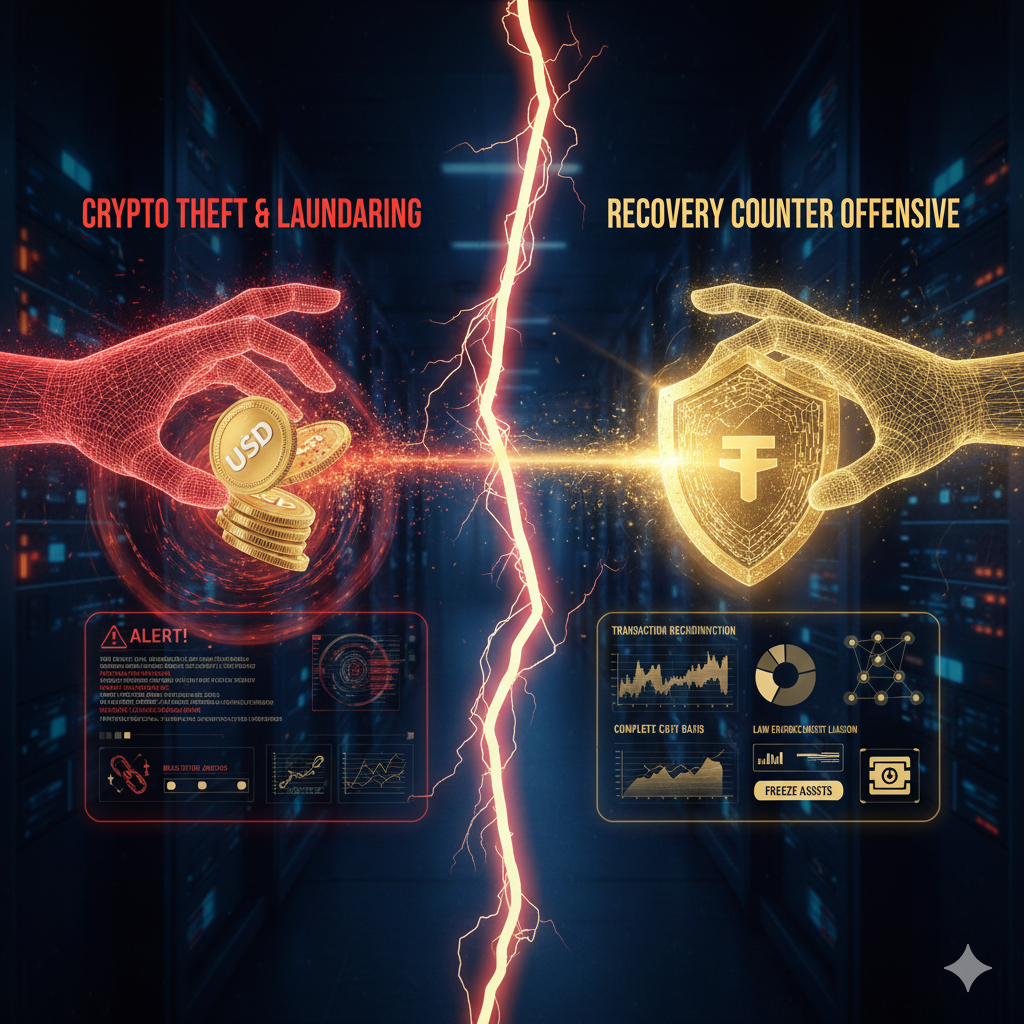
Tether can freeze stolen USDT through its built-in blacklist function, which prevents flagged addresses from transferring tokens – but triggering a freeze requires proper documentation, law enforcement coordination, and rapid response before criminals convert funds to other assets. Unlike decentralized cryptocurrencies where transactions are truly irreversible, centralized stablecoins like USDT and USDC include administrative controls allowing issuers to freeze addresses involved in theft, fraud, sanctions violations, and other illicit activity. Tether has frozen over $2.5 billion in USDT since 2017, including $435 million in a single enforcement action coordinating with US authorities in late 2024, demonstrating that stablecoin recovery represents one of the most viable pathways for crypto theft victims.
At Crypto Trace Labs, our team of VP and Director-level executives from Blockchain.com, Kraken, and Coinbase has coordinated numerous stablecoin freeze requests, working directly with issuer compliance teams and law enforcement to lock stolen funds before criminals can launder them. This guide explains how stablecoin blacklist functions work technically, what documentation issuers require to freeze addresses, how quickly victims must act, and what realistic outcomes victims can expect when pursuing stablecoin recovery through proper channels.
How Does Tether’s Blacklist Function Actually Work?
Tether’s USDT smart contract includes an administrative function that allows the company to add addresses to a blacklist, preventing those addresses from sending or receiving tokens. This is not a theoretical capability – it is actively used and publicly verifiable on the blockchain. When an address is blacklisted, any attempt to transfer USDT to or from that address will fail, effectively freezing the funds in place.
The technical implementation varies slightly across different blockchain networks where USDT operates. On Ethereum, the USDT contract includes functions like addBlackList and isBlackListed that Tether’s administrative addresses can call. Once blacklisted, the transfer and transferFrom functions check the blacklist status and revert if either the sender or recipient is flagged. This means stolen funds sitting at a blacklisted address become permanently immobilized until Tether removes the address from the blacklist.
Stablecoin Issuer Freeze Capabilities:
- Tether (USDT) – Blacklist function across Ethereum, Tron, Solana, and other networks; over $2.5 billion frozen since inception; active coordination with law enforcement globally
- Circle (USDC) – Blocklist function with similar technical implementation; frozen addresses documented on-chain; compliance-focused approach with proactive law enforcement partnerships
- Paxos (PYUSD, BUSD legacy) – Administrative freeze capabilities; regulated US entity with strict compliance requirements
- TrueUSD (TUSD) – Blacklist functionality; historically less active in freeze enforcement but capability exists
- DAI – Decentralized stablecoin without administrative freeze function; no issuer can blacklist addresses; truly irreversible transfers
The distinction between centralized stablecoins with freeze capabilities and decentralized alternatives without them is critical for recovery planning. If stolen funds remain in USDT or USDC, the freeze pathway exists. If criminals convert to DAI, ETH, or other decentralized assets, this specific recovery mechanism disappears.
Tether’s December 2024 transparency report documented 2,467 addresses on its blacklist, holding approximately $1.4 billion in frozen USDT at that time. The company reported coordinating with 124 law enforcement agencies across 48 countries during 2024, demonstrating the global reach of stablecoin freeze enforcement when proper channels are engaged.
What Triggers a Tether Freeze Request?
Tether does not freeze addresses based on individual victim reports alone. The company requires law enforcement involvement, legal documentation, or clear evidence of sanctions violations before adding addresses to the blacklist. Understanding what triggers freeze consideration helps victims pursue the correct pathway rather than wasting critical time on ineffective approaches.
The primary trigger for Tether freeze action is a formal request from law enforcement agencies investigating cryptocurrency theft, fraud, or money laundering. Agencies like the FBI, Secret Service, Department of Justice, and international equivalents can submit freeze requests through established channels. Tether’s compliance team evaluates these requests against their policies and applicable law before taking action.
Documentation That Supports Freeze Requests:
- Law Enforcement Case Numbers – Official investigation reference numbers from FBI, Secret Service, local cybercrime units, or international agencies demonstrate legitimate investigative basis
- Court Orders – Restraining orders, asset preservation orders, or judicial freeze orders from courts with jurisdiction provide legal compulsion for issuer action
- OFAC Sanctions Matches – Addresses matching Treasury Department sanctions lists trigger automatic or near-automatic freezing under US law compliance
- Blockchain Forensic Reports – Professional blockchain analytics documenting theft, tracing fund flows, and identifying scam addresses support law enforcement requests
- Victim Statements and Evidence – Detailed documentation of the theft including transaction hashes, communication records, and loss documentation supports the investigative file
- Exchange Cooperation Letters – Communications from regulated exchanges identifying addresses involved in fraud strengthen the evidentiary basis
Individual victims cannot typically trigger Tether freezes directly. However, victims who file proper law enforcement reports, provide comprehensive documentation, and engage professional forensic support dramatically increase the likelihood that their case receives the attention and resources needed to pursue freeze requests through official channels.
How Fast Must You Act for a Stablecoin Freeze?
Speed is the critical factor determining whether stablecoin freeze requests succeed. Criminals who steal cryptocurrency understand that centralized stablecoins carry freeze risk, so sophisticated attackers convert stolen USDT to other assets within hours or even minutes of the theft. The window for effective freeze action is measured in hours, not days.
Analysis of address poisoning attacks shows that criminals typically begin moving stolen USDT within 30 minutes to 2 hours of receiving funds. The December 2025 attack that stole $50 million in USDT from a single victim saw funds begin moving within hours, with portions routed through decentralized exchanges and converted to ETH before any freeze request could be processed.
Typical Criminal Laundering Timeline:
- 0-30 minutes – Funds arrive at attacker address; sophisticated attackers begin immediate conversion or distribution
- 30 minutes – 2 hours – Primary laundering phase; funds split across multiple wallets, swapped through DEXs, or bridged to other chains
- 2-6 hours – Secondary laundering; converted funds move through additional hops, mixers, or cross-chain bridges
- 6-24 hours – Cash-out attempts begin; funds reach exchange deposit addresses or OTC channels
- 24-72 hours – Remaining traceable funds typically complete laundering or reach final destinations
The practical implication is stark: victims who wait days to report theft or gather documentation likely miss the freeze window entirely. Funds that remain in USDT at identifiable addresses after 72 hours are relatively rare – criminals prioritize converting stablecoins specifically because freeze risk is well understood in criminal communities.
Crypto Trace Labs maintains direct relationships with compliance teams at major stablecoin issuers and exchanges, enabling faster communication during the critical early hours when freeze requests can still catch funds before conversion. Our executive-level contacts at Coinbase, Kraken, Binance, and other platforms accelerate the coordination process that individual victims cannot replicate through standard support channels.
What Happened in the $50 Million Address Poisoning Case?
The December 2025 address poisoning attack that stole $50 million in USDT from a single victim illustrates both the potential and limitations of stablecoin freeze mechanisms. This case, documented by Web3 security firm Web3 Antivirus and widely reported in cryptocurrency media, provides concrete evidence of how these attacks unfold and what recovery efforts look like in practice.
The victim sent a $50 test transaction to confirm a destination address before transferring the remaining funds. Unknown to the victim, an attacker had previously sent a small “dust” transaction from a spoofed address designed to closely match the legitimate destination – with identical first three and last four characters. When the victim copied what they believed was the confirmed address from their transaction history, they actually copied the attacker’s poisoned address, sending $49,999,950 in USDT to the scammer.
Timeline of the $50 Million Attack:
- Attack Preparation – Attacker generated vanity address matching victim’s frequent destination, sent dust transaction to poison transaction history
- Initial Test Transaction – Victim sent $50 test to legitimate address, confirmed receipt, believed address was verified
- Fatal Transfer – Victim copied poisoned address from transaction history, sent $49,999,950 USDT to attacker
- Rapid Laundering – Stolen funds quickly converted to ETH, distributed across multiple wallets, portions funneled through Tornado Cash mixer
- Victim Response – Victim published on-chain message demanding return of 98% of funds within 48 hours, offering $1 million white-hat bounty
- Legal Threats – Message warned of legal escalation and criminal charges if funds not returned, calling it “final opportunity to resolve peacefully”
The victim’s wallet had been active for approximately two years and was primarily used for USDT transfers. The compromised funds were withdrawn from Binance shortly before the poisoned transfer – suggesting the victim was conducting a routine large transfer they had likely performed many times before.
This case demonstrates that even experienced cryptocurrency users with established transaction patterns remain vulnerable to address poisoning attacks. The speed of the subsequent laundering through DEX swaps and Tornado Cash highlights why immediate response is essential for any recovery attempt.
Can Victims Request USDT Freezes Directly?
Individual victims cannot typically request Tether freezes directly through customer support channels. Tether operates as a financial infrastructure provider, not a consumer-facing service, and its compliance processes are designed to work with law enforcement agencies and regulated entities rather than individual claimants. This reality frustrates many victims who learn about freeze capabilities but cannot access them independently.
The pathway to a freeze request runs through law enforcement. When victims file reports with FBI IC3, local police cybercrime units, or international equivalents, those agencies can then engage with Tether’s compliance team through established law enforcement channels. The quality of victim documentation directly impacts whether investigators pursue freeze requests and how quickly they can act.
Steps to Position for Potential Freeze Action:
- Immediate Documentation – Record all transaction details including hashes, timestamps, addresses, and amounts before taking any other action
- Law Enforcement Reports – File reports with FBI IC3, FTC, local police, and Action Fraud (UK) to create official records
- Professional Forensic Analysis – Engage qualified cryptocurrency forensic investigators to trace funds and produce court-admissible documentation
- Exchange Notifications – Report theft to any exchanges where funds may land, triggering their own compliance review processes
- Legal Consultation – Consider cryptocurrency-experienced attorneys who can pursue civil remedies including emergency asset preservation orders
- Coordinated Approach – Work with forensic investigators who maintain direct relationships with issuer compliance teams and can facilitate communication
The distinction between filing reports and achieving freeze action is significant. Many victims file IC3 reports that enter a queue alongside thousands of other complaints. Cases that receive active investigation and freeze coordination typically involve larger dollar amounts, clear evidence, professional forensic documentation, and sometimes legal representation pushing the case forward.
Crypto Trace Labs has coordinated freeze requests across multiple cases, leveraging our direct compliance relationships and ACAMS-certified expertise to bridge the gap between victim documentation and issuer action. Our team understands exactly what documentation Tether and Circle compliance teams require and how to present cases for maximum likelihood of freeze consideration.
What Documentation Do Exchanges Need for Freeze Requests?
When stolen USDT reaches regulated exchanges rather than remaining at attacker-controlled addresses, a parallel freeze pathway exists through exchange compliance teams. Exchanges like Coinbase, Kraken, and Binance maintain their own compliance processes and can freeze accounts pending investigation when presented with credible evidence of theft or fraud.
Exchange compliance requirements vary but generally follow similar patterns. Understanding what documentation strengthens freeze requests helps victims and their representatives present cases effectively during the critical early hours when funds may still be recoverable.
Standard Exchange Compliance Documentation:
- Transaction Hash Evidence – Complete transaction records showing the theft, including the victim’s sending address, the fraudulent receiving address, amounts, and timestamps
- Blockchain Forensic Reports – Professional analysis from recognized firms using tools like Chainalysis or Elliptic documenting the theft and tracing fund flows to the exchange
- Law Enforcement Reference – Case numbers, officer contact information, or official correspondence demonstrating active investigation
- Victim Identity Verification – Proof that the requesting party is the legitimate victim, preventing attackers from using freeze requests as harassment tools
- Legal Documentation – Court orders, attorney letters, or formal legal demands that create compliance obligations for the exchange
- Communication Evidence – Records of any scam communications, phishing messages, or fraud evidence supporting the theft narrative
Exchange response times vary significantly based on documentation quality and case presentation. Well-documented requests with law enforcement involvement and professional forensic reports typically receive faster attention than individual victim complaints lacking supporting evidence.
Crypto Trace Labs’ executive-level contacts at major exchanges enable direct communication with compliance decision-makers rather than entry-level support queues. This access difference can mean hours or days in response time – often the difference between catching funds and watching them disappear.
What Are the Limitations of Stablecoin Freezes?
Stablecoin freeze capabilities provide a genuine recovery pathway but come with significant limitations that victims must understand. Freezing an address does not automatically return funds to victims, criminals who convert quickly may evade freezes entirely, and the process requires resources and coordination that many victims cannot independently mobilize.
The most fundamental limitation is timing. Sophisticated criminals understand stablecoin freeze risk and prioritize rapid conversion. Funds that reach DEXs, cross-chain bridges, or mixing services before freeze requests process are no longer recoverable through this mechanism. The $50 million address poisoning case demonstrated this reality – portions of the stolen USDT were converted to ETH and mixed through Tornado Cash before any freeze action was possible.
Key Limitations of Stablecoin Freeze Mechanisms:
- Speed Requirements – Freezes only catch funds that remain in USDT/USDC at identifiable addresses; rapid conversion defeats this pathway entirely
- No Automatic Return – Frozen funds remain in place but are not automatically returned to victims; legal process typically required to actually recover assets
- Law Enforcement Gatekeeping – Individual victims cannot trigger freezes directly; cases must rise to law enforcement attention and action
- Jurisdictional Complexity – International cases involving multiple jurisdictions complicate enforcement and recovery processes
- Conversion to Decentralized Assets – Funds swapped to ETH, BTC, DAI, or other decentralized assets cannot be frozen by any issuer
- Mixer and Bridge Usage – Funds processed through Tornado Cash, cross-chain bridges, or privacy protocols become difficult or impossible to freeze even if they return to stablecoins
- Resource Requirements – Effective freeze coordination requires professional forensic analysis, legal support, and compliance relationships most victims lack
These limitations do not make freeze pursuit worthless – they define realistic expectations. Cases where significant USDT remains at identifiable addresses within the critical window represent genuine recovery opportunities. Cases where funds converted quickly or processed through sophisticated laundering require alternative approaches or may not be recoverable through any mechanism.
How Does Tether Coordinate with Law Enforcement?
Tether maintains active law enforcement coordination programs, working with agencies worldwide to freeze addresses involved in theft, fraud, sanctions evasion, and other criminal activity. Understanding this coordination helps victims recognize what pathways exist and how their reports can potentially connect to freeze action.
Tether’s 2024 transparency reporting documented partnerships with 124 law enforcement agencies across 48 countries. The company reported responding to over 1,000 law enforcement requests during the year, with freeze actions ranging from individual scam addresses to large-scale coordinated enforcement involving hundreds of millions of dollars.
Documented Tether Law Enforcement Coordination:
- US Federal Agencies – FBI, Secret Service, DOJ, and Treasury Department (OFAC) coordination for domestic cases and sanctions enforcement
- International Partners – Interpol, Europol, and national agencies across major jurisdictions including UK, Singapore, Hong Kong, and others
- Sanctions Compliance – Automatic or rapid freezing of addresses matching OFAC sanctions lists, including addresses connected to North Korean operations like Lazarus Group
- Exchange Cooperation – Coordination with regulated exchanges when stolen funds flow through their platforms, supporting parallel freeze actions
- Asset Recovery Support – Cooperation with judicial processes for returning frozen funds to victims through proper legal channels
The December 2024 enforcement action that froze $435 million demonstrated Tether’s capability for large-scale coordinated action when working with US authorities. This single action represented nearly 20% of all funds Tether had frozen since inception, showing that major enforcement efforts can achieve significant results.
For individual victims, the implication is clear: cases that reach law enforcement attention and receive active investigation can potentially access these coordination mechanisms. The challenge lies in ensuring your case receives that attention, which typically requires comprehensive documentation, professional forensic support, and sometimes legal representation to elevate the case beyond the mass of routine complaints.
What Are Realistic Recovery Expectations?
Setting realistic expectations helps victims make informed decisions about pursuing stablecoin freeze pathways versus alternative approaches. Recovery through freeze mechanisms is possible and documented, but success rates depend heavily on factors including response speed, criminal sophistication, and available resources.
Professional recovery services working stablecoin freeze cases report varying success rates depending on case characteristics. Cases reported within 24 hours with funds still in USDT at identifiable addresses show meaningfully higher recovery rates than cases reported after extended delays or where funds converted quickly.
Recovery Outcome Factors:
- Immediate Response (0-24 hours, funds in USDT) – Highest freeze success probability; professional coordination can sometimes catch funds before conversion
- Early Response (24-72 hours, partial USDT) – Moderate freeze prospects for remaining stablecoin portions; converted funds require alternative tracing approaches
- Delayed Response (72+ hours) – Limited freeze prospects as most sophisticated criminals complete conversion; investigation may support later recovery through other mechanisms
- Professional Coordination – Cases with forensic documentation, legal support, and direct compliance relationships significantly outperform individual victim efforts
- Law Enforcement Engagement – Active investigation with assigned agents dramatically increases freeze request success versus unfiled or routine reports
- Dollar Amount – Larger cases typically receive more attention from law enforcement and compliance teams, though this creates unfortunate disparities for smaller victims
Even when freeze requests succeed, frozen funds are not automatically returned. Legal process – potentially including court orders across multiple jurisdictions – may be required to actually recover assets. Victims should understand that a successful freeze represents an important step but not the conclusion of recovery efforts.
Crypto Trace Labs provides honest case assessments explaining realistic outcomes based on specific circumstances before engagement. We do not promise guaranteed recovery or accept cases where analysis indicates negligible success probability. For certain non-custodial wallet recovery scenarios involving technical access issues rather than theft, we offer arrangements with no upfront fees – you only pay after successful fund recovery.
Frequently Asked Questions
Can Tether freeze stolen USDT?
Yes, Tether can freeze stolen USDT through its built-in blacklist function, which prevents flagged addresses from sending or receiving tokens. Tether has frozen over $2.5 billion in USDT since 2017, coordinating with 124 law enforcement agencies across 48 countries during 2024 alone. However, freezes require law enforcement involvement, proper documentation, and rapid response before criminals convert funds to other assets. Individual victims cannot trigger freezes directly but can support the process through comprehensive reporting and professional forensic documentation.
How do I report stolen USDT to Tether?
Individual victims cannot report directly to Tether’s compliance team for freeze action. The pathway runs through law enforcement: file reports with FBI IC3, local police cybercrime units, and relevant agencies, then provide comprehensive documentation supporting investigation. Law enforcement agencies can then engage Tether through established channels. Professional cryptocurrency forensic investigators with direct compliance relationships can help bridge this gap, ensuring your case documentation meets the standards required for freeze consideration.
How fast do criminals move stolen USDT?
Sophisticated criminals typically begin moving stolen USDT within 30 minutes to 2 hours, converting to ETH or other assets through decentralized exchanges and distributing across multiple wallets. The December 2025 $50 million address poisoning attack saw funds begin moving within hours, with portions routed through Tornado Cash before any freeze request could process. This timeline makes immediate response critical – funds remaining in USDT after 72 hours are relatively rare as criminals prioritize converting stablecoins due to known freeze risk.
What documentation do I need for a freeze request?
Effective freeze requests require law enforcement case numbers, complete transaction records including hashes and timestamps, professional blockchain forensic reports documenting the theft and fund flows, victim identity verification, and ideally court orders or formal legal demands. The quality of documentation directly impacts whether investigators pursue freeze requests and how quickly compliance teams respond. Professional forensic analysis from firms using tools like Chainalysis or Elliptic significantly strengthens case presentation.
Can Circle freeze stolen USDC like Tether freezes USDT?
Yes, Circle maintains similar blocklist functionality for USDC with comparable technical implementation. Circle has frozen addresses involved in theft, fraud, and sanctions violations, though the company’s compliance-focused approach and US regulatory status create somewhat different processes than Tether. Both issuers require law enforcement involvement for freeze action and neither responds to individual victim requests without official investigation backing.
What happens to frozen USDT?
Frozen USDT remains at the blacklisted address but cannot be transferred. The funds are not automatically returned to victims – legal process is typically required to actually recover assets. This may involve court orders, law enforcement asset forfeiture proceedings, or negotiated settlements. Frozen funds represent secured assets pending legal resolution rather than completed recovery. Victims should understand that successful freeze is an important step but not the final recovery stage.
Does reporting to FBI IC3 actually trigger Tether freezes?
FBI IC3 reports can potentially lead to Tether freezes, but the pathway involves multiple steps. IC3 reports enter a queue alongside thousands of other complaints; cases receiving active investigation and agent assignment can then access freeze coordination channels. Larger dollar amounts, clear evidence, professional forensic documentation, and sometimes legal representation increase likelihood that cases rise to active investigation status. Comprehensive initial reporting creates the foundation for potential escalation.
Can stolen USDT be recovered after it’s converted to ETH?
Once USDT converts to ETH or other decentralized assets, the stablecoin freeze mechanism no longer applies. Recovery then depends on tracing funds to centralized exchanges or services where different freeze mechanisms exist, or law enforcement asset seizure through other means. Conversion to decentralized assets significantly complicates recovery but does not make it impossible – professional blockchain forensics can trace converted funds through complex laundering chains to identify potential recovery touchpoints.
How much USDT has Tether actually frozen?
Tether has frozen over $2.5 billion in USDT since launching the blacklist function, including $435 million in a single December 2024 enforcement action coordinating with US authorities. The company’s December 2024 transparency report documented 2,467 addresses on the blacklist holding approximately $1.4 billion in frozen USDT at that time. These figures demonstrate that stablecoin freezes represent a genuine, actively-used recovery mechanism rather than theoretical capability.
Should I hire a recovery service for stolen USDT?
Professional recovery services with direct compliance relationships, law enforcement coordination experience, and recognized forensic capabilities can significantly improve freeze request outcomes compared to individual victim efforts. However, victims should carefully verify any service’s credentials, avoid guaranteed recovery claims, and watch for recovery scam red flags. Legitimate services provide case assessments with realistic expectations before significant financial commitment and do not demand upfront cryptocurrency payments.
What Should You Do Next?
This guide was prepared by the team at Crypto Trace Labs, drawing on 10+ years of crypto and financial crime experience. Our founders held VP and Director positions at Blockchain.com, Kraken, and Coinbase, and hold ACAMS certifications, MLRO qualifications across UK, US, and Europe, and Chartered status at Fellow Grade. We have provided expert witness testimony in court proceedings and maintain direct executive contacts at all major cryptocurrency exchanges and stablecoin compliance teams globally.
If you have lost USDT or other stablecoins to theft, scams, or fraud, time is critical. Every hour that passes reduces the likelihood that funds remain in freezable form as criminals convert to decentralized assets. Professional investigation combining blockchain forensics with direct compliance relationships offers freeze coordination capabilities unavailable through individual efforts or standard support channels. Crypto Trace Labs provides honest case assessments with realistic outcome expectations before engagement. For certain non-custodial wallet recovery scenarios, we offer arrangements with no upfront fees – you only pay after successful fund recovery.
Contact Crypto Trace Labs for an urgent case assessment and professional stablecoin recovery coordination.
This content is for informational purposes only and does not constitute legal, financial, or compliance advice. Crypto asset recovery outcomes depend on specific circumstances, regulatory cooperation, and technical factors. Consult qualified professionals regarding your situation.