

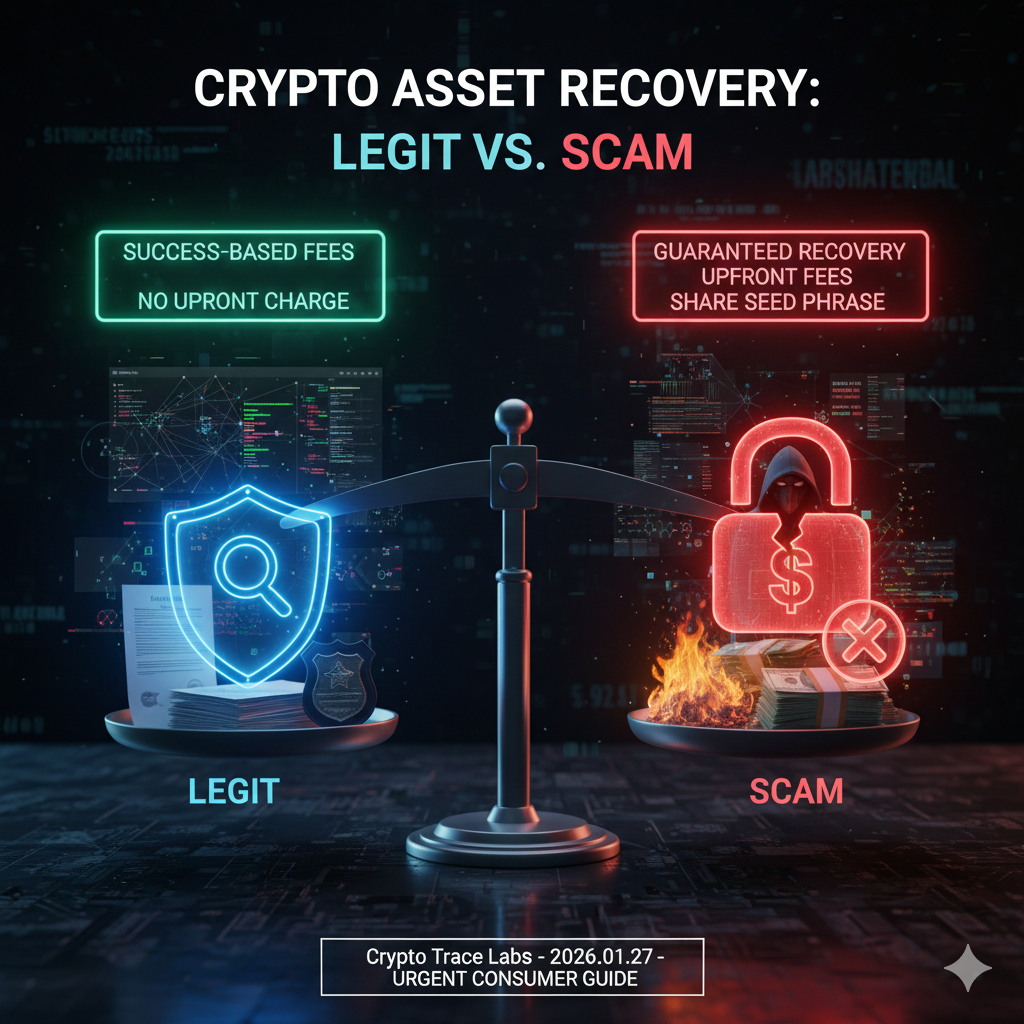
Crypto asset recovery is the process of tracing, freezing, and retrieving cryptocurrency that has been stolen, lost to scams, or become inaccessible due to forgotten credentials. Legitimate recovery involves blockchain forensics to track fund movements, coordination with exchanges to freeze accounts, legal action to compel disclosure or asset return, and technical methods to recover access to wallets. Recovery is sometimes possible – particularly when victims act quickly and stolen funds reach compliant exchanges – but it is never guaranteed, and the industry is plagued by secondary scams targeting people who have already lost money once.
At Crypto Trace Labs, our team includes VP and Director-level executives from Blockchain.com, Kraken, and Coinbase with over a decade of crypto and financial crime experience. We have helped victims understand their realistic options, traced funds across complex laundering paths, and worked with exchanges and law enforcement to freeze assets where possible. This guide explains what legitimate recovery looks like, how to identify scam recovery services, and the steps you should take after experiencing crypto theft.
What Is Crypto Asset Recovery?
Crypto asset recovery includes several distinct activities, and understanding what each involves helps set realistic expectations.
Blockchain Forensics and Tracing uses specialized software from providers like Chainalysis and Elliptic to follow cryptocurrency movements across wallets, exchanges, bridges, and mixing services. Tracing does not recover funds directly – it identifies where stolen assets went and whether they reached services that might cooperate with freeze requests.
Exchange Freezes occur when centralized platforms with strong AML compliance programs identify deposits linked to theft and place holds on the associated accounts. This requires the exchange to have strong compliance programs, receive timely notification from victims or law enforcement, and be willing to cooperate. Not all exchanges respond to requests, and funds must actually reach the platform before they can be frozen.
Legal and Regulatory Action involves court orders, subpoenas, and law enforcement cooperation to compel exchanges to freeze assets, disclose account holder information, or return funds. This path requires documented evidence and often takes months or years.
Wallet Access Recovery applies when the owner has lost passwords, seed phrases, or device access but the funds have not actually been stolen. This is a technical challenge rather than a theft investigation.
What recovery is not: “hacking back” to steal funds from thieves, guaranteed return of assets, bypassing sanctions or legal restrictions, or any process requiring you to share your seed phrase with a third party.
Can Stolen Crypto Actually Be Recovered?
In some cases, yes – especially when victims act within hours, document everything thoroughly, and stolen funds reach regulated exchanges before being converted or withdrawn. But full recovery is uncommon, and partial recovery depends on factors largely outside the victim’s control.
Recovery is more likely when funds are sent to major centralized exchanges with compliance teams that respond to freeze requests. Stablecoins like USDT and USDC can sometimes be frozen by their issuers at specific addresses. Law enforcement involvement increases pressure on exchanges to cooperate. Quick reporting before funds move through multiple laundering layers improves odds substantially.
Recovery is less likely when funds immediately move through decentralized exchanges, cross-chain bridges, or mixing services. Privacy coins like Monero present significant tracing challenges. Exchanges in jurisdictions with weak enforcement may ignore requests. Long delays before reporting give attackers time to convert and withdraw.
The honest answer is that most stolen cryptocurrency is not recovered. But “most” is not “all,” and professional investigation sometimes identifies recovery paths that victims would never find on their own. The key is understanding realistic probabilities before spending money on investigation services.
For detailed guidance on what to do immediately after crypto theft, see our step-by-step guide.
How Do Crypto Recovery Scams Work?
Recovery scams specifically target people who have already lost money to cryptocurrency fraud – a cruel secondary victimization. Scammers monitor social media for posts about crypto losses, scrape complaint databases, and even purchase victim lists from the original fraudsters. The FTC reports that recovery scams have increased dramatically alongside the growth in crypto fraud overall.
The Upfront Fee Model demands payment before any work begins, often framed as “processing fees,” “tax clearance,” or “blockchain activation costs.” Legitimate firms may charge retainers or hourly fees, but requests for substantial upfront payment with guaranteed results are a major red flag.
The Seed Phrase Request asks victims to share their wallet recovery phrase for “verification” or “connection to recovery systems.” No legitimate recovery service ever needs your seed phrase. Sharing it gives complete control of your wallet to anyone who receives it.
Fake Law Enforcement Claims involve scammers impersonating FBI agents, Interpol officers, or financial regulators who claim they have located your funds and need fees to release them. Real law enforcement does not charge victims to return seized assets.
Impersonation of Legitimate Firms uses names and branding copied from real blockchain analytics or investigation companies. Scammers create lookalike websites and reach out via social media or unsolicited messages claiming to represent known firms.
The Escalating Fee Trap starts with a small “diagnostic” payment, then requires additional fees for each supposed step – “exchange cooperation fees,” “international transfer clearance,” “tax documentation” – with promises that the next payment will finally release funds.
For comprehensive guidance on spotting fake crypto recovery services, see our detailed warning signs guide.
What Red Flags Indicate a Recovery Scam?
Learning to identify scam indicators protects you from losing even more money after an initial theft.
Guaranteed Recovery: No legitimate service can guarantee results. Recovery depends on where funds went, exchange cooperation, legal processes, and factors no investigator controls. Anyone promising certain recovery is lying.
Upfront Payment for Guaranteed Results: Legitimate firms may charge for investigative work, but combining large upfront fees with recovery guarantees is a scam pattern.
Requests for Seed Phrases or Private Keys: Never share these with anyone. A legitimate investigator needs transaction hashes and wallet addresses – public information – not your private credentials.
Unsolicited Contact: Real recovery firms do not monitor social media for victims to cold-message. If someone contacts you first offering recovery help, be extremely suspicious.
Pressure to Act Immediately: Scammers create urgency to prevent you from researching them or consulting others. Legitimate professionals understand that careful decisions take time.
Untraceable Payment Methods: Requests for payment in cryptocurrency, gift cards, or wire transfers to individuals rather than business accounts suggest fraud.
No Written Contract or Engagement Terms: Professional services provide clear documentation of scope, fees, and limitations before beginning work.
Claims of Special Government Access: No private firm has secret connections to release seized funds or bypass legal processes.
How Do You Choose a Legitimate Recovery Service?
Selecting a credible firm requires verification of credentials, realistic conversations about outcomes, and clear documentation of the engagement.
Verify Business Registration and History: Legitimate firms have verifiable corporate registration, physical addresses, and documented history. Search for the company name plus “scam” or “reviews” to see if others report problems.
Look for Recognized Credentials: Certifications like ACAMS (Certified Anti-Money Laundering Specialist) indicate professional training. Court testimony experience demonstrates that legal systems have accepted the firm’s expertise. Relationships with established blockchain analytics providers suggest genuine technical capability.
Assess Website and Communication Quality: Professional firms have detailed service descriptions, clear contact information, and realistic messaging about outcomes. Vague promises, grammatical errors, and pressure tactics indicate problems.
Request References or Case Studies: Established firms can describe past work in general terms (while protecting client confidentiality) or provide references. Complete inability to document any track record is concerning.
Review Engagement Terms Carefully: Legitimate services provide written contracts specifying scope, fees, timelines, and limitations. Terms should explicitly state that recovery is not guaranteed.
Confirm They Work With – Not Against – Authorities: Real recovery involves cooperation with exchanges, law enforcement, and legal processes. Any firm suggesting they can bypass these systems or “hack back” is either fraudulent or proposing illegal activity.
Crypto Trace Labs offers no upfront charge for non-custodial wallet recoveries – you only pay after successful fund recovery. This success-based model aligns our incentives with yours rather than extracting fees regardless of outcome.
What Should You Do Immediately After Crypto Theft?
The first 24-48 hours after discovering theft significantly impact recovery possibilities. Taking systematic action during this window improves outcomes.
Document Everything First:
Record all transaction hashes from the theft, the addresses that received your funds, exact timestamps, and the amount and type of cryptocurrency stolen. Screenshot any communications with scammers including usernames, email addresses, and phone numbers. Preserve browser history and any files or software involved. This documentation is essential for both reporting and investigation.
Secure Remaining Assets:
Transfer any cryptocurrency still in compromised wallets to new wallets created on a clean device with fresh seed phrases. Change passwords on exchange accounts and enable two-factor authentication if not already active. Check for unauthorized token approvals and revoke them using tools like Revoke.cash.
Report to Relevant Authorities:
File reports with the FBI’s Internet Crime Complaint Center (IC3), your local police, and the FTC. Report to your country’s financial crime agency. For comprehensive guidance on where and how to report cryptocurrency fraud, see our detailed resource. These reports create official records and may contribute to larger investigations even if immediate action is not visible.
Notify Exchanges and Platforms:
If you can identify which exchanges received stolen funds, contact their support teams with documentation. Include transaction hashes and explain the situation. Some exchanges have dedicated fraud teams that respond to well-documented reports.
Then Consider Professional Help:
After completing immediate documentation and reporting, evaluate whether professional blockchain forensics investigation makes sense given the amount lost and your specific circumstances.
When Should You Not Use a Recovery Service?
Recovery services are not appropriate for every situation. Understanding when to avoid them saves money and prevents exploitation.
When Losses Are Small Relative to Investigation Costs: If you lost $500, spending $2,000 on investigation fees makes no financial sense. Legitimate firms should be honest about this math rather than accepting cases where costs will exceed any possible recovery.
When You Are Being Pressured to Decide Immediately: Legitimate services allow time for research and consideration. Pressure to commit quickly suggests the “service” is more interested in your money than your recovery.
When Requested Actions Are Illegal: Any service proposing to “hack” exchanges, access accounts without authorization, or help you evade sanctions or regulatory requirements is proposing criminal activity that will create more problems.
When You Have Already Paid Multiple Services Without Results: If several previous recovery attempts have failed after taking your money, another payment to another service is unlikely to produce different results. The pattern suggests you are being targeted by recovery scammers.
When Time Has Passed and Funds Have Moved Extensively: If theft occurred months ago and funds have already moved through multiple mixing services and conversion steps, realistic recovery probability is extremely low regardless of investigation quality.
What Does Legitimate Recovery Actually Cost?
Fee structures vary across the industry, and understanding common models helps identify reasonable versus exploitative pricing.
Hourly or Retainer Fees cover investigator time for tracing, documentation, and coordination. Rates typically range from $150-500 per hour depending on firm reputation and case complexity. This model means you pay for work performed regardless of outcome.
Success-Based Fees charge a percentage of recovered funds only if recovery succeeds. Percentages commonly range from 10-30% depending on case difficulty and amount involved. This aligns firm incentives with your outcome but may not be available for all case types.
Hybrid Models combine a smaller upfront retainer with success fees on recovery. This balances investigator compensation for work performed with outcome-based incentives.
What Is Not Reasonable: Demands for large upfront payments combined with guaranteed results. Fees that exceed the amount lost. Requests for payment in cryptocurrency or untraceable methods. Escalating fees where each “step” requires additional payment.
Crypto Trace Labs uses a success-based model for non-custodial wallet recoveries with no upfront charge – you pay only after we successfully recover funds. For tracing and investigation services, we provide clear written terms before any engagement begins.
Frequently Asked Questions
Can I recover crypto sent to the wrong address?
If you sent cryptocurrency to an incorrect address by mistake, recovery depends entirely on who controls that address. If it belongs to an exchange, their support team may be able to assist. If it is another individual’s wallet, you would need their voluntary cooperation since blockchain transactions are irreversible. If the address has no owner or belongs to someone unidentifiable, recovery is generally impossible. Unlike bank transfers, there is no central authority that can reverse cryptocurrency transactions without the recipient’s consent.
Is it possible to trace crypto through mixing services?
Yes, though difficulty varies by service type. Blockchain analytics firms like Chainalysis and Elliptic have developed techniques to trace funds through many mixing services using timing analysis, amount correlation, and behavioral patterns. Several mixers have been sanctioned specifically because investigators successfully traced North Korean and other criminal funds through them. However, sophisticated mixing and privacy tools do increase tracing difficulty, and some transactions may not be traceable with current methods.
Can a service recover my lost seed phrase?
No legitimate service can “recover” a seed phrase you have lost entirely. If you wrote down your seed phrase but cannot find it, that is a search problem, not a technical one. If you remember partial information, some specialized firms attempt to reconstruct possibilities through brute-force approaches, but success rates vary dramatically. Anyone claiming they can simply recover or retrieve a seed phrase you never recorded is either confused about what you are asking or running a scam.
How long does the crypto recovery process typically take?
Timelines vary enormously depending on case complexity. Simple tracing to identify where funds went may take days to weeks. Obtaining exchange cooperation for freezes can take weeks to months. Legal processes involving court orders or law enforcement typically take months to years. Some cases resolve quickly when funds happen to land at cooperative exchanges; others drag on indefinitely. Legitimate services should give realistic timeline estimates rather than promising rapid results.
Are crypto recovery lawyers worth hiring?
Legal counsel becomes valuable when recovery requires court orders, subpoenas, or formal legal action against identifiable parties. For straightforward tracing and exchange coordination, lawyers may be unnecessary. For complex cases involving significant amounts, international jurisdictions, or uncooperative parties, legal representation can be essential. The decision depends on case specifics, amount at stake, and whether legal action is a realistic path. Some victims benefit from consulting a lawyer before deciding on overall strategy.
What information does a legitimate recovery service need from me?
A legitimate investigator needs transaction hashes showing the theft, your wallet addresses involved, timestamps of when theft occurred, documentation of any communication with scammers, and details about how the theft happened. They do not need your seed phrase, private keys, exchange passwords, or remote access to your computer. Any request for credentials that would give someone control over your remaining assets is a major red flag regardless of stated justification.
Can exchanges refuse to help with recovery?
Yes. Exchanges have no universal legal obligation to freeze funds or cooperate with individual victims, though many do so voluntarily for documented cases. Cooperation varies by platform, jurisdiction, and case quality. Some exchanges have dedicated fraud investigation teams that respond promptly to well-documented reports. Others are slow, unresponsive, or located in jurisdictions with minimal enforcement. Legitimate recovery services have established relationships with exchange compliance teams, which can improve response rates and speed.
Should I report crypto theft to police even if recovery seems unlikely?
Yes. Police reports create official records that may be required for insurance claims, support any future legal action, and contribute to aggregate data that influences law enforcement resource allocation. Even if individual case investigation is unlikely, your report may connect to larger patterns that eventually lead to arrests. Reports to agencies like the FBI’s IC3 feed into databases used to identify organized criminal networks. The reporting process is free and takes relatively little time compared to potential future benefits.
What Should You Do Next?
This guide was prepared by the team at Crypto Trace Labs, drawing on 10+ years of crypto and financial crime experience. Our founders held VP and Director positions at Blockchain.com, Kraken, and Coinbase, and hold ACAMS certifications, MLRO qualifications across UK, US, and Europe, and Chartered status at Fellow Grade. We maintain executive-level contacts at major exchanges for expedited cooperation during investigations.
If you have experienced cryptocurrency theft and want to understand your realistic options, professional assessment can clarify whether recovery efforts make sense for your specific situation. We offer no upfront charge for non-custodial wallet recoveries – you only pay after successful fund recovery.
Contact Crypto Trace Labs for confidential consultation on crypto asset recovery and investigation.
This content is for informational purposes only and does not constitute legal, financial, or compliance advice. Crypto asset recovery outcomes depend on specific circumstances, regulatory cooperation, and technical factors. Recovery is never guaranteed. Consult qualified professionals regarding your situation.