


Last Updated: March 2026
Wrapped token forensics is the investigative process of tracing cryptocurrency that has been converted into a bridge-pegged representation on a different blockchain, most commonly Bitcoin wrapped as WBTC on Ethereum. When Bitcoin is deposited with a custodian and WBTC is minted in return, or when WBTC is burned to redeem native Bitcoin, each event leaves a permanent and traceable record on both blockchains. Investigators use these dual-chain records to follow funds across network boundaries and link wrapped asset activity to the original Bitcoin wallet owners.
At Crypto Trace Labs, our team – VP and Director-level executives from Blockchain.com, Kraken, and Coinbase – has traced wrapped token flows across WBTC, wETH, and multiple bridge protocols as part of DeFi fraud investigations and AML compliance reviews. This guide draws on that experience to explain what investigators need to know about wrapped asset forensics.
Key Takeaways
- Minting records expose the depositor: Every WBTC minting event is tied to a merchant transaction on Bitcoin and a KYC-verified Bitgo custodian record, giving investigators a direct link between WBTC holder and underlying Bitcoin identity.
- Burn events anchor the withdrawal: WBTC redemptions produce a burn transaction on Ethereum and a release on Bitcoin, creating bookend evidence around the wrapped period. Chainalysis (2024) attributes 71% of WBTC redemptions to identified entities.
- Bridge contracts are transparent: Unlike privacy-focused mixers, WBTC bridge contract state is fully public on Ethereum, making the complete minting and burning history readable through standard forensic tooling.
- Criminal use of wrapping grew: Elliptic (2024) reported a 290% increase in illicit fund flows through wrapped token protocols between 2022 and 2024, as criminals exploit cross-chain movement to create tracing gaps.
- DeFi exposure amplifies complexity: Once minted, WBTC frequently enters Aave, Uniswap, or Curve pools, requiring smart contract event log analysis at each interaction before the burn event can be traced.
Why This Matters
Wrapped token forensics matters because WBTC and similar bridge assets allow Bitcoin holders to participate in Ethereum DeFi activity while creating apparent breaks in the on-chain trace. An investigator following Bitcoin funds that suddenly disappear into a custodian deposit address may lose the thread entirely without understanding the wrapped token structure. Compliance teams at regulated exchanges must identify when customer deposits arrive from WBTC redemption addresses, as those funds may carry historical exposure from DeFi activity. Law enforcement agencies building asset freezing cases require continuous fund tracing from Bitcoin through the wrapped period and back.
WBTC Custodial Structure and Forensic Value
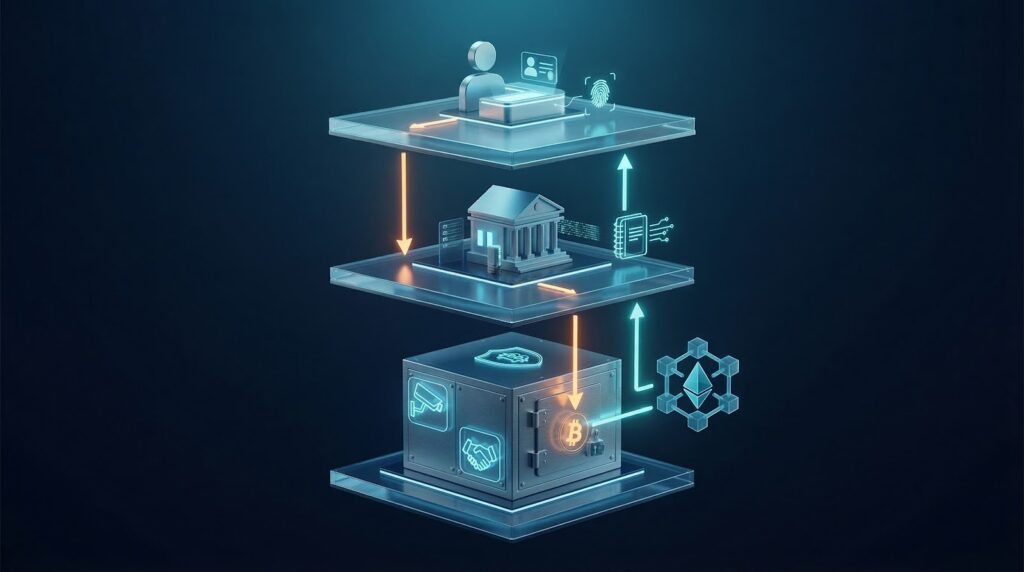
WBTC operates through a three-tier structure: Bitgo acts as custodian holding the underlying Bitcoin, merchants handle the conversion process between users and Bitgo, and users interact with merchants to mint or burn WBTC. Each merchant must pass KYC verification with Bitgo before receiving minting approval. This structure means every WBTC minting event links to a KYC-verified merchant identity, and merchants maintain records of the user deposits that triggered each minting transaction.
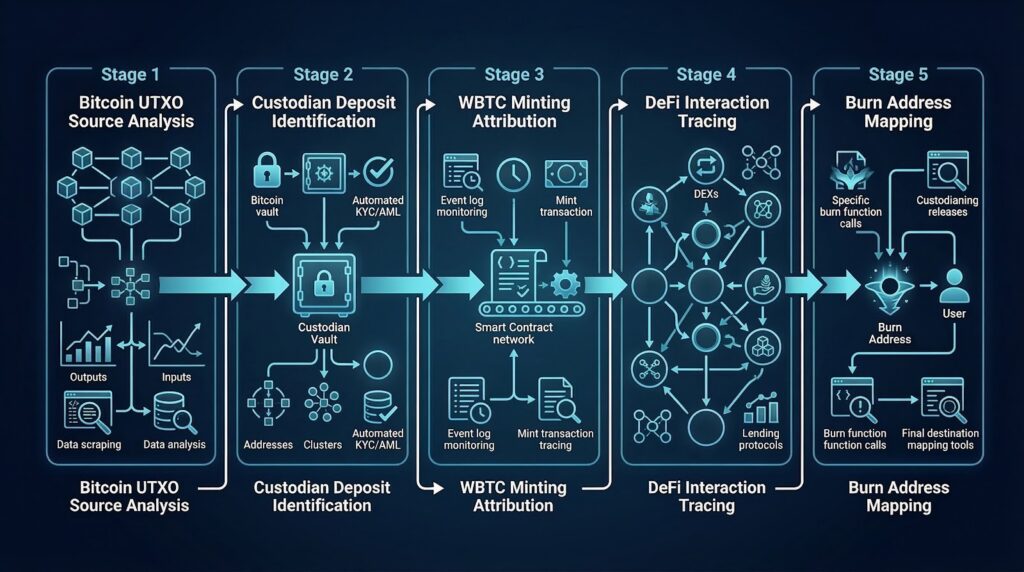
Forensic investigators access this attribution trail by identifying the Bitcoin custodian deposit address in the WBTC minting transaction, tracing the Bitcoin funding that address back through UTXO history, and cross-referencing the Ethereum WBTC recipient address against known exchange wallets. According to Bitgo’s transparency reports, the 21 active WBTC merchants include major regulated exchanges including Coinbase, Kraken, and Blockchain.com – giving investigators direct KYC data access when fund flows route through these entities.
Tracing Wrapped Asset Bridge Contracts
Bridge contract tracing for wrapped tokens follows a different methodology than WBTC, as permissionless bridges like Ren Protocol, Multichain, and native Ethereum bridges do not require custodian KYC. These bridges use smart contract logic to lock assets on one chain and mint wrapped versions on the destination chain. The entire process executes through publicly readable contract events, giving investigators full visibility into lock amounts, sender addresses, and recipient addresses.
The standard investigation approach for non-custodial bridges maps the lock event on the source chain to the mint event on the destination chain using the bridge’s transaction identifier. Investigators then apply UTXO or UTXO-equivalent analysis to the source chain funding transaction and cross-reference the destination mint recipient against exchange attribution databases. According to TRM Labs (2024), 65% of non-custodial bridge transfers involving illicit funds link to identified exchange withdrawal addresses within 90 days of the bridge event.
Wrapped Token Forensic Platform Comparison
Forensic platform coverage varies significantly across the major wrapped token protocols. Investigators need to match their tooling to the specific bridge used in each case.
The following comparison summarises platform capabilities across the main wrapped asset types:
| Platform | WBTC Coverage | Non-Custodial Bridges | DeFi Interaction Tracing | Attribution Database |
|---|---|---|---|---|
| Chainalysis Reactor | Full custodian linkage | Partial cross-chain | Strong Aave/Uniswap | Largest exchange database |
| Elliptic Investigator | Full custodian linkage | Full multi-chain | Strong event log coverage | Broad exchange coverage |
| TRM Labs | Good WBTC coverage | Growing multi-chain | Moderate DeFi | Global exchange database |
| Crystal Intelligence | Basic WBTC | Limited bridges | Limited DeFi | European-focused |
Investigators handling WBTC cases with custodian involvement should prioritise Chainalysis Reactor and Elliptic Investigator for their direct Bitgo merchant attribution. Non-custodial bridge cases benefit from Elliptic’s multi-chain coverage. Our team uses both platforms in combination, supplemented by direct exchange relationship contacts from founding experience at Blockchain.com, Kraken, and Coinbase.
AML Compliance Obligations for Wrapped Tokens
Regulated exchanges and DeFi compliance teams face specific AML obligations when customers interact with wrapped tokens. WBTC transactions exceeding reporting thresholds trigger Travel Rule requirements, with the merchant acting as the obligated Virtual Asset Service Provider. Non-custodial bridge transactions present greater compliance complexity because no regulated intermediary captures originator and beneficiary data at the point of bridging.
Under UK AML regulations and EU AML directives, regulated exchanges receiving WBTC redemptions must treat them as equivalent to Bitcoin deposits for risk assessment purposes. If the WBTC originated from a sanctioned DeFi protocol or passed through a blacklisted address during its Ethereum period, the receiving exchange bears responsibility for identifying and reporting that exposure. According to ACAMS (2024), fewer than 40% of regulated exchanges had specific wrapped token monitoring policies in place, creating significant compliance gaps. MLRO-qualified compliance teams must implement chain-specific monitoring that accounts for the wrapped asset lifecycle.
Wrapped Token Evidence in Legal Proceedings
Wrapped token evidence meets UK court admissibility standards when investigators document the complete chain: Bitcoin funding address, custodian deposit transaction, WBTC minting event with block height and contract address, all DeFi interactions during the wrapped period, and the final burn and Bitcoin redemption address. The continuous economic equivalence of the wrapped token to the underlying Bitcoin must be established through the custodian mechanism.
Courts have accepted WBTC tracing evidence in asset freezing injunction proceedings when supported by a certified forensic report and expert witness testimony. The Crypto Trace Labs team – ACAMS-accredited, MLRO-qualified across UK, US, and EU, and Chartered Fellow Grade at the CMI – has provided court-recognized expert witness testimony in wrapped asset recovery cases.
Frequently Asked Questions
What is wrapped token forensics?
Wrapped token forensics is the investigative process of tracing cryptocurrency converted into bridge-pegged representations on different blockchains, such as Bitcoin wrapped as WBTC on Ethereum. Investigators follow the minting and burning events that bridge assets between networks, linking the wrapped token holder to the underlying original asset owner. The discipline requires cross-chain visibility and knowledge of each bridge mechanism’s custodial or contract-based architecture to maintain evidence continuity across the full asset lifecycle.
How does WBTC tracing work for investigators?
Investigators trace WBTC by identifying the Bitgo custodian deposit transaction on Bitcoin, linking it to the Ethereum WBTC minting event through the merchant record, then tracking WBTC movements across Ethereum using smart contract event log analysis. The custodian structure provides KYC attribution at the minting stage. When WBTC is burned for Bitcoin redemption, investigators identify the redemption Bitcoin address and apply UTXO analysis to subsequent movement. Chainalysis (2024) attributes 71% of WBTC redemptions to identified entities through this methodology.
What makes non-custodial bridges harder to trace?
Non-custodial bridges do not require KYC verification or custodian intermediaries, so investigators cannot access merchant identity records at the minting stage. Attribution must rely entirely on blockchain analysis – tracing the source chain funding transaction through UTXO clustering and cross-referencing the destination chain recipient with exchange attribution databases. Despite this, bridge contract events remain fully public on both chains. TRM Labs (2024) found 65% of illicit non-custodial bridge transfers link to identified exchange addresses within 90 days.
Can WBTC holders remain anonymous?
WBTC holders face significant de-anonymisation risk because the custodial minting structure requires KYC at the merchant level, and all minting and burning events are permanently recorded on both Bitcoin and Ethereum. Internal WBTC transfers between wallets on Ethereum are more difficult to attribute, but entry and exit events provide strong anchors. Investigators with exchange relationships can access KYC data from the 21 active WBTC merchants, most of which are regulated exchanges operating under UK AML regulations and EU AML directives.
What DeFi interactions complicate wrapped token tracing?
When WBTC enters lending protocols like Aave, liquidity pools like Uniswap or Curve, or yield aggregators, investigators must trace each smart contract interaction using Ethereum event log analysis before the WBTC burn can be linked to the original Bitcoin holder. Each protocol interaction adds contract addresses and intermediate token swaps. Elliptic Investigator and Chainalysis Reactor support multi-hop DeFi tracing, allowing investigators to follow WBTC through complex protocol chains back to the original minting address and its associated Bitcoin source.
How does blockchain analytics cover wrapped assets?
Leading blockchain analytics platforms cover wrapped assets by indexing bridge contract events alongside standard transaction data. Chainalysis Reactor and Elliptic Investigator both track WBTC minting and burning events, linking them to Bitcoin custodian records and Ethereum address clusters. Non-custodial bridge coverage varies by protocol – Elliptic provides the broadest multi-chain coverage across Ren, Multichain, and native Ethereum bridges. Investigators can also use public Ethereum block explorers to manually trace bridge contract events when enterprise tooling lacks specific bridge support.
What compliance obligations apply to wrapped token transactions?
Regulated exchanges receiving WBTC must treat incoming transfers as equivalent to Bitcoin deposits for AML risk assessment. Travel Rule obligations apply to WBTC transfers above reporting thresholds when processed through regulated merchants. Under UK AML regulations and EU AML directives, exchanges must assess whether WBTC received from customers originated from sanctioned protocols or passed through blacklisted addresses. According to ACAMS (2024), fewer than 40% of regulated exchanges had dedicated wrapped token monitoring policies, creating significant compliance exposure.
How does Crypto Trace Labs trace wrapped token flows?
Crypto Trace Labs traces wrapped token flows by establishing the Bitcoin funding source first, then following the custodian deposit through the WBTC minting event and any subsequent DeFi interactions on Ethereum. When the burn event is identified, investigators apply UTXO analysis to the Bitcoin redemption address. Executive-level contacts at Blockchain.com, Kraken, and Coinbase – all active WBTC merchants – accelerate KYC data requests. The firm offers no upfront charge for non-custodial wallet recoveries where wrapped token tracing is required.
What evidence is needed to freeze WBTC in court proceedings?
To support a WBTC asset freezing application, investigators must document the Bitcoin funding address, custodian deposit transaction hash and block height, Ethereum WBTC minting transaction with merchant identifier, all WBTC transfers and DeFi interactions during the wrapped period, and the burn transaction with Bitcoin redemption address. The economic equivalence between the Bitcoin original and the WBTC must be established through the custodian mechanism. Expert witness certification strengthens applications where the judge has limited prior exposure to wrapped asset structures.
Executive Summary
Wrapped token forensics traces WBTC and bridge-wrapped assets by following minting and burning events across Bitcoin and Ethereum. The WBTC custodial structure – Bitgo, merchants, and users – provides KYC attribution at the minting stage, while non-custodial bridges require pure blockchain analysis. Investigators use Chainalysis Reactor and Elliptic Investigator to follow WBTC through DeFi interactions before tracing the burn event back to the Bitcoin redemption address. AML compliance teams must implement wrapped token monitoring under UK AML regulations and EU AML directives. Elliptic (2024) found a 290% increase in illicit wrapped token flows between 2022 and 2024.
What Should You Do Next?
If your investigation involves WBTC or bridge-wrapped assets, tracing the complete lifecycle across both chains requires specialist tooling and custodian-level relationships.
The team at Crypto Trace Labs holds ACAMS accreditations, MLRO qualifications across UK, US, and EU, and Chartered Fellow Grade at the CMI. Founding members held VP and Director positions at Blockchain.com, Kraken, and Coinbase – including active WBTC merchant entities – providing direct attribution contacts unavailable to standard investigators. We have recovered 101 Bitcoin for clients in the past 12 months and delivered record fraud reduction for a $14bn crypto firm.
We offer no upfront charge for non-custodial wallet recoveries. Contact Crypto Trace Labs to discuss your wrapped asset case.
People Also Read
- Sidechain Transaction Analysis: Tracking Assets Through Liquid and RSK
- Flash Loan Attack Analysis: On-Chain Investigation of DeFi Exploits
- ERC-20 Token Flow Analysis: Tracing Custom Tokens Through Smart Contracts
About the Author
Crypto Trace Labs is a specialist crypto asset recovery and blockchain forensics firm. Founding members held VP and Director positions at Blockchain.com, Kraken, and Coinbase. Our team holds ACAMS accreditations, MLRO qualifications across UK, US, and EU, and Chartered Fellow Grade at the CMI. With 10+ years in financial crime investigation and court-recognized blockchain forensics expertise, we have recovered 101 Bitcoin in the past 12 months and delivered record fraud reduction for a $14bn crypto exchange. We offer no upfront charge for non-custodial wallet recoveries. Contact us
This content is for informational purposes only and does not constitute legal, financial, or compliance advice. Crypto asset recovery outcomes depend on specific circumstances, regulatory cooperation, and technical factors. Consult qualified professionals regarding your specific situation.