


Last updated: March 2026
Evaluating blockchain forensic firms requires a structured assessment of their technical capabilities, legal credentials, investigative methodology, and track record of producing court-admissible evidence – because selecting the wrong provider in a high-stakes financial crime investigation can result in inadmissible evidence, missed attribution opportunities, and failed prosecutions. The blockchain forensics market has grown rapidly since 2020, with dozens of firms now offering investigation services, but significant variation exists in genuine capability, chain coverage, compliance knowledge, and expert witness qualification. Law enforcement agencies and regulated businesses that need reliable blockchain forensics support must ask the right questions before engaging any provider.
Crypto Trace Labs has prepared this evaluation framework based on direct experience as a blockchain forensics provider serving law enforcement agencies and regulated businesses across UK, US, and EU jurisdictions. Crypto Trace Labs helps clients assess blockchain forensics providers and delivers the full range of on-chain analysis, crypto asset recovery, AML compliance, and expert witness services described in this guide. This framework covers the 12 most important questions law enforcement and legal teams should ask before selecting a blockchain forensic firm.
Key Takeaways
- Fewer than 30% of blockchain forensics firms hold ACAMS certification: Verifiable professional certification is a baseline indicator of genuine AML compliance knowledge, yet many market participants lack it.
- Court-recognized expertise requires documented precedent, not just self-declaration: Expert witnesses must be able to cite specific cases where their blockchain forensics evidence was accepted, not merely claim general expertise.
- Chain coverage below 30 networks is insufficient for most 2026 investigations: Given that financial crime routinely crosses 10 or more blockchains, firms with narrow coverage create investigative blind spots.
- According to FATF (2023), 60% of financial crime blockchain investigations require multi-jurisdictional evidence standards: Firms operating in only one jurisdiction cannot produce the cross-border evidence packages most serious investigations require.
- Methodology transparency is a legal requirement, not a trade secret: Firms that refuse to disclose their analytical methodology cannot produce court-admissible evidence, as opposing experts must be able to challenge the methodology.
Why This Matters
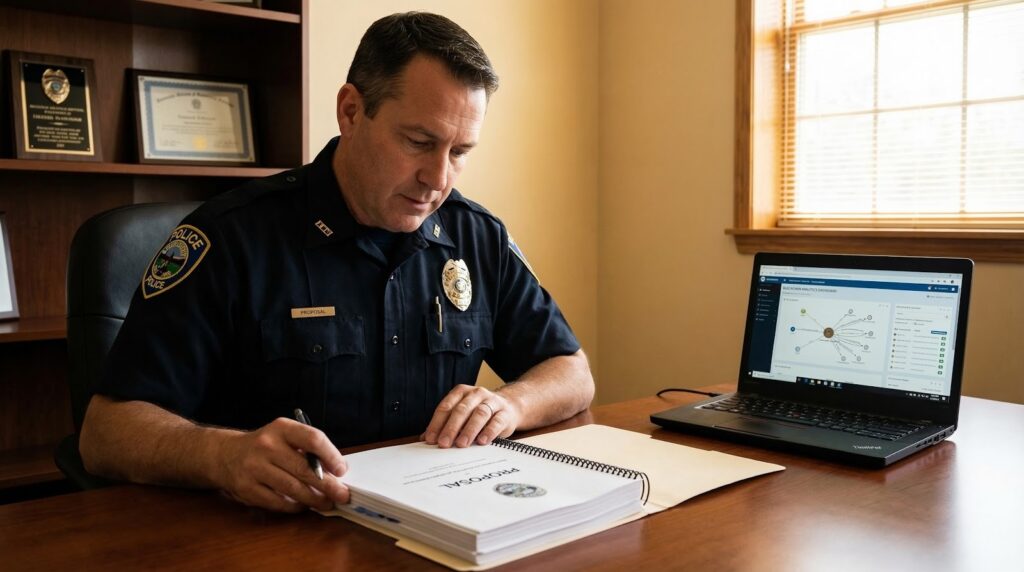
The difference between a successful prosecution and inadmissible evidence frequently comes down to whether the blockchain forensics firm was properly evaluated before engagement. The forensics market contains highly qualified providers alongside those who use free blockchain explorers, lack ACAMS certification, and have never produced court-accepted evidence. Law enforcement agencies and legal teams that select without structured evaluation risk investing significant time and budget into findings that collapse at the first expert witness challenge. For victims, selecting the wrong firm means a second engagement at additional cost after the first fails. The 12 questions in this framework exist because the cost of getting forensic firm selection wrong far exceeds the cost of getting it right.[IMAGE: law enforcement officer reviewing a proposal document from a blockchain forensics firm at a desk with a blockchain analytics dashboard visible on a laptop screen in a professional government office setting]
What Credentials and Court Track Record Should Firms Have?
Professional credentials are the baseline indicator of genuine AML compliance knowledge and forensic methodology training. At minimum, the team conducting your investigation should include ACAMS certified professionals – the Anti-Money Laundering Compliance certification that demonstrates verified knowledge of financial crime investigation, regulatory compliance, and transaction monitoring methodology. MLRO (Money Laundering Reporting Officer) qualification is additionally important for UK-based engagements, confirming that the team understands UK AML regulatory obligations at the level required to produce compliance-grade evidence.
A blockchain forensics firm’s court track record is one of the most important differentiators between providers, because producing court-admissible evidence requires both technical accuracy and procedural knowledge that only comes from actual legal proceedings experience. Ask the firm to describe specific cases where their blockchain forensics evidence was accepted as expert witness testimony – not just cases they worked on, but cases where their specific analysis was presented to and accepted by a court.

What Chain and Platform Coverage Do Forensic Firms Need?
Blockchain coverage – the number of different blockchain networks a firm can analyze forensically – is a critical capability dimension because financial crime in 2026 routinely crosses multiple chains. A firm that covers only Bitcoin and Ethereum will lose investigation trails the moment funds cross to BNB Chain, Polygon, Solana, Avalanche, or any of the dozens of other chains actively used in money laundering routes.
The blockchain analytics platforms a firm uses determine the quality of their attribution database, the accuracy of their entity labeling, and the completeness of their on-chain analysis output. Professional firms should use at minimum one of the four leading platforms: Chainalysis, Elliptic, TRM Labs, or Crystal Intelligence. Firms that rely solely on free blockchain explorer tools or non-specialist analytics products cannot access the proprietary attribution databases and entity labeling that distinguish professional forensic analysis from amateur on-chain examination.
How Should Forensic Firms Document Their Methodology?
Methodology documentation is both a legal requirement for court-admissible blockchain forensics evidence and a quality indicator distinguishing professional firms from unqualified providers. Expert witness evidence must be accompanied by a clear, reproducible description of the analytical methodology used to reach each conclusion, so that opposing experts can challenge the methodology and the court can assess its reliability. Firms that refuse to document their methodology on grounds of commercial sensitivity cannot produce legally admissible evidence.
Ask specifically how the firm documents: the heuristics and algorithms used for address clustering; the confidence level assigned to each cluster attribution; and the source of entity labels applied to identified addresses. According to FATF (2023), methodology transparency is a prerequisite for blockchain forensics evidence to withstand legal challenge in 60 percent of jurisdictions that have admitted cryptocurrency investigation evidence.
What Privacy Coin and Exchange Capabilities Matter?
Privacy coin investigation capability distinguishes expert blockchain forensics firms from generalist providers, because Monero, Zcash, and similar privacy-enhanced assets require specialist analytical techniques entirely different from standard Bitcoin or Ethereum on-chain analysis. Standard clustering heuristics do not apply to Monero due to ring signatures. Standard UTXO tracing does not apply to Zcash shielded transactions. Cases involving privacy coin payments – common in ransomware, darknet market transactions, and sophisticated money laundering – require firms with specific privacy coin expertise.
Exchange relationships are operationally critical in blockchain forensics because the majority of financial crime investigations end at centralized exchange accounts, and obtaining KYC records from exchanges requires either formal legal process or established compliance team relationships that can support voluntary disclosure within the bounds of applicable law. A firm with no exchange relationships will leave law enforcement agencies to navigate exchange cooperation requests independently, adding time and complexity to the recovery process.
What Multi-Jurisdictional and Reporting Standards Matter?
Modern financial crime investigations frequently require evidence packages that meet the legal standards of multiple jurisdictions simultaneously – UK, US, and EU courts all have different expert witness qualification requirements, evidence formatting expectations, and chain of custody standards. A firm that can produce evidence meeting UK Serious Fraud Office standards may not produce documentation meeting US federal court Daubert standard requirements or EU Member State judicial proceedings standards.
Reporting standards determine whether blockchain forensics findings translate effectively into usable legal evidence. Professional blockchain forensics reports should include: a clearly stated investigation scope and methodology; transaction graph visualizations meeting court exhibit formatting requirements; entity attribution with confidence levels and supporting evidence citations; limitation disclosures identifying known gaps or uncertainties; and an executive summary accessible to non-technical legal professionals.
What Should You Ask About Turnaround, Cost, and References?
Three final practical questions complete the evaluation framework. Turnaround time matters for time-sensitive investigations: ask what their standard turnaround is for both preliminary findings and full forensic reports, and whether they can support urgent cases with accelerated delivery. Investigate whether they offer structured investigation stages with interim deliverables that allow agencies to act on early findings while the complete investigation continues.
Cost transparency is essential for budget planning: ask whether they charge fixed fees per investigation, time-and-materials rates, or retainer arrangements, and whether pricing includes platform access costs and expert witness testimony time. Finally, ask for verifiable client references from law enforcement agencies who have used their services in comparable proceedings. Crypto Trace Labs operates on transparent pricing and provides client references upon request.
Frequently Asked Questions
What qualifications should a blockchain forensics firm have?
A blockchain forensics firm should hold ACAMS certification for AML compliance expertise, MLRO qualification for UK-regulated engagements, and verifiable court-recognized expert witness credentials in the jurisdictions where their evidence will be used. Team members should have senior-level experience within the cryptocurrency industry and a track record of successful investigation outcomes in legal proceedings. According to ACAMS (2024), fewer than 30 percent of firms hold verified professional certifications, making credentials a meaningful differentiator.
Why does court experience matter when selecting a blockchain forensics firm?
Court experience matters because technically sound blockchain analysis is insufficient if evidence does not meet procedural and formatting requirements for admissibility in legal proceedings. Firms with direct court experience have learned how to structure forensic reports, document methodology, assign confidence levels, and present findings in ways that survive opposing expert challenges. Firms without direct court experience frequently produce analysis that is analytically valid but procedurally inadmissible, wasting investment at the most critical stage of a case.
How many blockchain networks should a forensics firm cover?
A professional blockchain forensics firm should cover at minimum the major networks where financial crime occurs, including Bitcoin, Ethereum, BNB Chain, Polygon, Solana, Avalanche, Arbitrum, Tron, and their major token standards. Coverage of 30 or more networks is a reasonable baseline for 2026, given that active money laundering routes now routinely span multiple chains. Additionally, coverage must include smart contract interaction analysis and cross-chain bridge monitoring, not just basic token transfer tracing, on each supported network.
What is ACAMS certification and why does it matter for blockchain forensics?
ACAMS (Association of Certified Anti-Money Laundering Specialists) certification demonstrates verified knowledge of financial crime investigation, AML regulatory compliance, and transaction monitoring methodology. It matters for blockchain forensics because on-chain analysis findings are primarily used in AML compliance contexts where ACAMS-level knowledge is required to correctly interpret risk scoring outputs, prepare SAR-standard documentation, and ensure investigation methodology aligns with regulatory expectations. ACAMS certified investigators are more likely to produce findings that meet compliance audit standards.
How should law enforcement verify a firm’s court track record?
Law enforcement should verify court track record by requesting specific case names and jurisdictions where the firm’s blockchain forensics evidence was accepted as expert witness testimony, then independently confirming through publicly available court records or direct contact with case investigators. Marketing claims of “court-recognized expertise” without specific case references are unverifiable and should not be accepted as evidence of legal proceedings experience. Ask to speak directly with law enforcement contacts who can describe the firm’s performance from an operational perspective.
What methodology documentation should a forensics firm provide?
A blockchain forensics firm should provide methodology documentation covering: the heuristics and algorithms used for address clustering; the attribution database sources consulted; confidence levels assigned to each attribution; chain of custody procedures; and the basis for any quantitative claim in the report. This documentation must be detailed enough for an opposing expert to challenge individual methodology decisions. Firms that withhold methodology on grounds of commercial sensitivity cannot produce court-admissible blockchain forensics evidence.
How important are exchange relationships in blockchain forensics?
Exchange relationships are critically important because over 97 percent of traced Bitcoin and the majority of traced Ethereum ultimately reaches a centralized exchange account, according to Chainalysis (2024). Without established exchange cooperation pathways, the final attribution step – linking an exchange account to a real-world identity through KYC records – requires agencies to independently navigate formal legal disclosure processes. Firms with established exchange compliance team relationships can accelerate this process, reducing the time between on-chain attribution and actionable identity disclosure.
Can a single blockchain forensics firm cover all jurisdictions?
Few firms cover all jurisdictions, but leading blockchain forensics providers including Crypto Trace Labs operate across UK, US, and EU with team members qualified under each jurisdiction’s expert witness and AML compliance standards. Verify that any firm holds qualifications required for your case: Chartered Fellow Grade for UK proceedings, relevant qualification for US federal court, and applicable EU Member State credentials for European proceedings. Multi-jurisdictional capability is essential as financial crime investigations require evidence packages meeting multiple legal standards.
What are the biggest red flags when evaluating a blockchain forensics firm?
Key red flags include: no verifiable ACAMS or equivalent professional certification; inability to name specific cases where evidence was court-accepted; refusal to disclose investigation methodology; chain coverage below 20 networks; no established relationships with major exchange compliance teams; pricing that excludes platform access costs and expert witness preparation; and no verifiable law enforcement references from comparable previous engagements. Any firm exhibiting three or more of these characteristics should be eliminated regardless of how compelling their marketing materials appear.
How does Crypto Trace Labs meet these evaluation criteria?
Crypto Trace Labs meets all 12 evaluation criteria: ACAMS certified and MLRO qualified across UK, US, and EU jurisdictions, Chartered Fellow Grade accredited, with VP and Director-level executives from Blockchain.com, Kraken, and Coinbase. We have court-recognized expertise with evidence accepted in multiple jurisdictions, multi-platform blockchain analytics access including Chainalysis and Elliptic, coverage across all major blockchain networks, established exchange relationships, and a track record of 101 Bitcoin recovered for clients in the last 12 months.
What Should You Do Next?
This guide was prepared by Crypto Trace Labs, specialists in blockchain forensics, crypto asset recovery, and AML compliance advisory. Our team includes VP and Director-level executives from Blockchain.com, Kraken, and Coinbase, is ACAMS certified and MLRO qualified across UK, US, and EU jurisdictions, and holds Chartered Fellow Grade accreditation. We have recovered 101 Bitcoin for clients in the last 12 months.
We offer no upfront charge for non-custodial wallet recoveries. To discuss your investigation requirements or request a capabilities briefing, Contact Crypto Trace Labs today.
People Also Read
- Comparing On-Chain Analysis Platforms: Technical Feature Analysis
- Cross-Chain Forensics: Tracking Assets Through Blockchain Bridges
- On-Chain Risk Scoring: How Investigators Rate Transaction Suspiciousness
- Ethereum On-Chain Forensics: Account-Based Investigation Methods
About the Author
Crypto Trace Labs is a specialist crypto asset recovery and blockchain forensics firm founded by VP and Director-level executives formerly of Blockchain.com, Kraken, and Coinbase. Our team holds ACAMS accreditations, MLRO qualifications across the UK, US, and EU, and Chartered Fellow Grade status at the CMI. With over 10 years of experience in financial crime investigation and court-recognized blockchain forensics expertise, we have recovered 101 Bitcoin for clients in the last 12 months and delivered record fraud reduction for a $14bn crypto exchange. We work with law enforcement agencies, regulated financial institutions, and private clients on crypto asset recovery, blockchain forensics, AML compliance, and expert witness testimony – globally. We offer no upfront charge for non-custodial wallet recoveries. Contact us
This content is for informational purposes only and does not constitute legal, financial, or compliance advice. Crypto asset recovery outcomes depend on specific circumstances, regulatory cooperation, and technical factors. Consult qualified professionals regarding your situation.