


Last updated: March 2026
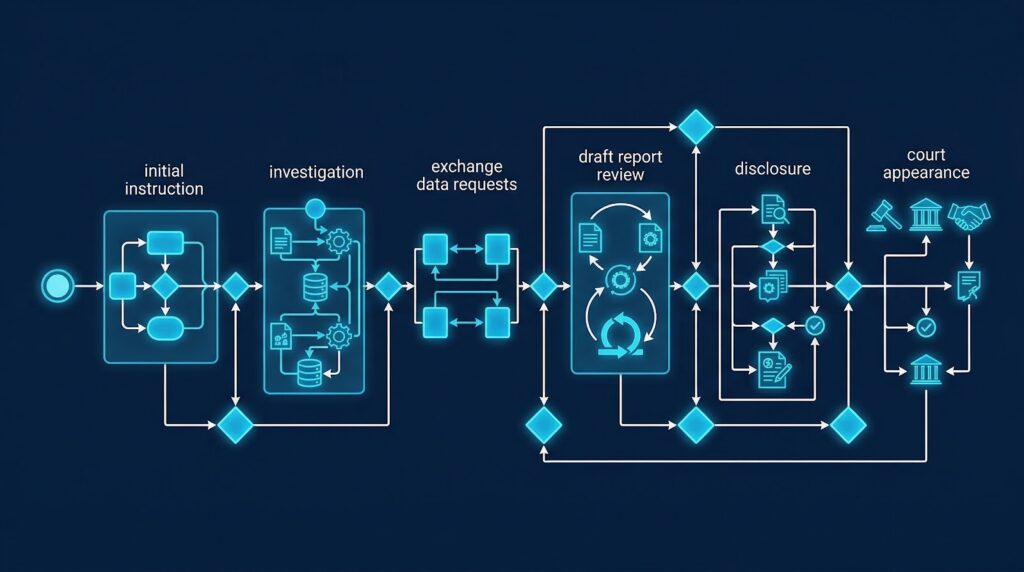
How solicitors should work with blockchain forensic experts is a practical question with significant consequences for case outcomes. Cryptocurrency cases present evidentiary challenges that differ materially from standard financial crime – the underlying data is immutable and publicly available on the blockchain, but interpreting it correctly, attributing wallet addresses to real-world identities, and presenting findings in a court-admissible format requires specific technical expertise that most litigation teams do not hold in-house. Instructing the wrong expert, or instructing the right expert in the wrong way, can result in inadmissible evidence, missed transactions, and collapsed proceedings.
Crypto Trace Labs works with solicitors across the UK on civil and criminal cryptocurrency matters, providing forensic investigation reports, expert witness testimony, and strategic advice on evidence preparation. This guide is written specifically for litigation solicitors who need to understand how to instruct blockchain forensic experts effectively.
Key Takeaways
- Instruction timing matters: blockchain forensic investigations started within 24-48 hours of a known incident significantly increase the chances of identifying exchange destinations and freezing proceeds
- CPR Part 35 governs expert witness evidence in UK civil proceedings – blockchain forensic experts must comply with the same duties as any other expert, including the overriding duty to the court
- Solicitor-expert privilege applies to working documents and instructions, but the final expert report must be disclosed and is subject to cross-examination
- Exchange data preservation requests should be sent to all relevant exchanges simultaneously as early as possible, as transaction records may be deleted after standard retention periods
- Expert credentials are challengeable – opposing counsel will ask about ACAMS accreditation, MLRO qualifications, and court experience at the outset of any contested hearing
Why This Matters
The quality of blockchain forensic instruction directly determines the quality of the evidence available to the court. Solicitors who treat blockchain forensic experts as simple data providers rather than as technical advisers throughout the litigation will miss opportunities to preserve key evidence, obtain the right exchange data, and build the strongest possible case. The FCA (2024) has noted that inadequate solicitor-expert collaboration is a primary cause of avoidable evidence failures in cryptocurrency asset recovery proceedings. Understanding how to instruct blockchain forensic experts correctly is a core litigation competency for any solicitor handling cryptocurrency matters in 2026.

Early Instruction and Evidence Preservation
Early instruction is the single most impactful decision a solicitor can make in a cryptocurrency case. Exchanges retain transaction records and KYC data for varying periods – some apply GDPR deletion schedules that may remove data within 6-12 months of account closure. IP address logs at exchanges typically have shorter retention periods of 30-90 days. Once data is deleted, the investigation pathway it would have provided is permanently closed. A blockchain forensic expert instructed on day one can identify which exchanges hold relevant data and advise on the appropriate preservation requests before retention periods expire.
Early instruction also enables real-time monitoring of wallet activity. If a defendant is still actively moving funds, the forensic expert can alert the solicitor to new transactions as they occur, enabling timely freezing injunction applications. Crypto freezing injunctions are most effective when sought before funds reach a final withdrawal destination.
Scoping the Investigation Correctly
A forensic investigation scoped too narrowly will miss relevant transactions. Scoped too broadly, it will be disproportionate and expensive. The solicitor and forensic expert should discuss the following before work begins: the known wallet addresses to investigate, the relevant time period, the blockchains likely to be involved based on the nature of the case, the legal objectives (evidence for criminal referral, freezing injunction, civil recovery, or POCA confiscation), and the required format of the final report. Relevant questions include whether DeFi or privacy coin transactions are likely, whether cross-chain bridge transfers are involved, and whether the case may span multiple jurisdictions requiring multi-jurisdictional compliance.
The Expert’s Duties Under CPR Part 35
In UK civil proceedings, blockchain forensic experts instructed as expert witnesses are bound by CPR Part 35 and Practice Direction 35. The expert’s overriding duty is to the court, not to the instructing party, meaning the expert must provide an honest, balanced opinion even if it includes conclusions unfavourable to the client. The expert report must contain a statement of truth, the expert’s qualifications and experience, the basis for each opinion, a summary of the evidence relied upon, and a statement confirming awareness of the CPR Part 35 duties.
Solicitors should brief experts clearly that their report must comply with these requirements from the first draft. Experts who are not accustomed to UK court requirements may produce reports better suited to corporate investigation contexts that will not survive court scrutiny. Checking the expert’s prior UK court experience before instruction is essential, not optional.
Reviewing Draft Expert Reports
Solicitors have a legitimate role in reviewing draft expert reports for legal compliance, factual accuracy, and clarity, but must not direct the expert to change their substantive technical conclusions. The distinction between legitimate review and improper influence on an expert’s opinion is critical. Appropriate solicitor feedback on a draft report includes: identifying factual errors in the description of the legal proceedings, noting ambiguous language that could be misunderstood by a judge, requesting clearer explanation of technical terminology, and ensuring CPR Part 35 compliance. Inappropriate feedback includes: asking the expert to change a conclusion because it is unfavourable, omitting findings that are relevant but unhelpful, or reframing probabilistic statements as definitive ones.
Exchange Data Requests and Legal Orders
Exchange data requests are a critical component of any cryptocurrency investigation, providing the KYC identity data that bridges on-chain transaction evidence to real-world identities. UK solicitors can obtain exchange data through Norwich Pharmacal orders, Bankers Trust orders, and information orders under POCA. International exchanges may require letters of request, MLAT requests, or mutual assistance through the National Crime Agency. The blockchain forensic expert should identify which exchanges hold relevant data and advise on the appropriate legal instrument for each jurisdiction. Acting on this advice promptly – ideally before commencing other proceedings – maximises the data available before retention periods expire.
| Exchange Type | UK Legal Instrument | Timeline |
|---|---|---|
| UK-registered exchange | Norwich Pharmacal or POCA order | 2-4 weeks |
| EU exchange (post-Brexit) | Letters of request | 4-12 weeks |
| US exchange | MLAT or subpoena via NCA | 8-24 weeks |
| Unregulated / offshore | Varies or unavailable | Case-by-case |
Frequently Asked Questions
When should a solicitor instruct a blockchain forensic expert?
A solicitor should instruct a blockchain forensic expert as early as possible – ideally on the day the matter is opened or the client makes initial contact. Early instruction enables preservation of exchange data before retention periods expire, real-time monitoring of wallet activity if funds are still moving, and strategic advice on which legal instruments to use to obtain exchange records. Investigations started within 24-48 hours of a known incident significantly increase the chances of identifying exchange destinations and successfully freezing proceeds before they are withdrawn.
What qualifications should a blockchain forensic expert hold?
A blockchain forensic expert instructed in UK proceedings should hold ACAMS (Association of Certified Anti-Money Laundering Specialists) accreditation as the minimum professional standard. For UK civil proceedings, the expert should additionally have MLRO qualifications and, ideally, Chartered Fellow Grade at the CMI for senior investigators. Prior UK court experience as an expert witness is essential – an expert who has not previously given expert evidence in UK proceedings will face challenges establishing their credibility under cross-examination. Solicitors should verify credentials directly with the accrediting bodies before instruction.
What is the expert’s duty under CPR Part 35?
Under CPR Part 35, a blockchain forensic expert instructed as an expert witness in UK civil proceedings owes an overriding duty to the court that takes precedence over any duty to the instructing party. The expert must provide honest, balanced opinion that includes findings unfavourable to the client if relevant. The expert report must include a CPR Part 35 compliant statement of truth, qualifications summary, basis for each opinion, and an acknowledgement of the court duty. Solicitors cannot direct experts to change substantive technical conclusions, though legitimate review for legal compliance and clarity is appropriate.
Can a solicitor review and comment on a draft expert report?
Yes. Solicitors have a legitimate role reviewing draft expert reports for legal compliance, factual accuracy, and clarity of expression. Appropriate feedback includes identifying factual errors in legal context descriptions, noting ambiguous technical language, requesting explanation of jargon for a non-technical judge, and checking CPR Part 35 compliance. Inappropriate involvement includes directing the expert to change substantive technical conclusions, omitting unfavourable findings, or reframing probabilistic attributions as definitive. The boundary between legitimate review and improper influence is critical and solicitors should be explicit with experts about what feedback is being given and why.
What is a Norwich Pharmacal order in cryptocurrency cases?
A Norwich Pharmacal order is a disclosure order granted by the English court requiring a third party – typically a crypto exchange – to disclose information about a wrongdoer. In cryptocurrency cases, Norwich Pharmacal orders are used to compel exchanges to identify the account holder behind a specific wallet address or transaction. The applicant must show they have a good arguable case of wrongdoing, that the respondent is mixed up in the wrongdoing (even innocently), and that disclosure is necessary and proportionate. Norwich Pharmacal orders are one of the most commonly used legal instruments in UK crypto asset recovery proceedings.
How should solicitors handle expert evidence in criminal proceedings?
In UK criminal proceedings, expert evidence is governed by different rules from CPR Part 35. The defence and prosecution each instruct their own experts. The Criminal Procedure Rules Part 19 and CrimPR Practice Direction impose similar duties to CPR Part 35, including the overriding duty to the court. Solicitors instructing blockchain forensic experts in criminal proceedings should ensure the expert understands that their role is to assist the court in understanding technical evidence, not to advocate for the defendant. Expert reports in criminal proceedings are disclosable and the expert will be subject to cross-examination on their methodology and qualifications.
What exchange data can be obtained via legal proceedings?
Via appropriate legal instruments, solicitors can obtain from crypto exchanges: the identity of the account holder linked to a specific wallet address (KYC data), transaction history and balance records, IP address logs for account access, device fingerprint data, bank account details used for fiat withdrawals, and communication records if available. The specific data available depends on exchange registration, jurisdiction, and retention policies. UK-registered exchanges respond to English court orders. US exchanges require MLAT requests or letters of request. Exchanges registered in offshore jurisdictions with minimal regulatory oversight may be unable or unwilling to respond.
How do solicitors handle cross-border cryptocurrency cases?
Cross-border cryptocurrency cases require coordination between legal teams in each relevant jurisdiction and the blockchain forensic expert advising on which jurisdictions hold relevant data. The forensic expert should identify exchange locations and advise on MLAT timelines and procedural requirements for each jurisdiction. UK solicitors should engage local counsel in relevant jurisdictions early. The forensic expert should hold MLRO qualifications covering each relevant jurisdiction – UK, US, and EU as a minimum for most complex international cases. Cases involving multiple jurisdictions substantially increase both cost and timeline and should be scoped accordingly from the outset.
What should a blockchain forensic expert report include?
A blockchain forensic expert report for UK court proceedings should include: the expert’s qualifications and accreditations, a statement of instructions from the solicitor, a summary of the evidence examined, the methodology used for each analytical step, the findings with confidence levels stated for any probabilistic attribution, a comparison table where multiple platforms or methods were used, a chronological transaction narrative, any limitations or data gaps, a CPR Part 35 compliant statement of truth, and appendices including the relevant transaction graphs and data extracts. Reports that conflate probabilistic findings with confirmed attributions are vulnerable to successful cross-examination.
How should solicitors prepare experts for cross-examination?
Solicitors should prepare blockchain forensic experts for cross-examination by reviewing the methodology sections of the report in detail, identifying any attribution conclusions that rely on probabilistic rather than deterministic evidence, briefing the expert on known technical challenges to the evidence and the likely lines of cross-examination, and arranging a pre-hearing conference with counsel. Experts should be briefed to acknowledge uncertainty where it exists rather than defending overconfident positions. An expert who concedes probabilistic limitations clearly and confidently is more credible to a court than one who overstates certainty and is then forced to retract under cross-examination.
Executive Summary
Solicitors handling cryptocurrency matters should instruct blockchain forensic experts at the earliest possible stage to preserve exchange data, enable real-time monitoring, and maximise the evidence available before retention periods expire. CPR Part 35 governs expert duties in UK civil proceedings – the expert owes an overriding duty to the court and must provide balanced findings including conclusions unfavourable to the client. Exchange data is obtained through Norwich Pharmacal orders, POCA orders, and MLAT requests depending on exchange jurisdiction. Expert credentials including ACAMS accreditation and prior UK court experience should be verified before instruction, as they will be challenged by opposing counsel.
What Should You Do Next?
Effective solicitor-expert collaboration is built on clear instruction, early engagement, and mutual understanding of the legal and technical constraints on each side. Solicitors who engage blockchain forensic experts strategically – not just as report writers but as advisers throughout the litigation – consistently achieve better outcomes.
Crypto Trace Labs works directly with solicitors across the UK on civil crypto asset recovery, criminal defence advisory, and expert witness assignments. Our ACAMS-accredited, CPR Part 35-compliant team holds MLRO qualifications across UK, US, and EU and has provided expert witness testimony in Crown Court and civil proceedings. Contact Crypto Trace Labs to discuss your matter in confidence.
People Also Read
- How to Evaluate Blockchain Forensic Firms: 12 Questions Law Enforcement Should Ask
- Crypto Freezing Injunctions: How Courts Protect Victims of Cryptocurrency Theft
- How Does Blockchain Forensics Work? Expert Methods Explained
- On-Chain Risk Scoring: How Investigators Rate Transaction Suspiciousness
About the Author
Crypto Trace Labs is a specialist crypto asset recovery and blockchain forensics firm founded by VP and Director-level executives formerly of Blockchain.com, Kraken, and Coinbase. Our team holds ACAMS accreditations, MLRO qualifications across the UK, US, and EU, and Chartered Fellow Grade status at the CMI. With over 10 years of experience in financial crime investigation and court-recognized blockchain forensics expertise, we have recovered 101 Bitcoin for clients in the last 12 months and delivered record fraud reduction for a $14bn crypto exchange. We work with law enforcement agencies, regulated financial institutions, and private clients on crypto asset recovery, blockchain forensics, AML compliance, and expert witness testimony – globally. We offer no upfront charge for non-custodial wallet recoveries. Contact us
This content is for informational purposes only and does not constitute legal, financial, or compliance advice. Crypto asset recovery outcomes depend on specific circumstances, regulatory cooperation, and technical factors. Consult qualified professionals regarding your specific situation.