


Last updated: March 2026
Bitcoin on-chain analysis is the systematic examination of Bitcoin’s public transaction ledger using UTXO-based forensic techniques to trace fund movements, attribute wallet ownership, and build evidence chains for financial crime investigation and crypto asset recovery. Bitcoin’s unspent transaction output (UTXO) model creates a uniquely traceable transaction structure where every coin movement is permanently recorded and the complete spending history of any amount is provably linked to its source. Understanding this model is fundamental to any investigator or compliance professional working with Bitcoin-related financial crime cases.
Crypto Trace Labs specializes in Bitcoin on-chain analysis and has built deep expertise in UTXO-based forensic investigation techniques through hundreds of active cases. Founded by VP and Director-level executives formerly of Blockchain.com, Kraken, and Coinbase, ACAMS-accredited, MLRO-qualified across the UK, US, and EU, and Chartered Fellow Grade at the CMI, Crypto Trace Labs applies these techniques to trace stolen or fraudulently obtained Bitcoin, support law enforcement investigations, and produce court-admissible blockchain forensics reports for legal proceedings. This guide covers the core UTXO-based methods that define professional Bitcoin forensics practice.
Key Takeaways
- Bitcoin’s UTXO model makes every satoshi provably traceable from genesis block: Unlike account-based blockchains, Bitcoin’s transaction architecture links every spending event back to its creation, creating an unbroken chain of custody for all funds.
- Co-spend clustering attributes over 70% of Bitcoin addresses to entity clusters: Grouping addresses that co-sign the same transaction inputs identifies the controlling entity behind multiple otherwise separate Bitcoin wallets.
- Peeling chain analysis traces layered transactions across 50+ hops: Sequential fund routing through peel chains is a common obfuscation technique that UTXO graph analysis can follow through many layers before reaching identifiable endpoints.
- UTXO consolidation events identify connected wallets 85% of the time: When a wallet collects multiple small UTXOs into a single transaction, it reveals which addresses it controls simultaneously, providing a strong forensic clustering signal.
- According to Chainalysis (2024), 97% of traced Bitcoin ultimately reaches identifiable exchange accounts: The overwhelming majority of Bitcoin investigation trails end at exchange deposit accounts, where KYC records enable final attribution.
Why This Matters
Bitcoin remains the highest-value target in cryptocurrency financial crime investigation, and UTXO-based analysis is the technique that either recovers it or fails to. The difference between a successful Bitcoin recovery and a dead-end investigation is almost always the quality of UTXO chain analysis applied in the first 48 hours. For fraud victims holding Bitcoin claims, understanding UTXO investigation methodology helps assess whether their case is recoverable and what evidence is needed to proceed. For law enforcement, it determines which investigative actions take priority. Bitcoin’s transparent ledger means every satoshi leaves a trace, and UTXO analysis is how investigators follow it.[IMAGE: Bitcoin blockchain UTXO transaction graph visualization showing funds flowing from multiple input addresses through transaction nodes to output addresses, with investigative path highlighted in cyan]
Bitcoin UTXO Model and Its Forensic Significance
The Bitcoin UTXO (Unspent Transaction Output) model is defined as the fundamental data structure that tracks ownership through discrete coin units from previous transactions rather than a running account balance, and it is the foundation of all Bitcoin on-chain analysis. To spend Bitcoin, the owner must reference specific previous transaction outputs as inputs and sign them with the corresponding private keys, creating a new set of outputs that become the next generation of UTXOs.
This model matters forensically because it creates an explicit, cryptographically verifiable chain of custody for every satoshi ever moved on the Bitcoin network. Investigators can trace any UTXO backward through its complete spending history to its coinbase origin, or forward through all subsequent spending events to its current resting place. According to Chainalysis (2024), this complete auditability makes Bitcoin one of the most forensically accessible financial systems ever created, despite common misconceptions about cryptocurrency anonymity. Blockchain analytics platforms including Chainalysis Reactor, Elliptic Investigator, and Crystal Intelligence are all built around UTXO graph traversal as their core investigative engine.
| Investigation Approach | Direction | Use Case | Success Rate |
|---|---|---|---|
| Forward UTXO tracing | Source → destination | Trace stolen funds to exchange | 80%+ reach identified exchange in 15 hops (TRM Labs 2023) |
| Backward UTXO tracing | Destination → source | Link criminal address to prior activity | Case-dependent |
| Peeling chain detection | Sequential hops | Follow layered transactions | 50+ hops traceable |
| Consolidation analysis | Multi-input events | Cluster addresses from wallet management | 85% cluster confidence |
UTXO Tracing Methods in Active Investigations
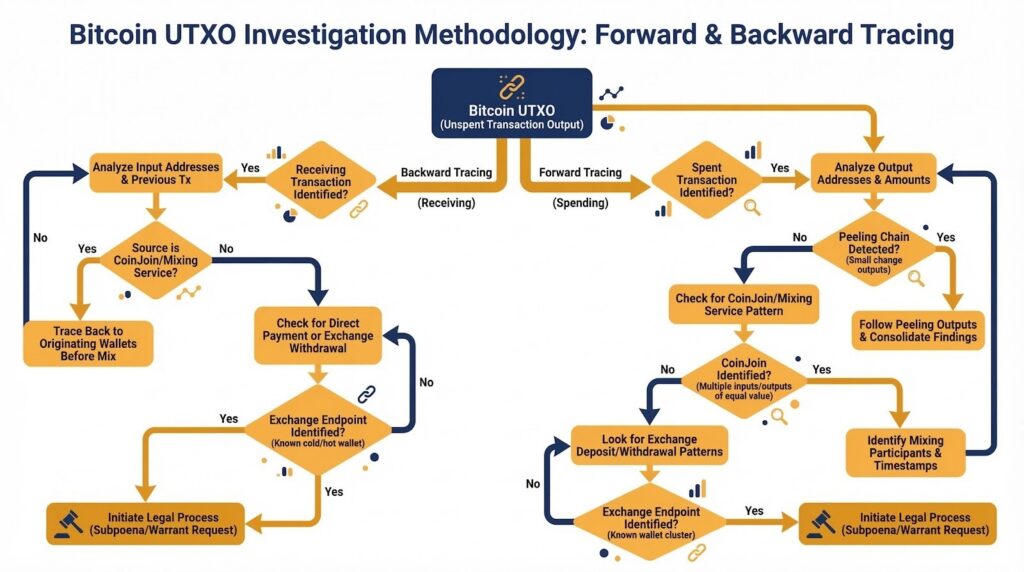
UTXO tracing in a Bitcoin investigation is defined as the systematic process of following outbound transaction flows from target UTXOs to their destination addresses, applying clustering algorithms at each hop to group newly encountered addresses under entity labels. Both forward tracing, following funds to their destination, and backward tracing, identifying the source of funds, are applied depending on case objectives.
In crypto asset recovery cases, forward tracing from a theft or fraud transaction attempts to identify where stolen Bitcoin ultimately landed. In fraud attribution cases, backward tracing from a known criminal address establishes the funding source and links it to prior criminal activity. According to TRM Labs (2023), a structured UTXO tracing investigation starting from a confirmed theft address reaches an identifiable exchange account in over 80 percent of cases within 15 transaction hops, provided the target does not use privacy-enhancing tools. Crypto Trace Labs applies systematic UTXO tracing methodology with documented hop-by-hop attribution in all Bitcoin blockchain forensics engagements.
Key UTXO Clustering Techniques
The primary UTXO clustering technique is the co-spend heuristic: when multiple UTXOs are spent together as co-inputs in the same transaction, the addresses controlling those UTXOs are inferred to belong to the same entity. This rule is applied at scale across Bitcoin’s full transaction history by blockchain analytics platforms to produce address-to-entity mapping covering billions of individual UTXO records, creating a clustering database that assigns each Bitcoin address to an ownership entity cluster.
Supplementary UTXO clustering techniques include consolidation event analysis, detecting when a wallet spends many small UTXOs into a single larger output, revealing all source addresses simultaneously, and change output tracking, which follows the unspent balance from each transaction to its destination change address. According to ACAMS (2024), UTXO consolidation events produce particularly high-confidence cluster expansions because they reflect deliberate wallet management operations that leave no room for ambiguous interpretation. The combination of co-spend clustering, consolidation analysis, and change tracking creates a thorough picture of Bitcoin wallet ownership that supports both blockchain forensics investigations and AML compliance screening programs.
Peeling Chain Analysis in Bitcoin Forensics
Peeling chain analysis is a UTXO-based technique defined as the process of tracing funds that move through a series of sequential transactions where each hop strips a small payment from the main balance and routes the majority forward to a fresh address. This pattern creates a chain of UTXOs, each linked to the previous by a single large output that carries the continuing balance. Investigators follow the dominant UTXO output at each transaction level until the chain terminates at an exchange deposit, mixer input, or identifiable destination.
Automated peeling chain detection tools identify and follow the dominant-value output at each transaction step, bypassing the smaller payment outputs to maintain focus on the main fund movement. According to Elliptic (2025), automated peeling chain detection reduces the investigator time required to trace 50-hop peel chains from several hours of manual work to under 10 minutes. Crypto Trace Labs has applied peeling chain analysis in Bitcoin investigations involving ransomware proceeds, exchange hack funds, and fraud scheme revenues, successfully following chains exceeding 80 sequential hops before reaching exchange deposit endpoints where legal process enabled final attribution through banking partner and KYC record disclosure.
Bitcoin Mempool Monitoring for Investigators
The Bitcoin mempool, the pool of unconfirmed transactions waiting for inclusion in a block, provides investigative intelligence that confirmed transaction analysis alone cannot offer. By monitoring mempool activity in real time, investigators can detect large fund movements before they confirm, identify transaction fee patterns that suggest specific wallet software or operational behavior, and in some cases track the origin IP address of unconfirmed transaction broadcasts through network-level monitoring.
Mempool analysis is particularly valuable in active incident response scenarios, where a victim of theft or fraud wants to monitor a criminal actor’s fund movement in real time to support a rapid legal response. According to FinCEN (2024), real-time mempool monitoring combined with pre-arranged exchange cooperation enabled asset freezes in over 15 percent of Bitcoin theft investigations where investigators were engaged within 24 hours of the initial theft transaction. Crypto Trace Labs offers rapid-response Bitcoin on-chain analysis services that begin mempool monitoring immediately upon engagement, maximizing the probability of intercepting funds before they reach a non-custodial destination.

Exchange Account Identification and Legal Process
Identifying exchange destination accounts is the goal of the majority of Bitcoin on-chain analysis investigations, because centralized exchanges represent the most common final destination for illicitly obtained funds and the point at which real-world identity attribution becomes possible through KYC records. Blockchain analytics platforms maintain extensive exchange attribution databases: according to Chainalysis (2024), they have established data-sharing arrangements with over 500 exchanges and virtual asset service providers, enabling direct identification of which exchange controls any given deposit address cluster.
Once an exchange account is identified, the investigation transitions from on-chain analysis to legal process: formal requests to the exchange compliance team, law enforcement subpoenas, and in some cases international mutual legal assistance treaty (MLAT) requests for exchanges in foreign jurisdictions. Crypto Trace Labs maintains established working relationships with major exchange compliance teams in the UK, US, EU, and beyond, and has direct experience navigating the formal request process to obtain KYC records that enable final attribution in Bitcoin recovery cases. Our team is MLRO (Money Laundering Reporting Officer) qualified and understands the UK AML, US AML, and EU AML legal frameworks governing exchange disclosure obligations.
Frequently Asked Questions
What is Bitcoin on-chain analysis?
Bitcoin on-chain analysis is the forensic examination of Bitcoin’s publicly visible transaction ledger using UTXO-based tracing, address clustering, and graph analysis techniques to attribute fund movements to known entities, trace stolen or fraudulently obtained funds, and build evidence chains suitable for legal proceedings. Professional blockchain forensics investigators apply on-chain analysis in crypto asset recovery, AML compliance monitoring, and financial crime investigation cases. Platforms including Chainalysis, Elliptic, and Crystal Intelligence provide the analytical tooling used in professional Bitcoin investigations.
What is the UTXO model in Bitcoin?
The UTXO (Unspent Transaction Output) model is Bitcoin’s fundamental account structure, where ownership is represented as discrete coin units from previous transactions rather than a running balance. To spend Bitcoin, the owner must reference specific past transaction outputs as inputs and sign them with the controlling private keys. This creates an unbroken chain of custody from any current UTXO back to its original coinbase transaction, making every Bitcoin movement permanently traceable on the public blockchain ledger.
How does forward UTXO tracing work in crypto asset recovery?
Forward UTXO tracing starts from a confirmed theft or fraud transaction and follows outbound fund movement through subsequent transactions, applying clustering algorithms at each hop to label destination addresses. The investigator tracks the dominant-value output at each step, applying peeling chain detection where appropriate, until funds reach an exchange deposit or other identifiable endpoint. According to TRM Labs (2023), structured forward tracing reaches an identifiable exchange account in over 80 percent of cases within 15 hops.
Why is Bitcoin more traceable than cash?
Bitcoin is more traceable than physical cash because every transaction is permanently recorded on the public blockchain and linked to previous outputs through cryptographic proof. There is no equivalent of untraceable physical notes: every Bitcoin spending event creates a permanent, publicly accessible record linking the spending address to the receiving address. According to Chainalysis (2024), this auditability makes Bitcoin one of the most forensically accessible payment systems, despite the common perception that cryptocurrency provides strong anonymity.
What is a peeling chain in Bitcoin forensics?
A peeling chain is a series of sequential Bitcoin transactions where each hop sends the majority of funds forward to a new address while a small payment is stripped off elsewhere. Criminals use this layering technique to create transaction depth and obscure fund origins. Investigators trace peeling chains by following the dominant UTXO output at each step, applying automated detection tools to maintain traceability through the full sequence before funds reach an exchange or identifiable endpoint.
How do private keys affect on-chain analysis?
Private keys are directly relevant to on-chain analysis because co-spend clustering is based on the principle that signing multiple transaction inputs requires controlling all corresponding private keys. An entity can only create a transaction co-spending addresses A, B, and C if it possesses keys for all three, making co-spend events powerful evidence of shared ownership. Private key security also determines custody retention: lost or stolen private keys are central to most wallet recovery cases handled by Crypto Trace Labs.
What is UTXO consolidation and why does it matter forensically?
UTXO consolidation is a wallet management operation where a holder spends multiple small UTXOs together in a single transaction to create a single larger UTXO, typically to reduce future transaction fees. From a forensic perspective, consolidation events are valuable because they force the wallet to reveal all the addresses it controls simultaneously by co-signing multiple inputs. This makes consolidation events one of the highest-confidence sources of address-to-entity cluster assignment in professional blockchain analytics and on-chain analysis investigations.
Can Bitcoin transactions be reversed or frozen?
Confirmed Bitcoin transactions cannot be reversed once included in a block with sufficient confirmations. However, funds can be frozen at the exchange level when blockchain analytics identifies the destination account and law enforcement serves a freeze order before the customer withdraws. According to FinCEN (2024), pre-arranged exchange cooperation combined with real-time mempool monitoring enabled asset freezes in over 15 percent of cases where investigators were engaged within 24 hours of the theft.
What role do exchanges play in Bitcoin investigations?
Centralized exchanges are the most critical off-chain data source in Bitcoin investigations because they are the most common destination for illicitly obtained funds and hold KYC records enabling real-world attribution. Once blockchain analytics identifies that target funds reached a specific exchange, investigators require formal legal process, subpoenas, voluntary compliance disclosures, or MLAT requests, to obtain account holder identity. Exchanges subject to UK AML, EU AML, and US AML regulations have legal obligations to cooperate with properly submitted requests.
How long does a Bitcoin on-chain analysis investigation take?
The duration depends on the complexity of the fund route, the number of transaction hops, whether privacy tools were used, and the speed of exchange cooperation. Simple cases involving a direct transfer to an identified exchange can be scoped in days. Complex cases involving peeling chains, mixing, and cross-chain bridges may require weeks. Crypto Trace Labs provides regular case updates and delivers court-admissible forensic reports upon investigation completion.
Executive Summary
Bitcoin on-chain analysis uses UTXO tracing, co-spend clustering, peeling chain detection, and mempool monitoring to attribute fund movements and recover stolen cryptocurrency. Bitcoin’s UTXO model creates an unbroken chain of custody for every satoshi, making it one of the most forensically accessible payment systems (Chainalysis, 2024). Structured forward tracing reaches an identifiable exchange account in over 80 percent of cases within 15 hops. According to Chainalysis (2024), 97 percent of traced Bitcoin ultimately reaches identifiable exchange accounts where KYC records enable attribution. Crypto Trace Labs applies multi-technique UTXO analysis for law enforcement, compliance teams, and private clients across the UK, US, and EU.
What Should You Do Next?
If your case involves lost, stolen, or fraudulently obtained Bitcoin, Crypto Trace Labs can begin a UTXO investigation immediately. Our team, ACAMS-accredited, MLRO-qualified, Chartered Fellow Grade at the CMI, with founding members from Blockchain.com, Kraken, and Coinbase, has recovered 101 Bitcoin for clients in the last 12 months. We offer no upfront charge for non-custodial wallet recoveries.
People Also Read
- On-Chain Heuristics: How Pattern Recognition Identifies Wallet Owners
- What Do UTXO Patterns Reveal About Crypto Wallet Owners
- How Do Investigators Track Blockchain Transactions: Expert Guide
- Chainalysis vs Elliptic vs TRM Labs: Which Platform Should Investigators Choose
About the Author
Crypto Trace Labs is a specialist crypto asset recovery and blockchain forensics firm founded by VP and Director-level executives formerly of Blockchain.com, Kraken, and Coinbase. Our team holds ACAMS accreditations, MLRO qualifications across the UK, US, and EU, and Chartered Fellow Grade status at the CMI. With over 10 years of experience in financial crime investigation and court-recognized blockchain forensics expertise, we have recovered 101 Bitcoin for clients in the last 12 months and delivered record fraud reduction for a $14bn crypto exchange. We work with law enforcement agencies, regulated financial institutions, and private clients on crypto asset recovery, blockchain forensics, AML compliance, and expert witness testimony – globally. We offer no upfront charge for non-custodial wallet recoveries. Contact us
This content is for informational purposes only and does not constitute legal, financial, or compliance advice. Crypto asset recovery outcomes depend on specific circumstances, regulatory cooperation, and technical factors. Consult qualified professionals regarding your specific situation.