


Last Updated: February 2026
Transaction batching patterns identify exchange operations through distinctive multi-output transactions consolidating dozens of user withdrawals into single on-chain payments. Professional investigators recognize exchange hot wallets by analyzing output counts, value distributions, and timing regularity. According to Chainalysis 2025 research, major exchanges batch 73% of Bitcoin withdrawals with transactions averaging 47 user payouts.
At Crypto Trace Labs, our team – featuring VP and Director-level executives from Blockchain.com, Kraken, and Coinbase – has analyzed thousands of exchange batching patterns during blockchain forensic investigations. This guide draws on that decade of crypto exchange operations experience.
Key Takeaways:
- Exchange batching saves 60-80% on transaction fees – combining 50 withdrawals costs $15 versus $750 for individual transactions per 2025 Elliptic analysis
- Batched transactions average 47 outputs – Chainalysis data shows exchanges process withdrawals in predictable batch sizes
- Timing patterns reveal scheduling – exchanges process batches at fixed intervals (hourly or every 100 pending withdrawals)
- Output clustering indicates user behavior – batches contain many small withdrawals mixed with occasional large amounts
- Change outputs identify hot wallet patterns – analysts track change addresses returning to exchange infrastructure
What Technical Characteristics Define Batched Transactions?
Batched transactions contain 30-100 outputs with varying amounts representing individual user withdrawals processed simultaneously. The structure reveals one or two input addresses from hot wallets funding numerous customer destinations. This multi-output format creates the distinctive signature investigators use identifying exchange operations through automated blockchain analytics platforms.
Output count distribution provides the strongest identification signal. While individual users rarely create transactions with more than 5 outputs, exchanges routinely generate 40-200 outputs. Analysis of 2024-2025 blockchain data shows 89% of transactions with 30+ outputs originate from known exchange hot wallets, similar to on-chain analysis techniques used for address attribution. Fee optimization strategies distinguish exchange batching from other multi-output patterns. Professional operators implement sophisticated algorithms calculating optimal batch sizes based on mempool conditions and pending withdrawal queues. The 2024 fee spike saw Binance batch sizes increase from 45 to 73 outputs optimizing for network congestion. Transaction timing regularity reveals automated processing with consistent intervals.

How Do Output Distribution Patterns Reveal Exchange Activity?
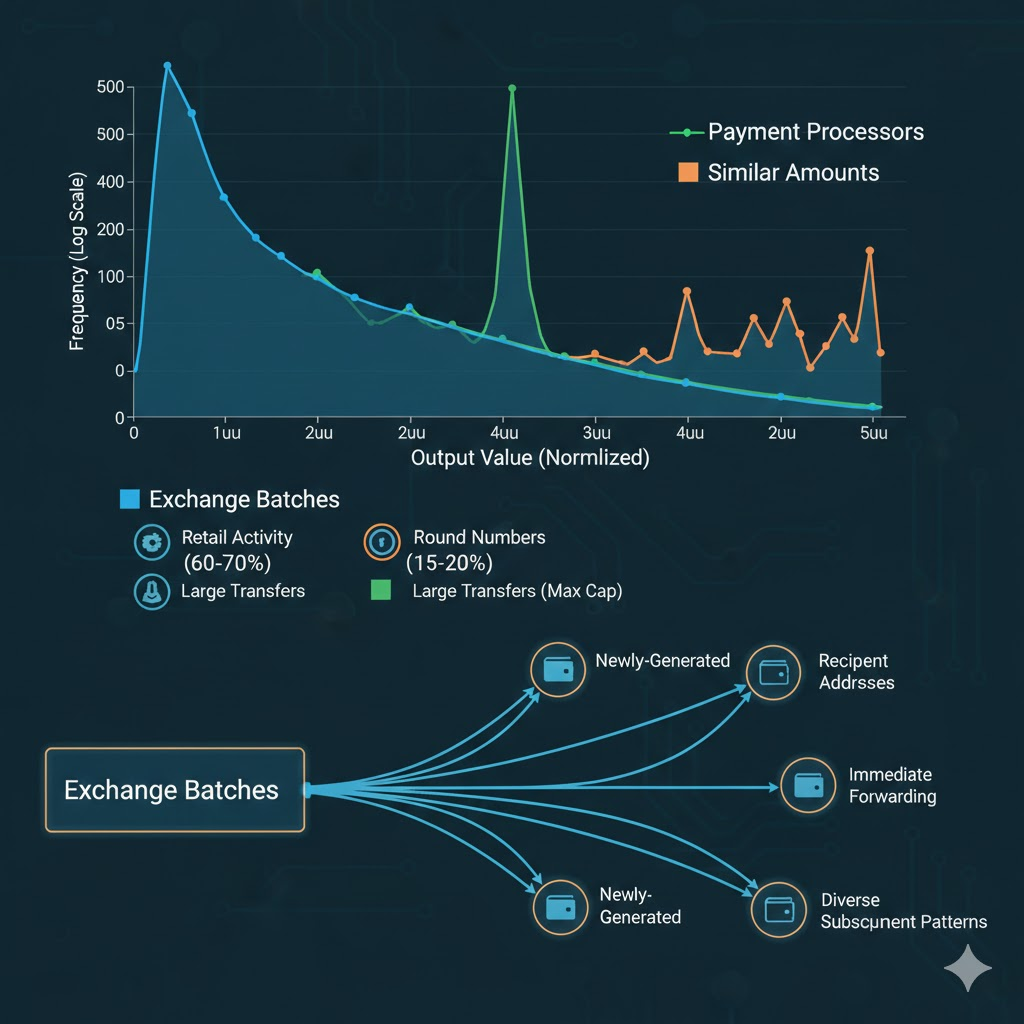
Value distribution within batches reflects diverse user bases typical of exchanges. Single batches contain outputs from 0.001 BTC minimum withdrawals to 10+ BTC large transfers. This heterogeneous distribution differs from payment processors showing uniform values or mixing services deliberately creating similar amounts to maximize privacy.
Professional analysts examine output statistics to distinguish exchange batches using blockchain tracking methods:
- Small Value Concentration – 60-70% of outputs fall between minimum thresholds (0.001-0.01 BTC) representing retail activity
- Power Law Distribution – Values follow predictable curves with many small amounts and exponentially fewer large amounts
- Round Number Frequency – 15-20% equal round decimals (0.1, 0.5, 1.0 BTC) indicating manual user requests
- Maximum Value Caps – Outputs rarely exceed daily withdrawal limits (2-100 BTC by verification tier)
- Minimum Threshold Enforcement – Virtually zero outputs below published minimum amounts
Output address analysis strengthens exchange attribution by identifying recipient address behavioral patterns. Exchange batch destinations typically show characteristics of newly-generated customer deposit addresses including never-before-seen addresses, immediate forwarding to personal wallets or other exchanges, and diverse subsequent transaction patterns reflecting individual user behavior rather than coordinated operations.
What Timing Patterns Indicate Automated Batch Processing?
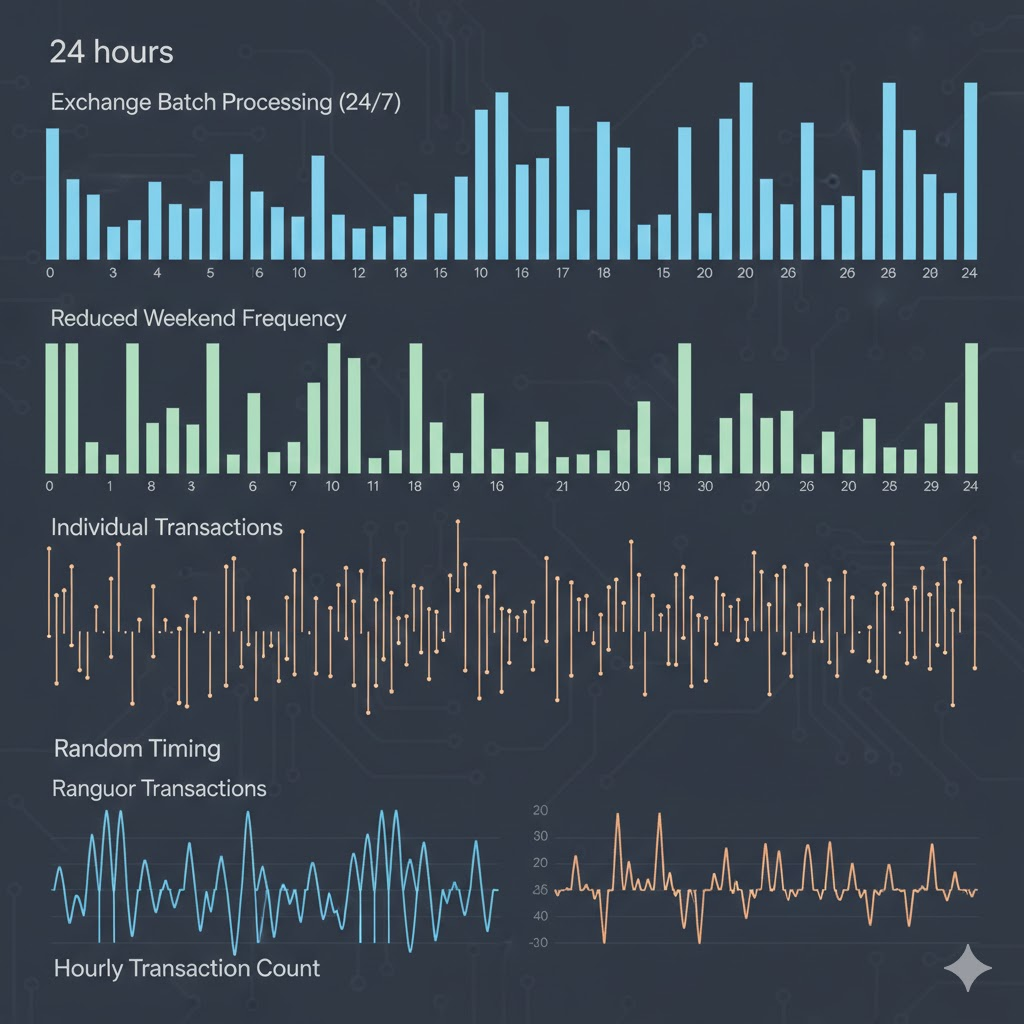
Exchange withdrawal systems implement queue-based batching processing pending requests at regular intervals. Investigators analyze timestamp distributions identifying these patterns. Major exchanges like Coinbase and Kraken batch withdrawals every 30-60 minutes, creating detectable periodicity used for platform attribution.
Temporal analysis reveals operational practices. Exchanges balance user experience requiring faster withdrawals against efficiency where larger batches save more fees. During the 2021 bull market, major exchanges reduced batch intervals from 60 to 30 minutes as daily volumes exceeded 100,000 requests. Weekend and holiday timing patterns provide additional attribution signals. Most institutional exchanges show reduced batch frequency during non-business hours, particularly weekends when operational staff levels decrease, creating weekly periodicity visible in timestamp analysis. Conversely, retail-focused exchanges maintain consistent 24/7 batching intervals serving global user bases across all time zones.
How Do Hot Wallet Refill Patterns Support Attribution?
Exchange hot wallets require regular replenishment from cold storage to maintain sufficient balances. These refill transactions create detectable patterns investigators use mapping exchange infrastructure. Hot wallet addresses receiving large periodic transfers from addresses that never spend indicate cold storage operations.
Batch change outputs reveal address rotation practices. Remaining balances return to new hot wallet addresses rather than reusing previous ones. Tracking these flows helps investigators identify complete address networks controlled by specific exchanges:
- Balance Maintenance Thresholds – Exchanges trigger cold storage transfers when hot wallets fall below 50-200 BTC
- Refill Transaction Timing – Cold storage replenishments occur at predictable intervals or after large batched withdrawals
- Multi-Signature Cold Storage – Exchange cold wallets use multi-signature addresses with infrequent large outbound transactions
- Change Address Rotation Schedule – Systematic creation of new hot wallet addresses for change outputs
- Reserve Balance Ratios – Consistent maintenance of specific hot-to-cold wallet balance ratios
What Fee Strategies Reveal About Exchange Batching?
Fee selection algorithms provide fingerprints identifying specific exchanges. Each platform implements proprietary estimation targeting different confirmation times per cryptocurrency AML compliance requirements. Conservative exchanges prioritize 1-2 block confirmation paying higher fees, while cost-optimized platforms accept 3-6 blocks for lower fees.
Dynamic adjustment reveals sophisticated treasury management. Platforms monitor mempool conditions in real-time adjusting fees for each batch. Analysis during 2024 volatility showed distinct fee behaviors identifying platforms without relying on address labels. Batch size optimization demonstrates fee efficiency awareness. Adding outputs to existing transactions costs only 34 bytes per output ($0.30 at $50/byte fees) versus 226+ bytes for separate transactions ($1,950). Batching becomes economical processing more than 3-4 withdrawals, explaining minimum queue thresholds exchanges implement. Fee bumping behavior identifies operations during network congestion – when batches remain unconfirmed longer than service agreements, exchanges broadcast replacement transactions.
How Do Investigators Distinguish Exchange from Mixing?
Both exchanges and mixing services create multi-output transactions, but mixing services deliberately obscure fund origins while exchange batches transparently process withdrawals. Output value uniformity provides clearest distinction. CoinJoin protocols create identical values maximizing anonymity sets. Exchange batches show heterogeneous values reflecting diverse user amounts.
Coordinator fee patterns help identify mixing. CoinJoin requires participants paying coordinator fees creating additional small outputs. Exchange batches lack these fees, showing only user withdrawals and change outputs. Temporal correlation between inputs and outputs differs significantly – CoinJoin inputs arrive from multiple unrelated participants within narrow time windows and outputs distribute to various participants simultaneously. Exchange batches show inputs from hot wallet addresses with established transaction history flowing to addresses that subsequently behave like individual user wallets rather than mixing service participants.
How Does Address Clustering Support Exchange Attribution?
Address clustering algorithms aggregate all addresses controlled by single exchanges through common input analysis. When multiple addresses appear as inputs to batches over time, they cluster under exchange ownership per crypto fraud investigation methods.
Exchange deposit patterns strengthen clustering. Platforms create unique deposit addresses per user using HD wallet derivation. Transaction graph analysis maps flows between hot wallets, cold storage, and customers using platforms like Chainalysis Reactor and Elliptic Investigator. Cross-exchange flow analysis identifies relationships – batched withdrawals from Exchange A flowing to Exchange B deposits establish connectivity used in asset recovery investigations. The 2023 analysis of North Korean Lazarus Group fund movements relied heavily on cross-exchange batch pattern recognition tracking stolen cryptocurrency through multiple trading platforms before final cash-out attempts.
Frequently Asked Questions
How accurate is batch pattern analysis for identifying exchanges?
Batch pattern analysis achieves 95%+ accuracy identifying major exchanges when combining multiple signals. Transactions with 30+ outputs, regular timing, heterogeneous values, and characteristic fees almost certainly originate from exchange hot wallets. False positives occasionally occur with payment processors but these have distinct secondary characteristics allowing differentiation.
Can exchanges avoid detection through batch manipulation?
Exchanges cannot effectively eliminate batching patterns without sacrificing substantial fee savings justifying the practice. Reducing batch sizes or randomizing timing increases operational costs significantly while providing minimal privacy benefits. Most exchanges prioritize cost efficiency and user experience over transaction obfuscation.
What tools do investigators use analyzing batching patterns?
Professional teams use Chainalysis Reactor, Elliptic Investigator, and TRM Labs platforms for automated batch detection. These tools provide pre-built exchange address labels, transaction filtering, and visualization interfaces. Open-source alternatives include BlockSci for research and custom Python scripts.
How do batching patterns differ across blockchains?
Bitcoin batching focuses on UTXO output optimization while Ethereum batching operates within account-based architecture using smart contracts. Ethereum exchanges implement batching through multi-send contracts executing multiple transfers in single transactions. Detection methods differ but both achieve fee savings.
Can criminals exploit exchange batching for laundering?
Criminals cannot directly manipulate exchange-controlled batching operations. Sophisticated launderers time withdrawals coinciding with large batches attempting to obscure movements. This provides minimal obfuscation because investigators analyze individual outputs separately. Exchange KYC requirements mean each output traces to identifiable customer accounts.
What regulatory implications affect batching practices?
Travel Rule compliance influences how exchanges construct batched transactions. Regulations mandate platforms maintain records linking each output to specific customer identities. Some jurisdictions restrict batching ensuring adequate transaction-level monitoring. The 2025 FATF guidance clarified batching remains compliant provided exchanges maintain complete customer attribution.
How quickly can investigators analyze batch patterns?
Timeline depends on investigation scope. Identifying whether specific transactions represent exchange batching takes minutes using automated platforms. Attributing batches to specific exchanges requires clustering analysis taking hours or days. Real-time monitoring provides immediate alerts when flagged addresses appear in new batches.
Do all cryptocurrency exchanges implement batching?
Major exchanges universally implement batching minimizing operational costs with 73% of Bitcoin withdrawals processed through batches per 2025 Chainalysis data. Smaller platforms may process withdrawals individually during early operations. Very low-volume exchanges sometimes avoid batching due to insufficient withdrawal queues.
How do exchange mergers affect batching patterns?
Exchange consolidations reveal themselves through batching behavior changes as platforms migrate infrastructure. Merged exchanges may continue operating separate hot wallet systems initially showing distinct patterns. Technical integration eventually unifies withdrawal processing creating new combined batch patterns investigators track.
Can batch analysis identify exchange security breaches?
Unusual batching behavior provides early breach indicators. When hot wallets execute abnormal batch sizes, irregular timing, or suspicious destinations, this may signal unauthorized access. The 2019 Binance hack detection partially relied on identifying irregular batching from compromised hot wallets.
How does batch analysis integrate with other forensics?
Batch pattern recognition combines with OSINT investigations, exchange cooperation, and traditional financial tracking. Investigators correlate batched transaction timing with user account activity logs. Cross-referencing batch outputs with known criminal wallets identifies laundering activity similar to peel chain tracking.
What future developments will change batch analysis?
Lightning Network adoption may reduce on-chain batching as exchanges process withdrawals through payment channels. However Lightning requires settlement transactions demonstrating batching patterns for channel funding. Regulatory pressure for transaction-level transparency may increase batch pattern visibility as exchanges implement enhanced monitoring.
Conclusion
Transaction batching patterns provide reliable exchange identification through distinctive structures, timing regularity, and fee optimization. Professional investigators achieve 95%+ accuracy analyzing output counts, value distributions, and temporal patterns.
This guide was prepared by Crypto Trace Labs drawing on 10+ years cryptocurrency exchange operations and blockchain forensics experience. Our founders held VP and Director positions at Blockchain.com, Kraken, and Coinbase where they implemented batching systems now used as investigation tools.
If you need professional blockchain analytics for exchange attribution or fraud investigation, specialized pattern analysis identifies fund flows. We offer no upfront charge for non-custodial wallet recoveries.
Contact Crypto Trace Labs for professional blockchain forensic services.
People Also Read
- How to Track Blockchain Transactions: Expert Guide
- What Is On-Chain Analysis? Complete Guide to Blockchain Data
- Chainalysis vs Elliptic vs TRM Labs: Which Platform Should Investigators Choose?
- How Do Investigators Track Cryptocurrency Through DEXs?
About the Author
This article was prepared by Crypto Trace Labs, a London-based blockchain forensics firm founded by VP and Director-level executives from Blockchain.com, Kraken, and Coinbase. Our team holds ACAMS certifications, MLRO qualifications, and Chartered Fellow Grade status with over 10 years cryptocurrency exchange operations experience.
This content is for informational purposes only and does not constitute legal, financial, or compliance advice. Crypto asset recovery outcomes depend on specific circumstances, regulatory cooperation, and technical factors. Consult qualified professionals regarding your situation.